


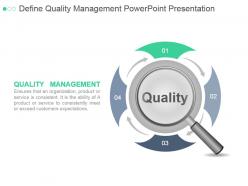
Define quality management powerpoint presentation





Try Before you Buy Download Free Sample Product
 Impress Your
 Audience
 100%
100% Editable
 Save Hours
 of Time


Our Define Quality Management Powerpoint Presentation are a good guarantee. They are bound to deliver on every aspect.
People who downloaded this PowerPoint presentation also viewed the following :
Define quality management powerpoint presentation with all 5 slides:
Our Define Quality Management Powerpoint Presentation ensure a comfortable existence. Create a haven for your ideas.
FAQs for Define quality
So there are seven main ones - customer focus, leadership commitment, getting employees engaged, process approach, continuous improvement, making decisions based on actual data, and managing relationships well. Your leadership can't just pay lip service to quality; they need to actually show they care. Honestly, the data thing is huge because too many companies just wing it based on whoever speaks loudest in meetings. Get your team involved in spotting problems and coming up with solutions. Build good relationships with suppliers too. Don't try to tackle everything at once though - just pick whichever area sucks the most right now and start there.
Dude, first thing - make sure your bosses are actually on board. Without that, you're basically screwed from day one. Map out what you're doing now vs what the standard wants (ISO whatever). Your team knows where stuff's broken better than anyone, so get them involved early. Train people properly too. Rolling it out bit by bit works way better than some giant change overnight - learned that the hard way at my last job. Document as you go but don't overthink it. Start tracking results right away so you can show wins and pivot if something's not working.
Honestly, good training makes such a huge difference for quality - like, it's probably the main thing that sets apart teams that actually perform well. Your people need to know what quality looks like for your specific situation, how to measure it, and what to do when things go wrong. Otherwise you're just crossing your fingers hoping everyone magically gets it (which... they definitely won't lol). I'd start by figuring out where your biggest quality problems are happening right now, then build training around fixing those first. It sounds obvious but so many places skip this step and wonder why their standards are all over the place.
Mix up your approach - surveys with rating scales work great, plus track your Net Promoter Score and how fast you handle complaints. Focus groups give you deeper insights than surveys ever will. Social media monitoring catches the stuff people won't tell you directly. Don't spam customers with feedback requests though, that backfires hard. Set up different ways to collect input throughout their whole experience with you. Oh, and this is crucial - actually follow up with people who give feedback. Show them what you changed based on their suggestions. Most companies totally drop the ball on that last part.
Look, continuous improvement is what stops your quality management from going to shit. You're not just putting out fires anymore - you're actually hunting for ways to make stuff work better. Small tweaks add up to huge wins over time, which honestly most people don't realize. Your team stays way more engaged too because they're problem-solving instead of mindlessly following the same routine. I'd pick one process this week and literally ask everyone "how do we make this 10% less painful?" Works every time.
Look, data analytics turns all those quality numbers into stuff you can actually use instead of just staring at spreadsheets. You'll catch patterns you'd miss otherwise - like why third shift always has more defects or which suppliers keep screwing up. The predictive part is where it gets interesting though; spotting problems before they cost you serious money. Plus you can finally prove whether your improvements actually worked instead of just hoping. Honestly, don't overthink it - just grab one metric you're already watching and see what story the data tells.
So ISO 9001 is like the starter pack - works for any business and covers your basic quality management stuff. Customer satisfaction, documentation, continuous improvement, all that. Industry-specific ones like AS9100 for aerospace or ISO 13485 for medical devices? They take ISO 9001 and dump a bunch of extra requirements on top. More risk management, stricter regulatory compliance - honestly can get pretty intense depending on your field. I'd say start with ISO 9001 first. Way less overwhelming and you can always add the industry-specific stuff later once you've got the basics down.
So here's the thing - good quality management basically stops problems before they blow up. You catch defects early instead of scrambling to fix everything later (which honestly is exhausting). Regular checks and solid procedures mean your team isn't constantly putting out fires. They can actually focus on real work instead of redoing stuff that should've been right the first time. The whole thing makes your output way more predictable too, so planning becomes less of a nightmare. I'd start by figuring out where most of your rework happens and tackle those spots first.
So the basics you'll run into everywhere are SPC charts and checklists - boring but they work. Root cause stuff like fishbone diagrams are pretty standard too. Six Sigma's huge right now, especially DMAIC and control charts. Documentation is honestly where most people screw up though. FMEA and Pareto charts help you figure out what's actually worth fixing first. Process mapping and audits catch problems early. I'd start simple with checklists and basic statistical charts. They're not sexy but they'll save your ass when things go sideways.
So quality management is basically like having checkpoints all through your supply chain. You're setting standards for suppliers, checking materials when they come in, making sure everything stays consistent at each handoff. Map it out and it gets pretty messy fast! Most companies use supplier audits, inspection processes, quality agreements - that whole thing. But honestly, the trick is building quality requirements into your supplier contracts from day one instead of trying to catch problems later. I'd start with your biggest suppliers and roll out quality scorecards with them first.
Oh man, quality standards are so different everywhere - what passes in one country might be trash in another. Supply chains are inconsistent too, plus every region has its own weird regulations to deal with. Those time zone calls are brutal (seriously, why is it always 5 AM for someone?). Some facilities have amazing setups while others are basically held together with duct tape. Training levels vary like crazy. Here's what worked for me: nail down your main processes but let teams adapt locally. Digital monitoring is a game-changer - catches problems fast before they snowball everywhere.
Honestly, just bake sustainability right into your current quality processes instead of treating it like some separate thing. Revise your quality goals to include stuff like waste reduction or energy efficiency targets. If you're already doing ISO 9001, adding ISO 14001 makes total sense - they work well together. Track those green metrics alongside your usual quality ones. Oh, and definitely add environmental criteria when you're evaluating suppliers. I've seen companies get way better results when they think of sustainability as just another part of quality rather than this whole different initiative. Makes it feel less overwhelming too.
Dude, you literally can't have good quality management without solid leadership and culture. Leaders have to actually walk the walk - real resources, not just empty promises. If your team doesn't buy into quality being everyone's job, they'll slack off the second nobody's looking. I mean, I've watched companies with flawless procedures totally bomb because executives saw quality as some side thing. Short sentences work sometimes. Culture beats process every time though - when people genuinely care about doing good work instead of just dumping everything on QA, that's when magic happens.
Okay, so first thing - stop whatever's causing more damage right now. Pull the product, fix the bug, whatever it takes. Then you've gotta be brutally honest with your customers about what went wrong and how you're fixing it. Don't try to sugarcoat it because people can smell BS from a mile away, and it always makes things worse. Show them you're actually doing something about it - like real changes to how you do things. Honestly, if you handle it right, customers will respect the transparency. Write down everything that happened so you can avoid this mess next time.
So everyone's going nuts over AI quality analytics right now - catching problems before they even happen instead of scrambling after. Real-time monitoring is huge too. Companies are finally ditching those awful spreadsheet systems for actual digital platforms, thank god. Customer-focused metrics are replacing the old internal stuff we used to obsess over. Oh, and sustainability compliance is suddenly everywhere - weird how that exploded so fast. You should mess around with some AI tools for your quality checks. Most places are at least testing something by now, so you don't want to fall behind.
-
Use of icon with content is very relateable, informative and appealing.
-
Very well designed and informative templates.