


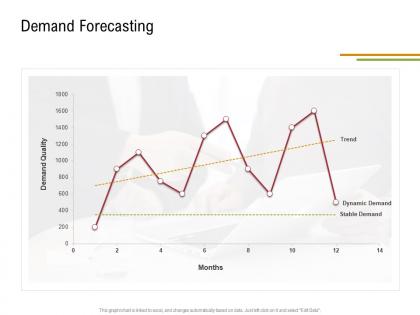
Demand forecasting sustainable supply chain management ppt slides




Try Before you Buy Download Free Sample Product
 Impress Your
 Audience
 100%
100% Editable
 Save Hours
 of Time


Our Demand Forecasting Sustainable Supply Chain Management Ppt Slides are topically designed to provide an attractive backdrop to any subject. Use them to look like a presentation pro.
People who downloaded this PowerPoint presentation also viewed the following :
Demand forecasting sustainable supply chain management ppt slides with all 2 slides:
Use our Demand Forecasting Sustainable Supply Chain Management Ppt Slides to effectively help you save your valuable time. They are readymade to fit into any presentation structure.
FAQs for Demand forecasting sustainable supply chain
Key factors influencing demand forecasting in sustainable supply chain management include consumer environmental preferences, regulatory compliance requirements, seasonal sustainability trends, circular economy initiatives, and carbon footprint considerations. These factors enable organizations to streamline inventory planning, minimize waste, and enhance resource allocation, with many retail and manufacturing companies finding that integrating sustainability metrics ultimately delivers competitive advantage and improved operational efficiency.
Companies integrate sustainability metrics into demand forecasting models by incorporating carbon footprint data, resource consumption patterns, waste generation rates, and supplier environmental scores alongside traditional demand variables. These enhanced models enable organizations to predict not just product demand but also environmental impact, allowing retailers, manufacturers, and logistics companies to optimize inventory levels while minimizing ecological footprint, ultimately delivering both operational efficiency and environmental responsibility.
Machine learning algorithms, IoT sensors, predictive analytics platforms, blockchain technology, and AI-powered demand sensing tools are most effective for sustainable supply chain forecasting. These technologies enhance accuracy by analyzing real-time data, tracking environmental variables, and integrating sustainability metrics, with many organizations finding that combining multiple technologies delivers significantly improved forecast precision and reduced waste.
Consumer behavior trends significantly impact sustainable supply chain demand forecasting by introducing volatility through shifting preferences for eco-friendly products, seasonal sustainability campaigns, and price sensitivity to green alternatives. Companies like Unilever and Patagonia leverage advanced analytics to track these behavioral patterns, enabling them to anticipate demand spikes for sustainable products while optimizing inventory levels and reducing waste across their supply networks.
Big data enhances demand forecasting for sustainable supply chains by analyzing consumer behavior patterns, environmental trends, seasonal variations, supplier performance metrics, and market fluctuations in real-time. Through advanced analytics and machine learning algorithms, organizations can predict demand more accurately while optimizing resource allocation, minimizing waste, and reducing carbon footprints, ultimately delivering enhanced operational efficiency and competitive sustainability advantage.
Collaboration with suppliers and partners improves demand forecasting accuracy by sharing real-time market intelligence, coordinating production schedules, and pooling historical data across the supply network. Through strategic partnerships, companies can better anticipate consumer behavior for eco-friendly products, reduce overproduction waste, and align sustainability goals, with many organizations finding that collaborative forecasting delivers 15-30% improved accuracy while minimizing environmental impact.
Common challenges in demand forecasting for sustainable products include limited historical data, fluctuating consumer preferences, seasonal variations, supply chain transparency issues, and regulatory changes affecting market dynamics. These obstacles can be overcome by leveraging advanced analytics, collaborating closely with suppliers and retailers, implementing real-time monitoring systems, and adopting flexible forecasting models, ultimately delivering improved accuracy and competitive advantage in increasingly sustainability-focused markets.
Predictive analytics enhances eco-friendly supply chain demand forecasting by analyzing historical consumption patterns, seasonal sustainability trends, consumer behavior shifts toward green products, and environmental impact data. Through machine learning algorithms, companies streamline inventory optimization, minimize waste generation, and reduce carbon footprints from overproduction, with many sustainable retailers finding that accurate demand prediction ultimately delivers both environmental benefits and significant cost savings.
Market volatility significantly impacts demand forecasting in sustainable supply chains by creating unpredictable fluctuations in consumer behavior, raw material availability, and regulatory requirements, often disrupting traditional forecasting models. However, this challenge drives organizations to adopt more sophisticated predictive analytics, real-time data integration, and flexible sourcing strategies, ultimately enhancing supply chain resilience and competitive advantage.
Companies balance profitability and sustainability in demand forecasting by integrating circular economy principles, optimizing inventory levels to reduce waste, and leveraging predictive analytics to align production with actual demand. Through strategic planning, organizations minimize overproduction costs while meeting environmental goals, with many manufacturers finding that sustainable forecasting practices ultimately deliver both cost savings and competitive advantage.
Customer engagement in sustainable product demand forecasting includes collaborative planning partnerships, feedback surveys, loyalty program data integration, social media sentiment analysis, and co-creation initiatives. These strategies enable organizations to capture real-time consumer preferences, seasonal sustainability trends, and purchasing intentions, while building stronger customer relationships and improving forecast accuracy for eco-friendly products across retail sectors.
Regulations and policies significantly reshape demand forecasting practices by requiring companies to integrate compliance costs, sustainability metrics, and environmental impact assessments into their predictive models. These regulatory frameworks drive organizations to adopt advanced analytics that account for carbon footprint requirements, circular economy mandates, and social responsibility standards, ultimately enabling more accurate demand predictions while ensuring regulatory compliance and competitive advantage in increasingly regulated markets.
Inventory management serves as a critical data foundation for sustainable demand forecasting by providing real-time visibility into stock levels, turnover rates, seasonal patterns, and consumer purchasing behaviors. Through advanced inventory tracking systems, companies can identify sustainable product trends, minimize waste from overproduction, and optimize resource allocation, with retailers like Patagonia and Unilever finding that integrated inventory insights deliver more accurate forecasts and reduced environmental impact.
Historical sales data improves sustainable supply chain demand predictions by identifying seasonal patterns, consumption trends, customer behavior shifts, and product lifecycle stages through advanced analytics and machine learning algorithms. These insights enable organizations to optimize inventory levels, reduce waste, minimize overproduction, and align procurement with actual demand, ultimately delivering cost savings and enhanced sustainability performance.
Best practices include real-time data integration, collaborative stakeholder feedback loops, seasonal sustainability pattern analysis, circular economy demand modeling, and automated alert systems for forecast deviations. These approaches enable organizations to adapt quickly to changing consumer preferences for eco-friendly products, optimize resource allocation while minimizing waste, and maintain supply chain resilience, with many companies finding that continuous monitoring delivers both environmental compliance and competitive advantage.
-
Illustrative design with editable content. Exceptional value for money. Highly pleased with the product.