


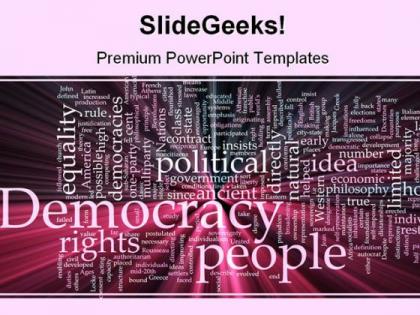
Democracy people government powerpoint backgrounds and templates 1210




Try Before you Buy Download Free Sample Product
 Impress Your
 Audience
 100%
100% Editable
 Save Hours
 of Time


Jack it up with our Democracy People Government PowerPoint Backgrounds And Templates 1210. Raise the level of your presentation.
People who downloaded this PowerPoint presentation also viewed the following :
Democracy people government powerpoint backgrounds and templates 1210 with all 3 slides:
Each time you need to make a presentation make sure it is perfect. Thousands of Democracy People Government PowerPoint Backgrounds And Templates 1210 are on hand at all hours to make your next pitch a winner.


FAQs for Democracy people government powerpoint backgrounds
Key pillars of functioning democracy include free and fair elections, rule of law, individual rights protection, separation of powers, and transparent governance. These foundational elements work together by ensuring accountability, preventing power concentration, and safeguarding citizen participation, with many nations finding that strengthening these pillars ultimately delivers greater political stability and economic growth.
Citizen participation and voting shape democracy by enabling representation, accountability, policy influence, and governmental legitimacy through regular elections and civic engagement. Through voting mechanisms, citizens directly impact legislative priorities, executive leadership, and judicial appointments, while broader participation through advocacy, town halls, and community organizing ensures responsive governance that reflects diverse societal needs and maintains democratic accountability.
Social media influences public opinion in democratic societies by amplifying diverse voices, enabling rapid information sharing, facilitating political mobilization, and creating echo chambers that can polarize viewpoints. Through targeted algorithms and viral content distribution, platforms like Facebook and Twitter reshape how citizens consume political information, engage in civic discourse, and form electoral preferences, ultimately delivering both enhanced democratic participation and increased concerns about misinformation's impact on informed decision-making.
Different electoral systems significantly impact minority representation through proportional representation, single transferable vote, mixed-member systems, reserved seats, and ranked-choice voting. These mechanisms enhance democratic inclusivity by enabling broader coalition-building, reducing winner-take-all dynamics, and creating pathways for diverse voices, with many multi-party democracies finding that proportional systems deliver more equitable representation and stronger institutional legitimacy.
The judiciary safeguards democratic values by ensuring constitutional compliance, protecting individual rights, maintaining checks and balances, and upholding rule of law. Through independent courts, judicial systems enable fair elections, prevent governmental overreach, and protect minority interests, with many democratic nations finding that strong judicial oversight ultimately delivers institutional stability and public trust in governance.
Education fosters democratic culture among youth by teaching critical thinking, civic responsibility, media literacy, and collaborative problem-solving through interactive learning experiences. Through student councils, debate programs, and community service projects, schools enable young people to practice democratic participation, develop empathy for diverse perspectives, and understand governance processes, ultimately preparing engaged citizens who value democratic principles.
Emerging democracies face challenges including weak institutional frameworks, political polarization, economic instability, corruption, and limited civic engagement. These nations often struggle with establishing rule of law, building public trust, and managing peaceful transitions of power, while external pressures and historical divisions can undermine democratic consolidation, ultimately requiring sustained commitment to transparent governance.
Globalization affects national democracies by creating interdependencies that limit sovereign decision-making, increasing influence of multinational corporations, and facilitating rapid information exchange that can both strengthen and destabilize democratic processes. While economic integration enables democratic values to spread across borders, it also presents challenges through reduced policy autonomy, with many nations finding that balancing global participation with domestic democratic governance requires strategic adaptation.
Technology enhances democratic engagement through online voting platforms, digital town halls, social media advocacy, real-time policy feedback systems, and transparent government data portals. However, it also presents challenges including misinformation spread, algorithmic bias, and privacy concerns, with many democratic institutions finding that strategic digital governance frameworks ultimately deliver greater citizen participation while maintaining electoral integrity.
Political polarization weakens democratic governance by reducing bipartisan cooperation, slowing legislative processes, and undermining public trust in institutions through increased partisanship and gridlock. This creates challenges for policy implementation and consensus-building, though it can also strengthen party identity and voter engagement, with many democracies finding that moderate voices and institutional reforms help bridge divides.
Strategies include fact-checking initiatives, media literacy education, platform accountability measures, transparent source verification, and promoting diverse information sources. These approaches streamline accurate information flow by enhancing public critical thinking, reducing echo chambers, and strengthening institutional credibility, with many democratic societies finding that comprehensive media literacy programs ultimately deliver more informed citizenry and resilient democratic processes.
Economic inequalities significantly influence political participation by creating barriers to civic engagement, limiting campaign contributions, and reducing access to political networks and information resources. While wealthier citizens often maintain higher voting rates and political influence through donations and lobbying, many democratic nations are finding that targeted voter education programs, digital engagement platforms, and campaign finance reforms help streamline participation and ultimately enhance democratic representation across socioeconomic levels.
Historical democratic movements demonstrate that successful transitions require grassroots mobilization, institutional frameworks, civil society engagement, and sustained citizen participation. From South Africa's peaceful transition to Eastern Europe's velvet revolutions, these movements show that combining mass organizing with strategic negotiation delivers lasting change, with many nations finding that inclusive dialogue and constitutional protections ultimately ensure democratic sustainability.
Grassroots activism strengthens democratic institutions by increasing civic engagement, holding elected officials accountable, amplifying marginalized voices, and fostering community-driven policy solutions. Through organized campaigns, voter education initiatives, and local advocacy efforts, these movements enhance government transparency, encourage broader political participation, and ultimately deliver more responsive governance that reflects diverse citizen needs and priorities.
A free press serves as democracy's watchdog by holding government accountable, informing citizens with accurate information, and facilitating transparent public discourse. Through independent journalism, media outlets expose corruption, investigate policy impacts, and provide diverse perspectives, with many democratic societies finding that robust press freedom correlates directly with stronger civic engagement and governmental responsiveness.
-
Awesome use of colors and designs in product templates.
-
Good research work and creative work done on every template.