


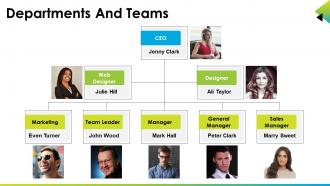
Departments and teams good ppt example





Try Before you Buy Download Free Sample Product
 Impress Your
 Audience
 100%
100% Editable
 Save Hours
 of Time


Demonstrate expertise at the helm with our Departments And Teams Good Ppt Example. Always adhere to the correct course.
People who downloaded this PowerPoint presentation also viewed the following :
Departments and teams good ppt example with all 5 slides:
Enable folks to indulge in humorous interaction with our Departments And Teams Good Ppt Example. It helps encourage jokes.




FAQs for Departments and teams
Key components of an effective organizational structure include clear reporting relationships, defined roles and responsibilities, appropriate span of control, effective communication channels, and decision-making authority distribution. These elements work together by streamlining workflows, enhancing accountability, and facilitating coordination across departments, with many organizations finding that well-designed structures ultimately deliver improved operational efficiency and faster strategic execution.
Organizational structure significantly influences company culture and employee morale by determining communication flows, decision-making processes, and reporting relationships throughout the organization. Clear hierarchies and well-defined roles enhance transparency and accountability, while flatter structures promote collaboration and innovation, with many companies finding that strategic structural alignment ultimately delivers higher employee engagement and improved organizational performance.
Functional structures organize by specialized departments like marketing and finance, divisional structures group by products or markets, and matrix structures combine both with dual reporting relationships. Functional works well for efficiency-focused companies, divisional suits diversified corporations managing multiple product lines, while matrix enables project-based organizations to leverage specialized expertise across departments, ultimately delivering greater flexibility and resource optimization.
Organizations can determine the best structure by analyzing their strategic objectives, operational complexity, market dynamics, and growth trajectory, while evaluating factors like decision-making speed, communication flows, and resource allocation needs. Through strategic assessment workshops and structural audits, companies across industries—from tech startups to manufacturing giants—align their organizational design with strategic priorities, ultimately enhancing operational efficiency and competitive positioning.
Communication serves as the foundation for successful organizational structures by ensuring clarity in roles, responsibilities, decision-making processes, and strategic objectives across all hierarchical levels. Effective communication channels enable seamless coordination between departments, facilitate faster problem resolution, and enhance employee engagement, with many organizations finding that transparent communication ultimately delivers improved operational efficiency and stronger organizational alignment.
Technology transforms organizational structures by enabling flatter hierarchies, remote collaboration, and decentralized decision-making through digital communication platforms, cloud-based systems, and automated workflows. These technological advances streamline operations, reduce management layers, and enhance cross-functional teamwork, with many companies finding that digital transformation ultimately delivers greater agility, faster innovation cycles, and improved competitive positioning in increasingly dynamic markets.
Common reorganization challenges include employee resistance, communication breakdowns, role confusion, cultural misalignment, and operational disruptions during transition periods. These obstacles can be addressed through transparent communication strategies, comprehensive change management programs, and phased implementation approaches, with many organizations finding that early employee engagement, clear role definitions, and consistent leadership support ultimately deliver smoother transitions and sustained organizational effectiveness.
Leaders can assess organizational structure effectiveness by evaluating communication flow, decision-making speed, role clarity, resource allocation efficiency, and alignment with strategic goals. Through employee feedback surveys, performance metrics analysis, and workflow assessments, organizations identify bottlenecks, redundancies, and gaps, with many finding that regular structural audits ultimately deliver improved coordination and competitive advantage.
Flat organizational structures offer advantages including faster decision-making, reduced communication barriers, increased employee autonomy, lower operational costs, and enhanced collaboration across teams. However, they present challenges with limited career advancement paths and potential role ambiguity, while many growing companies find that strategic combinations of flat and hierarchical elements deliver optimal scalability and operational efficiency.
Organizational structures significantly influence decision-making through varying levels of hierarchy, communication channels, and authority distribution. Flat structures enable faster, collaborative decisions with broader input, while hierarchical models provide clear accountability but slower processing, and matrix structures balance expertise access with coordination complexity, ultimately delivering strategic advantages when aligned with business objectives.
Organizational structure facilitates innovation through flat hierarchies, cross-functional teams, decentralized decision-making, open communication channels, and flexible resource allocation. While rigid structures can slow creativity, many companies find that hybrid approaches combining structured processes with innovation labs or skunkworks teams deliver breakthrough products and competitive advantage across industries.
Remote work trends alter traditional organizational structures by flattening hierarchies, decentralizing decision-making, and emphasizing outcome-based performance over physical presence. Many organizations increasingly adopt flexible reporting structures, cross-functional virtual teams, and digital-first communication channels, ultimately delivering enhanced operational efficiency and broader access to global talent while reducing overhead costs.
Organizations should evaluate structural efficiency using metrics like decision-making speed, communication flow effectiveness, employee engagement scores, span of control ratios, and cost per organizational layer. These measurements enable leaders to identify bottlenecks, streamline reporting relationships, and optimize resource allocation, with many companies finding that regular structural assessments ultimately deliver improved agility and competitive advantage.
Diversity and inclusion integrate into organizational design through diverse hiring panels, inclusive leadership development, cross-functional teams, mentorship programs, and bias-free promotion processes. These strategic approaches streamline talent acquisition while enhancing innovation, with many organizations finding that inclusive structures ultimately deliver improved decision-making, broader market insights, and competitive advantage in increasingly diverse markets.
Organizations can align their structure with changing market conditions through agile team formations, cross-functional integration, decentralized decision-making, flexible reporting hierarchies, and dynamic resource allocation. These strategies enable companies to respond faster to market shifts, streamline operations, and enhance competitive positioning, with many businesses finding that structural adaptability ultimately delivers improved customer responsiveness and operational efficiency.
-
Awesome use of colors and designs in product templates.
-
Helpful product design for delivering presentation.