


Derivatives options ppt powerpoint presentation infographic template cpb




Try Before you Buy Download Free Sample Product
 Impress Your
 Audience
 100%
100% Editable
 Save Hours
 of Time


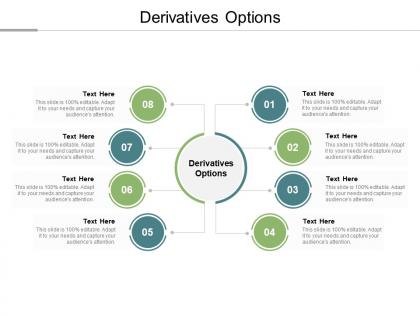
Elaborate on the job with our Derivatives Options Ppt Powerpoint Presentation Infographic Template Cpb. Include every detail imaginable.
People who downloaded this PowerPoint presentation also viewed the following :
Derivatives options ppt powerpoint presentation infographic template cpb with all 2 slides:
Our Derivatives Options Ppt Powerpoint Presentation Infographic Template Cpb include every detail imaginable. Be able to elaborate on the job.
FAQs for Derivatives options ppt powerpoint presentation
Options provide the right, but not obligation, to buy or sell assets at predetermined prices, unlike futures which create binding obligations for both parties, and swaps which involve exchanging cash flows or payments over time. While futures require margin deposits and daily settlements, and swaps typically involve longer-term commitments, options offer strategic flexibility through premium payments, with many financial institutions finding that this structure enables better risk management and speculative positioning.
Options pricing combines intrinsic value, which represents the immediate profit from exercising the option, and extrinsic value, which reflects time remaining and market volatility expectations. Financial institutions and investment firms leverage these components to assess risk-reward scenarios, hedge portfolios, and optimize trading strategies, with many finding that understanding this relationship enhances decision-making and delivers more strategic investment outcomes.
Traders can employ protective puts, covered calls, collar strategies, iron condors, and straddles to hedge options risks effectively. These strategies work by limiting downside exposure, generating income through premiums, and managing volatility, with many financial institutions and individual traders finding that strategic combinations ultimately deliver portfolio protection while maintaining upside potential in volatile markets.
Implied volatility significantly influences option pricing by reflecting market expectations of future price movements, with higher volatility increasing option premiums across all strike prices and expiration dates. Through sophisticated pricing models, traders leverage these volatility shifts to identify undervalued opportunities, time market entries strategically, and optimize portfolio hedging strategies, ultimately delivering enhanced returns and risk management capabilities.
Options trading faces different tax treatment than stocks, with short-term gains taxed as ordinary income and limited loss deductions, while stocks benefit from preferential long-term capital gains rates and unlimited loss offsets. These tax differences significantly impact net returns, with many institutional traders finding that strategic timing and structured approaches help optimize tax efficiency while maintaining portfolio performance in an increasingly complex regulatory environment.
Interest rates significantly influence option pricing through the cost of carrying underlying assets and present value calculations of future cash flows. Higher interest rates increase call option values while decreasing put option values, as they affect the theoretical forward price of underlying assets and discount rates used in valuation models like Black-Scholes, ultimately impacting trading strategies and risk management decisions across financial institutions.
Market makers provide essential liquidity in options markets by continuously quoting bid and ask prices, facilitating trades, and absorbing supply and demand imbalances through their inventory positions. These financial institutions enable smoother price discovery, tighter bid-ask spreads, and enhanced market efficiency, with many institutional investors finding that active market makers ultimately deliver better execution prices and reduced transaction costs.
Investors identify mispriced options by comparing current market prices with theoretical values calculated through models like Black-Scholes, analyzing implied volatility against historical volatility, and examining time decay patterns. Many traders also assess bid-ask spreads, open interest levels, and volume patterns, with investment firms finding that combining technical analysis with volatility modeling delivers more accurate pricing assessments.
Key indicators for assessing options market health include open interest levels, put-call ratios, implied volatility indices, trading volume patterns, and bid-ask spreads across strike prices. These metrics work together by revealing market sentiment, liquidity conditions, and pricing efficiency, with many financial institutions finding that elevated open interest and balanced put-call ratios typically signal robust, well-functioning options markets.
The Greeks provide essential risk metrics for options trading, with Delta measuring price sensitivity, Gamma tracking Delta changes, Theta calculating time decay, Vega assessing volatility impact, and Rho gauging interest rate effects. These metrics enable traders to construct balanced portfolios, hedge specific risks, and optimize timing strategies, with many institutional investors finding that systematic Greek analysis delivers more consistent returns and enhanced risk management across volatile market conditions.
American options can be exercised at any time before expiration, while European options can only be exercised at expiration, creating significant differences in valuation models and pricing. This flexibility makes American options typically more valuable, especially for dividend-paying stocks and volatile markets, with financial institutions and portfolio managers finding that early exercise capabilities provide enhanced risk management and strategic positioning opportunities.
Traders write uncovered options when expecting minimal price movement in the underlying asset, seeking to collect premium income from time decay and implied volatility reduction. This strategy works best in stable, sideways markets where options expire worthless, though it requires significant capital reserves and risk management expertise, with many professional traders finding success in high-probability, low-volatility environments.
Options for portfolio diversification present both significant opportunities and inherent risks that require careful consideration. While options can enhance returns through leveraged exposure, provide downside protection through protective puts, and generate income via covered calls, they also introduce complexity, potential losses exceeding premiums, and time decay challenges, with many institutional investors finding strategic options allocation ultimately delivers enhanced risk-adjusted returns when properly managed.
The expiration date fundamentally shapes options strategies by determining time decay rates, premium values, and strategic timing for entries and exits. Traders adjust approaches based on timeframes, with short-term options enabling quick profit captures in volatile markets like earnings announcements, while longer-dated options provide strategic hedging for institutional portfolios, ultimately delivering flexibility for both speculative and risk management objectives.
Open interest represents the total number of outstanding option contracts that haven't been settled, providing crucial insights into market sentiment, liquidity, and potential price movements. High open interest typically indicates strong market participation and easier trade execution, while significant changes can signal shifting investor sentiment, with many traders using this data alongside volume analysis to validate breakouts, identify support and resistance levels, and assess the strength of price trends before entering positions.
No Reviews