


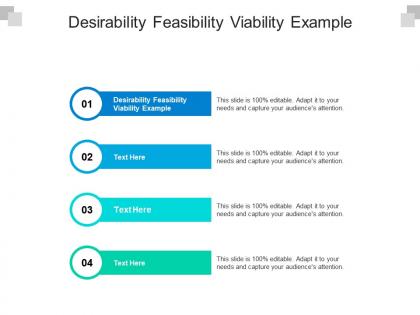
Desirability feasibility viability example ppt powerpoint presentation outline graphics design cpb




Try Before you Buy Download Free Sample Product
 Impress Your
 Audience
 100%
100% Editable
 Save Hours
 of Time


Our Desirability Feasibility Viability Example Ppt Powerpoint Presentation Outline Graphics Design Cpb are topically designed to provide an attractive backdrop to any subject. Use them to look like a presentation pro.
People who downloaded this PowerPoint presentation also viewed the following :
Desirability feasibility viability example ppt powerpoint presentation outline graphics design cpb with all 2 slides:
Use our Desirability Feasibility Viability Example Ppt Powerpoint Presentation Outline Graphics Design Cpb to effectively help you save your valuable time. They are readymade to fit into any presentation structure.
FAQs for Desirability feasibility viability example ppt powerpoint presentation outline
Desirability focuses on user needs and market demand, feasibility examines technical and operational capabilities, while viability assesses financial sustainability and business model strength. These three pillars work together strategically, with technology companies, healthcare organizations, and financial services finding that successful products require balancing customer appeal with technical execution and profitable scalability, ultimately delivering market-ready solutions.
Businesses can effectively assess product desirability through customer surveys, focus groups, prototype testing, social media sentiment analysis, and pre-order campaigns to gauge genuine market interest. These methods enable companies to validate demand across different customer segments, identify potential concerns early, and refine value propositions, ultimately reducing launch risks while maximizing market acceptance and competitive positioning.
Methods for measuring business idea feasibility include market research and surveys, financial modeling and break-even analysis, prototype testing, competitive analysis, and resource assessment. These approaches enable entrepreneurs to evaluate market demand, operational requirements, and financial viability systematically, with many startups finding that combining multiple measurement methods delivers more accurate feasibility insights and reduces implementation risks.
Market research contributes to product viability by analyzing target audience demand, competitive landscape assessment, pricing strategy validation, revenue potential forecasting, and market size determination. Through comprehensive consumer surveys, focus groups, and competitor analysis, organizations can identify sustainable business models, optimize resource allocation, and minimize financial risks, ultimately ensuring their product concept delivers profitable returns and maintains competitive advantage in increasingly dynamic markets.
Desirability assessments significantly shape the design phase by informing user interface decisions, feature prioritization, and overall user experience strategy through customer feedback, market research, and usability testing. These insights enable design teams to create more targeted solutions that resonate with end users, while reducing costly redesigns and ensuring products align with actual market needs, ultimately delivering stronger user adoption and competitive advantage.
User feedback serves as the primary validation mechanism for desirability by revealing actual user needs, preferences, pain points, and behavioral patterns through surveys, interviews, and usability testing. This direct insight enables product teams to refine features, prioritize development resources, and align offerings with market demands, with many organizations finding that continuous feedback loops significantly reduce development costs while enhancing customer satisfaction and competitive positioning.
Startups can balance these elements by prioritizing core features that address genuine customer pain points, leveraging low-cost validation methods like prototypes and surveys, and implementing phased development approaches. Through lean startup methodologies and agile frameworks, many emerging companies streamline resource allocation, validate market demand early, and maintain financial sustainability while building scalable solutions that deliver competitive advantage.
Common pitfalls include underestimating technical complexity, overlooking integration challenges with existing systems, misjudging resource requirements, insufficient market research, and neglecting scalability considerations. These evaluation gaps often lead organizations to pursue solutions that appear promising initially but face implementation roadblocks, with many companies finding that thorough feasibility assessments ultimately prevent costly project failures and enable more strategic innovation investments.
Visual presentation tools effectively communicate these three pillars through interactive dashboards, comprehensive infographics, comparative matrices, scenario modeling, and stakeholder journey maps. These tools streamline complex data by showcasing market demand through customer insights, demonstrating technical feasibility through process flows, and illustrating financial viability through projections, ultimately enabling stakeholders to make informed strategic decisions with greater confidence and alignment.
Key viability metrics include revenue potential, profit margins, market size, customer acquisition costs, lifetime value ratios, and cash flow projections. These financial indicators enable organizations to assess scalability, competitive positioning, and long-term sustainability, with many businesses finding that combining quantitative data with market validation ultimately delivers stronger investment decisions and strategic advantage.
Product desirability evolves through continuous market research, user feedback analysis, and adaptability to shifting consumer behaviors, demographics, and cultural trends. Companies like Netflix and Apple successfully maintain desirability by regularly updating features, expanding offerings, and anticipating user needs, while those failing to adapt risk declining market relevance, ultimately requiring strategic pivots to sustain competitive advantage.
Tesla's Model S exemplifies successful integration by combining consumer desire for sustainable luxury vehicles, technological feasibility through advanced battery systems, and strong business viability via premium pricing strategies. Similarly, Apple's iPhone revolutionized mobile technology by addressing user desirability for intuitive interfaces, leveraging feasible touchscreen innovation, and creating unprecedented market viability, ultimately delivering competitive advantages that transformed entire industries.
Companies can iterate on products by conducting regular user feedback sessions, A/B testing features, and implementing agile development cycles that balance customer desires with technical constraints. Through strategic prototyping and cross-functional collaboration, organizations in sectors like software development and consumer goods enhance user experience while managing development costs, ultimately delivering market-responsive products that maintain operational efficiency and competitive advantage.
Organizations can ensure long-term viability by conducting continuous market research, implementing scalable business models, maintaining financial sustainability through diverse revenue streams, and regularly reassessing customer needs. Through strategic planning and iterative testing, companies across sectors like healthcare and retail streamline operations, enhance customer experiences, and adapt to market changes, ultimately delivering sustained competitive advantage and measurable growth outcomes.
The interplay between desirability and feasibility creates a strategic filtering system where highly desired features must be balanced against technical constraints, resource availability, and development timelines. Teams prioritize features that maximize user value while remaining achievable within current capabilities, with many product organizations finding that this dual assessment prevents overcommitment and ensures sustainable development cycles that ultimately deliver competitive products to market faster.
-
Unique and attractive product design.