


Determine Release Planning For Product Lean Agile Project Management Playbook




Try Before you Buy Download Free Sample Product
 Impress Your
 Audience
 100%
100% Editable
 Save Hours
 of Time


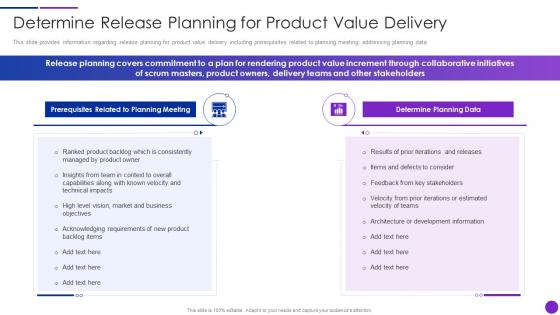
This slide provides information regarding release planning for product value delivery including prerequisites related to planning meeting, addressing planning data.
People who downloaded this PowerPoint presentation also viewed the following :
Determine Release Planning For Product Lean Agile Project Management Playbook with all 6 slides:
Use our Determine Release Planning For Product Lean Agile Project Management Playbook to effectively help you save your valuable time. They are readymade to fit into any presentation structure.





FAQs for Determine Release Planning For Product Lean Agile
A comprehensive release planning template should include scope definition, timeline milestones, resource allocation, risk assessment matrices, stakeholder communication plans, and success metrics. These components work together by establishing clear boundaries, managing dependencies, and tracking progress, with many organizations finding that structured templates streamline coordination between development teams, ultimately delivering faster releases and improved product quality.
Agile methodologies influence release planning by emphasizing iterative development, continuous feedback, and adaptive scheduling rather than fixed timelines. Through sprint-based cycles and regular stakeholder reviews, organizations streamline feature prioritization, reduce time-to-market, and enhance product quality, with many software companies finding that agile approaches deliver faster releases and improved customer satisfaction.
Essential metrics for measuring release success include user adoption rates, feature utilization, performance benchmarks, defect rates, and customer satisfaction scores. These metrics enable organizations to assess functionality impact, identify optimization opportunities, and validate business objectives, with many software companies finding that combining technical performance data with user engagement insights ultimately delivers comprehensive release evaluation and strategic guidance for future development cycles.
Feature prioritization during release planning involves evaluating business value, customer impact, technical complexity, and strategic alignment with organizational goals. Product teams typically use frameworks like MoSCoW, RICE scoring, or value vs. effort matrices, while collaborating with stakeholders across development, marketing, and customer success to ensure releases deliver maximum competitive advantage and user satisfaction.
Cross-functional collaboration ensures release planning incorporates diverse perspectives from development, testing, marketing, operations, and customer support teams, creating comprehensive timelines and identifying potential roadblocks early. This strategic coordination enables organizations to align technical capabilities with business objectives, streamline resource allocation, and deliver more successful product launches, with many companies finding that collaborative planning reduces deployment risks and accelerates time-to-market significantly.
Risk assessment integrates into release planning through automated vulnerability scanning, dependency analysis, performance testing, compliance validation, and stakeholder impact evaluation. These strategic processes enable organizations to identify potential bottlenecks, security vulnerabilities, and operational disruptions before deployment, with many development teams finding that proactive risk integration ultimately delivers smoother releases and enhanced customer experiences.
**INPUT**: What tools and software are best suited for managing release planning? **OUTPUT**: Release planning tools include Jira, Azure DevOps, GitLab, Rally, and VersionOne, which streamline backlog management, sprint coordination, and cross-team collaboration. These platforms enhance operational efficiency by automating workflow tracking, facilitating stakeholder communication, and providing real-time visibility into project timelines, with many development teams finding that integrated planning tools ultimately deliver faster releases and improved product quality.
Release plans should be reviewed and updated every 2-4 weeks during sprint planning cycles, with major reassessments occurring quarterly or when significant market changes arise. This iterative approach enables development teams to adapt to evolving customer needs, technical constraints, and business priorities, while maintaining project momentum and ultimately delivering more responsive, market-aligned products that enhance competitive advantage.
Effective strategies include regular stakeholder meetings, visual roadmaps, progress dashboards, risk assessments, and milestone updates. These approaches enhance transparency by providing clear timelines, defining deliverable expectations, and establishing feedback channels, with many organizations finding that consistent communication reduces project delays, minimizes scope creep, and ultimately delivers stronger stakeholder alignment and project success.
Scope creep during release planning is managed through structured change control processes, regular stakeholder alignment meetings, and clear documentation of approved requirements with impact assessments. Successful teams implement formal approval workflows for new requests, maintain transparent communication about timeline and resource implications, and establish priority frameworks that help distinguish essential features from nice-to-have additions, ultimately protecting project timelines while accommodating strategic changes.
Common release planning pitfalls include overcommitting to unrealistic timelines, inadequate stakeholder communication, insufficient testing buffers, poor dependency management, and scope creep during sprints. These challenges often emerge in fast-paced environments like fintech and e-commerce, where teams underestimate integration complexity and market pressures, ultimately compromising quality and delivery predictability while increasing technical debt.
User feedback can be incorporated through systematic collection via surveys, analytics, support tickets, and direct user interviews, then prioritized using feedback frequency, business impact, and technical feasibility. Many software companies establish feedback loops where customer insights directly influence roadmap decisions, enabling teams to address pain points, enhance popular features, and ultimately deliver more user-centric releases that improve satisfaction and retention.
Regional and cultural considerations significantly impact global release planning through localization requirements, regulatory compliance variations, market readiness assessments, and cultural adaptation needs. Companies must navigate different time zones, holidays, purchasing behaviors, and technical infrastructure capabilities, with many organizations finding that phased regional rollouts ultimately deliver better user adoption and market penetration than simultaneous global launches.
Defining a clear timeline in release planning establishes accountability, coordinates cross-functional teams, and ensures strategic resource allocation across development cycles. Through structured scheduling, organizations streamline dependencies, minimize bottlenecks, and enhance predictability, with many software companies finding that well-defined timelines ultimately deliver faster market entry and improved stakeholder confidence.
Templates streamline release planning workflows by standardizing processes, reducing preparation time, and ensuring consistent documentation across development cycles. They enable teams to focus on strategic decisions rather than formatting, while providing pre-built frameworks for timelines, resource allocation, and stakeholder communication, ultimately delivering faster project kickoffs and improved coordination across releases.
-
“Easy to use. I always wanted to have a quick search for products and SlideTeam has helped me have it.”
-
The templates you provide are great! They have saved me tons of time and made my presentations come alive. Thank you for this awesome product. Keep up the good work!