


Developing An Effective Customer Centric Marketing Strategy CD




Try Before you Buy Download Free Sample Product
 Impress Your
 Audience
 100%
100% Editable
 Save Hours
 of Time


Customer-centric marketing is an approach to marketing that prioritizes the needs, wants, and preferences of the customers above all else. This strategy involves understanding the customers journey and analyzing their behavior and preferences with that information to create personalized and relevant experiences. Our meticulously crafted PowerPoint presentation titled, Developing an effective customer-centric marketing strategy covers a brief overview of the companys current performance assessment along with an introduction to customer-centric marketing strategy along with its major insignificant elements and challenges. Additionally, our Customer Experience PPT deck also covers various customer-centric marketing strategies such as personalization, social listening, relationship building, social media engagement, and creating a user-friendly website. Furthermore, the Personalization slide of this complete deck highlights the process of formulating a customer-centric marketing strategy. It also covers various steps, such as understanding customers by conducting market research, gathering customer data, developing a buyer persona, and mapping the customer journey. Moreover, our Customer Retention presentation covers aligning business goals with customer needs, followed by various steps for creating a customer-centric marketing campaign plan. It further includes stages for fostering a customer-centric culture. Lastly, our Customer Engagement module consists of a-centric marketing budget allocation plan and the impact of implementing a customer-centric marketing strategy. Learn more by downloading our 100 percent editable and customizable template, also compatible with Google Slides.
People who downloaded this PowerPoint presentation also viewed the following :
Content of this Powerpoint Presentation
Slide 1: This slide introduces Developing an Effective Customer - Centric Marketing Strategy. State Your Company Name and begin.
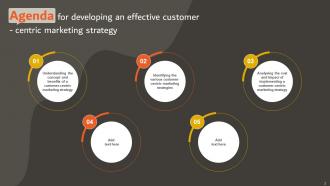
Slide 2: This slide is an Agenda slide. State your agendas here.
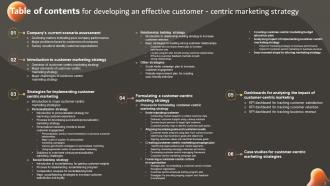
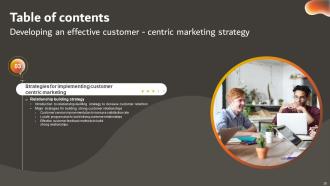
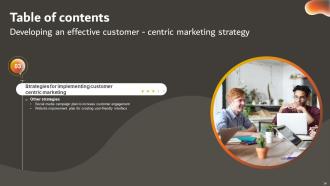
Slide 3: This slide shows a Table of Contents for the presentation.
Slide 4: This slide is an introductory slide.
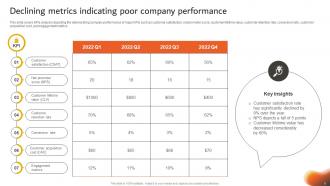
Slide 5: This slide covers KPIs analysis depicting the deteriorating company performance of major KPIs.
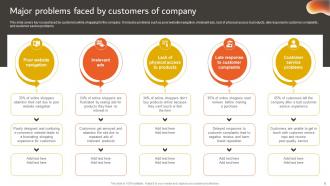
Slide 6: This slide includes key issues faced by customers while shopping for the company.
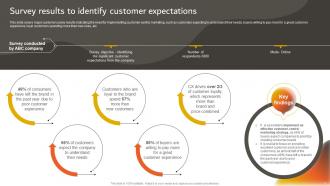
Slide 7: This slide covers major customer survey results indicating the need for implementing customer-centric marketing.
Slide 8: This slide is an introductory slide.
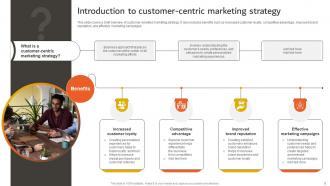
Slide 9: This slide puts a brief overview of customer-oriented marketing strategy.
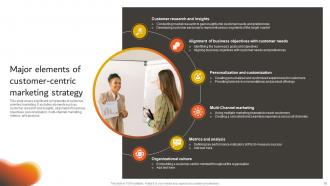
Slide 10: This slide marks the significant components of customer-oriented marketing.
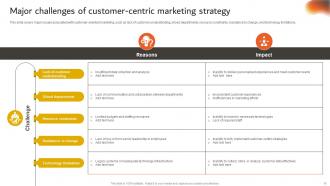
Slide 11: This slide covers major issues associated with customer-oriented marketing.
Slide 12: This slide is an introductory slide.
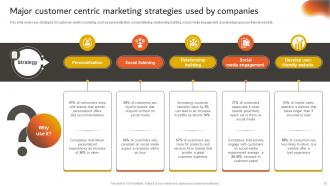
Slide 13: This slide covers key strategies for customer-centric marketing.
Slide 14: This slide is an introductory slide.
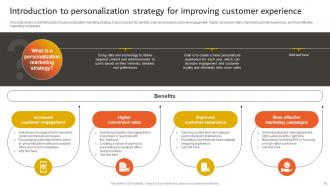
Slide 15: This slide highlights a brief introduction to personalization marketing strategy.
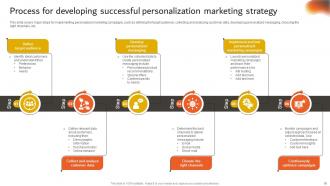
Slide 16: This slide covers major steps for implementing personalized marketing campaigns.
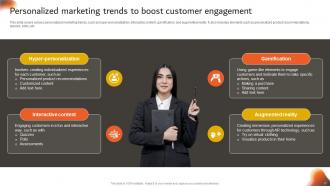
Slide 17: This slide puts various personalized marketing trends.
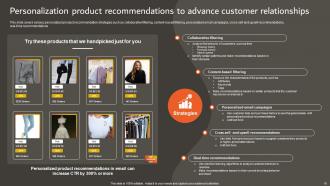
Slide 18: This slide illustrates various personalized product recommendation strategies.
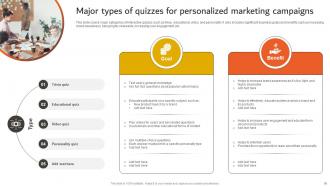
Slide 19: This slide covers major categories of interactive quizzes such as trivia, educational, video, and personality.
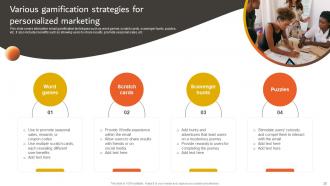
Slide 20: This slide depicts interactive email gamification techniques.
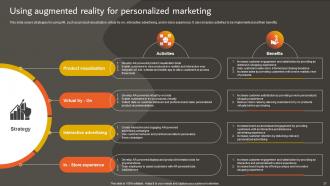
Slide 21: This slide demonstrates strategies for using AR.
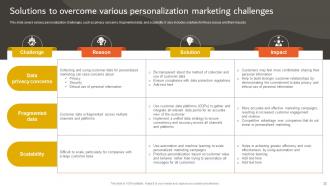
Slide 22: This slide covers various personalization challenges, such as privacy concerns, fragmented data, and scalability.
Slide 23: This slide is an introductory slide.
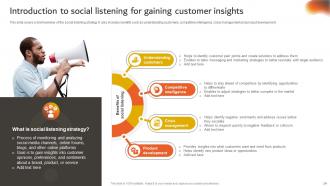
Slide 24: This slide covers a brief overview of the social listening strategy.
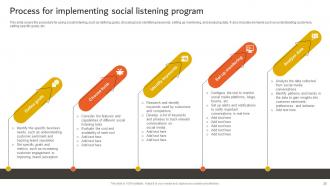
Slide 25: This slide entails the procedure for using social listening.
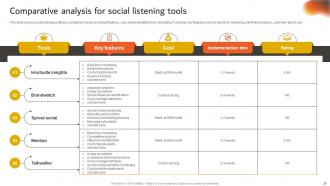
Slide 26: This slide marks social listening software comparison based on critical features, cost, implementation time, and rating.
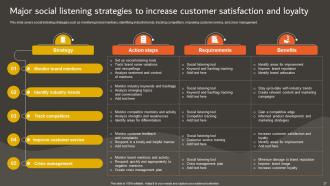
Slide 27: This slide covers social listening strategies.
Slide 28: This slide is an introductory slide.
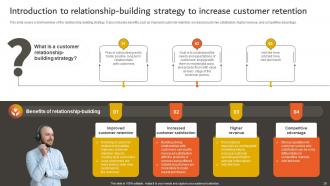
Slide 29: This slide illustrates a brief overview of the relationship-building strategy.
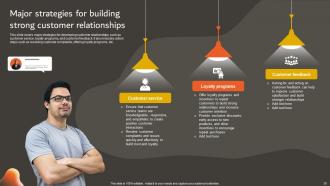
Slide 30: This slide highlights major strategies for developing customer relationships.
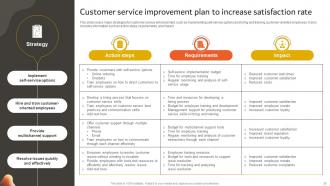
Slide 31: This slide covers major strategies for customer service enhancement.
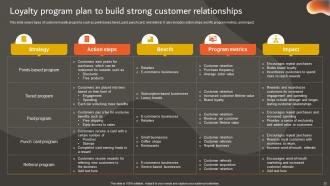
Slide 32: This slide marks types of customer loyalty programs such as point-based, tiered, paid, punch card, and referral.
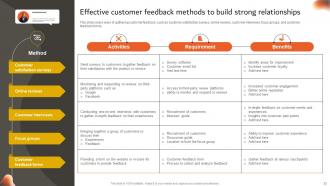
Slide 33: This slide puts ways of gathering customer feedback, such as customer satisfaction surveys, online reviews, customer interviews, focus groups, and customer feedback forms.
Slide 34: This slide is an introductory slide.
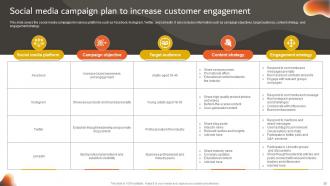
Slide 35: This slide puts the social media campaigns for various platforms such as Facebook, Instagram, Twitter, and LinkedIn.
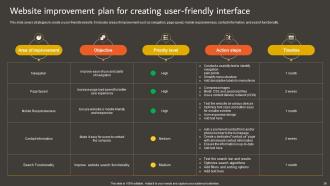
Slide 36: This slide covers strategies to create a user-friendly website.
Slide 37: This slide is an introductory slide.
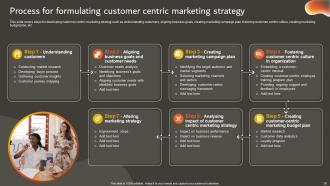
Slide 38: This slide identifies steps for developing customer centric marketing strategy.
Slide 39: This slide is an introductory slide.
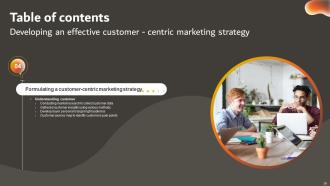
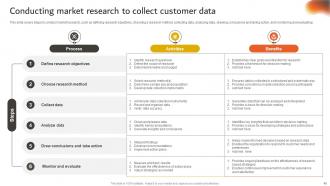
Slide 40: This slide marks steps to conduct market research.
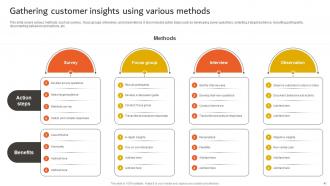
Slide 41: This slide covers various methods, such as surveys, focus groups, interviews, and observations.
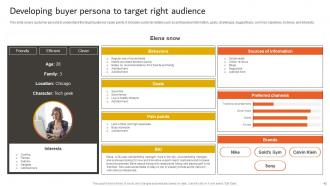
Slide 42: This slide includes customer persona to understand the target audience’s pain points.
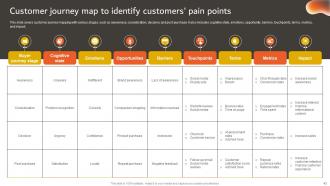
Slide 43: This slide narrates customer journey mapping with various stages, such as awareness, consideration, decision, and post-purchase.
Slide 44: This slide is an introductory slide.
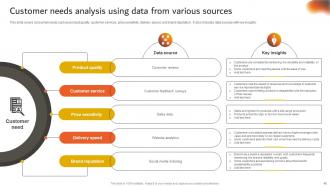
Slide 45: This slide puts consumer needs such as product quality, customer services, price sensitivity, delivery speed, and brand reputation.
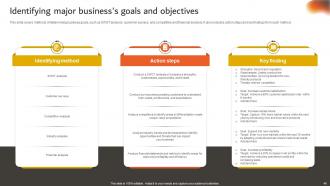
Slide 46: This slide covers methods of determining business goals, such as SWOT analysis, customer surveys, and competitive and financial analysis.
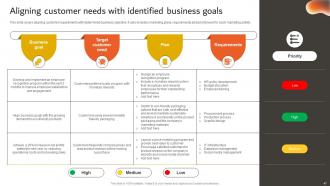
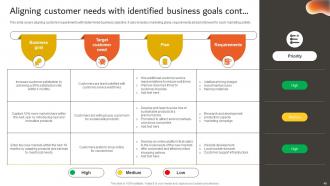
Slide 47: This slide entails aligning customer requirements with determined business objective.
Slide 48: This slide illustrates aligning customer requirements with determined business objective.
Slide 49: This slide is an introductory slide.
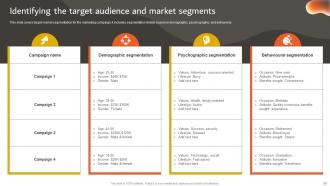
Slide 50: This slide covers target market segmentation for the marketing campaign.
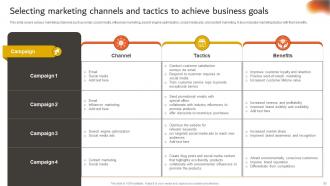
Slide 51: This slide highlights Selecting marketing channels and tactics to achieve business goals.
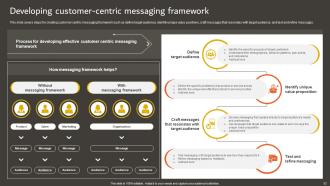
Slide 52: This slide covers Developing customer-centric messaging framework.
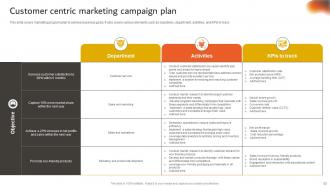
Slide 53: This slide portrays marketing program plan to achieve business goals.
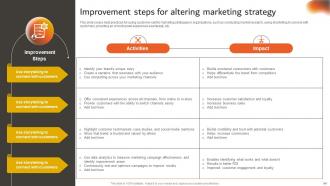
Slide 54: This slide is an introductory slide.
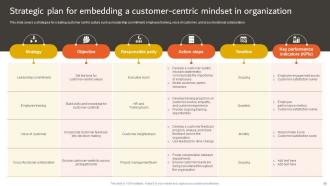
Slide 55: This slide showcases a strategies for creating customer centric culture.
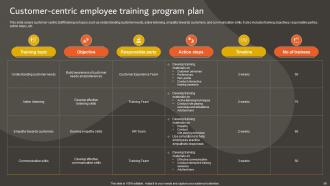
Slide 56: This slide shows customer-centric staff training.
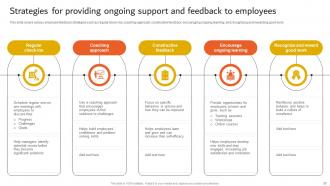
Slide 57: This slide covers various employee feedback strategies such as regular check-ins, coaching approach, constructive feedback, encouraging ongoing learning, and recognizing and rewarding good work.
Slide 58: This slide is an introductory slide.
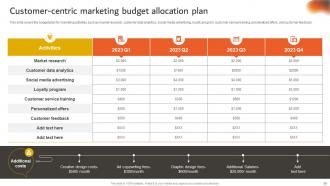
Slide 59: This slide marks the budget plan for marketing activities such as market research, customer data analytics, social media advertising, loyalty program, customer service training, personalized offers, and customer feedback.
Slide 60: This slide is an introductory slide.
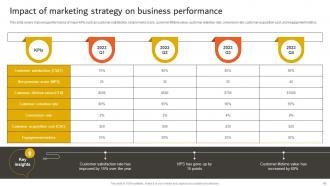
Slide 61: This slide entails improving performance of major KPIs.
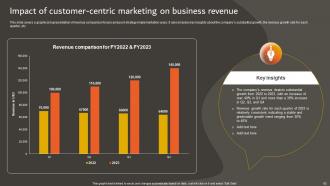
Slide 62: This slide addresses a graphical representation of revenue comparison for pre and post-strategy implementation years.
Slide 63: This slide is an introductory slide.
Slide 64: This slide covers best practices for using customer-centric marketing strategies.
Slide 65: This slide is an introductory slide.
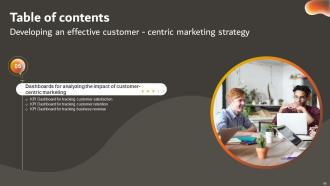
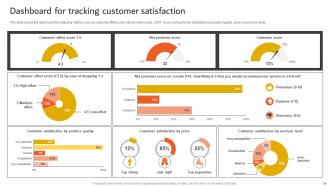
Slide 66: This slide entails the dashboard for analyzing metrics.
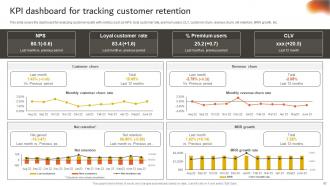
Slide 67: This slide is in continuation with the previous slide.
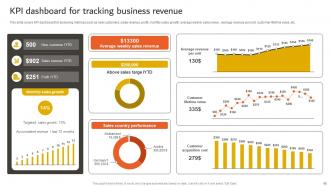
Slide 68: This slide puts KPI dashboard for tracking business revenue.
Slide 69: This slide is an introductory slide.
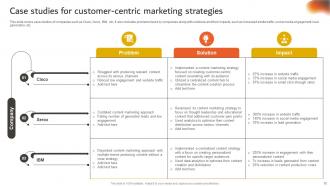
Slide 70: This slide focuses on case studies of companies such as Cisco, Xerox, IBM, etc.
Slide 71: This slide shows all the icons included in the presentation.
Slide 72: This slide is titled Additional Slides for moving forward.
Slide 73: This slide is Our Mission slide with related imagery and text.
Slide 74: This slide is an About Us slide to show company specifications etc.
Slide 75: This slide shows Post-It Notes. Post your important notes here.
Slide 76: This slide is Our Team slide with names and designations.
Slide 77: This slide is a thank-you slide with address, contact numbers, and email address.
Developing An Effective Customer Centric Marketing Strategy CD with all 85 slides:
Use our Developing An Effective Customer Centric Marketing Strategy CD to effectively help you save your valuable time. They are readymade to fit into any presentation structure.









FAQs for Developing An Effective Customer Centric
Customer-centric marketing strategies include comprehensive customer research, personalized messaging, omnichannel engagement, feedback integration, and data-driven personalization. These components work together by understanding individual preferences, delivering targeted experiences across touchpoints, and continuously adapting campaigns, with many retail and financial services organizations finding that this approach significantly enhances customer loyalty and drives revenue growth.
Businesses can effectively gather customer feedback through surveys, social media monitoring, review analysis, focus groups, and direct customer interviews, while leveraging analytics tools to identify patterns and preferences. This comprehensive approach enables companies to refine messaging, optimize product offerings, and personalize campaigns, with many organizations finding that data-driven insights significantly enhance customer engagement and drive measurable marketing ROI.
Personalization enhances customer-centric marketing by delivering tailored content, targeted product recommendations, customized messaging, and individualized experiences across multiple touchpoints. Through advanced analytics and customer data insights, businesses streamline engagement strategies, improve conversion rates, and build stronger brand loyalty, with many retailers and financial services finding that personalized approaches ultimately deliver higher customer lifetime value and competitive advantage.
Companies leverage data analytics to improve customer-centric marketing by tracking customer behavior patterns, segmenting audiences based on preferences, personalizing content delivery, predicting future purchasing decisions, and optimizing campaign performance across multiple touchpoints. Through advanced analytics platforms, retailers and financial services firms enhance customer experiences, reduce acquisition costs, and increase conversion rates, ultimately delivering higher ROI and stronger customer loyalty in an increasingly competitive marketplace.
Effective customer segmentation methods include demographic profiling, behavioral analysis, psychographic mapping, geographic targeting, and purchase history evaluation. These approaches enable organizations to create personalized campaigns by identifying distinct customer preferences, spending patterns, and engagement behaviors, with many retail and financial services companies finding that targeted segmentation increases conversion rates and customer lifetime value significantly.
Understanding the customer journey enables marketers to map touchpoints, identify pain points, and optimize interactions across awareness, consideration, purchase, and retention stages. This comprehensive view allows businesses to deliver personalized messaging, streamline conversion paths, and enhance customer experiences, ultimately driving higher engagement rates, improved customer satisfaction, and increased lifetime value through strategic alignment.
Digital tools that enhance customer engagement include CRM systems, marketing automation platforms, social media management tools, personalization engines, and analytics dashboards. These technologies streamline customer interactions by delivering targeted content, automating follow-ups, and tracking behavioral patterns, with many retail and financial services organizations finding that integrated platforms ultimately reduce response times while significantly improving customer satisfaction and conversion rates.
Brands ensure messaging consistency by developing comprehensive brand guidelines, implementing centralized content management systems, training all customer-facing teams, conducting regular audits across channels, and using integrated marketing platforms. Through unified messaging frameworks, companies like Starbucks and Apple deliver seamless experiences across retail, digital, and social touchpoints, ultimately strengthening brand recognition and customer trust.
Key metrics include customer lifetime value (CLV), Net Promoter Score (NPS), customer acquisition cost (CAC), retention rates, and customer satisfaction scores. These measurements enable businesses to assess relationship quality, loyalty trends, and revenue impact across touchpoints, with many organizations finding that tracking engagement metrics alongside financial outcomes delivers comprehensive insights into marketing effectiveness and competitive positioning.
Emotional connection is crucial for customer-centric brands, driving loyalty, advocacy, and long-term retention by creating deeper relationships beyond transactional interactions. Through personalized storytelling, authentic communication, and consistent value delivery, companies like Apple and Nike build emotional bonds that translate into higher customer lifetime value, reduced churn rates, and ultimately sustainable competitive advantage in increasingly crowded markets.
Common challenges include restructuring organizational processes, retraining staff mindsets, integrating customer data across departments, aligning internal metrics with customer outcomes, and managing initial implementation costs. While this transformation requires significant cultural and operational changes, companies like Amazon and Zappos demonstrate that customer-centricity ultimately delivers enhanced loyalty, increased retention rates, and sustainable competitive advantage.
Cultural differences significantly influence customer preferences through varying communication styles, purchasing behaviors, value systems, color associations, and decision-making processes across different markets. Global companies like McDonald's adapting menus regionally, or luxury brands like Louis Vuitton adjusting messaging for collectivist versus individualist cultures, demonstrate how cultural sensitivity ultimately delivers enhanced customer engagement and competitive advantage.
Long-term customer loyalty strategies include personalized communication, loyalty reward programs, exceptional customer service, consistent brand experiences, and proactive engagement across touchpoints. These approaches streamline retention by delivering tailored value, recognizing customer preferences, and building emotional connections, with many retail and financial services organizations finding that integrated loyalty initiatives ultimately reduce acquisition costs while enhancing lifetime customer value.
Storytelling creates customer-centric experiences by weaving brand narratives around customer journeys, pain points, and aspirations, making marketing messages personally relevant and emotionally resonant. Through authentic customer success stories, relatable scenarios, and outcome-focused narratives, brands enable deeper connections, enhanced engagement, and stronger loyalty, with many organizations finding that story-driven campaigns deliver significantly higher conversion rates and customer retention.
Companies can integrate customer insights by conducting regular surveys and feedback sessions, analyzing behavioral data and purchase patterns, creating detailed customer personas, implementing segmentation strategies, and establishing cross-functional teams. These practices enable organizations to deliver personalized campaigns, targeted messaging, and relevant product offerings, with many businesses finding that data-driven approaches significantly enhance customer engagement and drive measurable revenue growth.
-
Unique and attractive product design.
-
I didn’t expect such a good service for the money I am paying. But, they exceed my expectations. Great work SlideTeam.
-
SlideTeam is very efficient when it comes to saving time. I am happy that I chose them for my presentation.
-
You guys are life-saver when it comes to presentations. Honestly I cannot do much without your services. Thank you!!!