


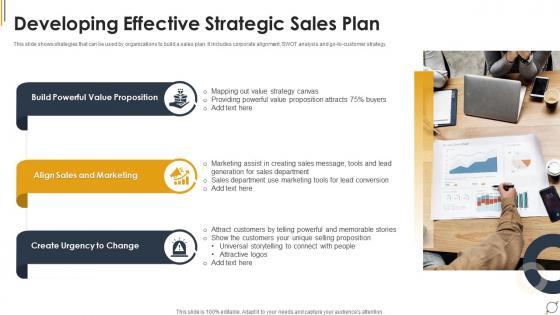
Developing Effective Strategic Sales Plan




Try Before you Buy Download Free Sample Product
 Impress Your
 Audience
 100%
100% Editable
 Save Hours
 of Time


This slide shows strategies that can be used by organizations to build a sales plan. It includes corporate alignment, SWOT analysis and go-to-customer strategy.
People who downloaded this PowerPoint presentation also viewed the following :
Developing Effective Strategic Sales Plan with all 6 slides:
Use our Developing Effective Strategic Sales Plan to effectively help you save your valuable time. They are readymade to fit into any presentation structure.





FAQs for Developing Effective
**INPUT**: What are the key components of an effective strategic sales plan? **OUTPUT**: Key components include market analysis, target customer segmentation, competitive positioning, sales objectives, resource allocation, and performance metrics. These elements work together by identifying opportunities, defining clear goals, and establishing measurable benchmarks, with many organizations finding that strategic integration of these components delivers increased revenue, enhanced team efficiency, and sustainable competitive advantage. **Word Count**: 54 words
Market research enhances strategic sales plan development by identifying customer needs, analyzing competitor strategies, and revealing market trends that inform targeting decisions. Through comprehensive data analysis, organizations can segment audiences more effectively, position products strategically, and allocate resources efficiently, ultimately delivering higher conversion rates and sustainable competitive advantage in increasingly dynamic markets.
Customer segmentation enables businesses to tailor their sales approach by dividing prospects into distinct groups based on demographics, buying behavior, needs, and industry characteristics. This strategic categorization allows sales teams to customize messaging, prioritize high-value prospects, and allocate resources more effectively, with companies like financial services and retail finding significantly improved conversion rates and customer acquisition costs.
Aligning sales goals with business objectives involves analyzing revenue targets, market expansion priorities, customer acquisition costs, profit margins, and growth timelines to ensure strategic coherence. Through comprehensive planning, organizations establish measurable KPIs, territory assignments, and resource allocation strategies that directly support broader business outcomes, with many companies finding that integrated goal-setting ultimately delivers enhanced operational efficiency and competitive market positioning.
Strategic sales plan success metrics include revenue growth, conversion rates, customer acquisition cost, average deal size, sales cycle length, and customer lifetime value. These measurements enable organizations to track performance across different stages, optimize resource allocation, and identify bottlenecks, with many companies finding that combining leading and lagging indicators delivers comprehensive visibility into sales effectiveness and future growth potential.
Technology and data analytics enhance strategic sales planning by providing predictive insights, automating forecasting processes, and identifying high-value opportunities through customer behavior analysis. Through CRM integration and AI-powered analytics, organizations streamline territory planning, optimize resource allocation, and accelerate decision-making, with many sales teams finding that data-driven approaches ultimately deliver more accurate projections and competitive advantage.
Common pitfalls include setting unrealistic targets, insufficient market research, neglecting competitor analysis, poor resource allocation, and lack of clear accountability measures. These oversights often result from rushing the planning process or failing to involve key stakeholders, with many organizations finding that inadequate performance tracking and inflexible frameworks ultimately undermine sales effectiveness and revenue growth.
A strategic sales plan should be reviewed quarterly for performance tracking and updated annually for comprehensive strategic adjustments, with additional reviews triggered by significant market changes or business pivots. Many organizations find that quarterly assessments enable rapid response to market shifts, customer behavior changes, and competitive pressures, while annual updates ensure long-term alignment with evolving business objectives and revenue targets.
Strategies include shared KPIs and revenue goals, integrated CRM systems, joint content development, regular cross-team meetings, and unified customer journey mapping. These approaches streamline lead handoffs, enhance message consistency, and improve conversion rates, with many organizations finding that aligned sales-marketing teams deliver 20% faster deal closures and significantly higher customer acquisition efficiency.
Competitive analysis impacts strategic sales plans by identifying market gaps, revealing pricing opportunities, uncovering competitor weaknesses, and highlighting successful tactics for adaptation. Through comprehensive competitor research, organizations can refine their value propositions, adjust pricing strategies, and develop differentiated approaches, with many sales teams finding that strategic competitive insights ultimately enhance win rates and accelerate revenue growth.
**INPUT**: How do you identify and prioritize key accounts in your sales strategy? **OUTPUT**: Key account identification involves analyzing revenue potential, market influence, strategic alignment, growth trajectory, and relationship depth to determine which prospects deliver maximum value. Through comprehensive account scoring and market research, sales teams streamline resource allocation, enhance customer experiences, and accelerate deal closure, with many organizations finding that strategic account prioritization ultimately delivers higher conversion rates and sustained competitive advantage. [Word count: 60]
Setting realistic sales targets involves analyzing historical performance data, market conditions, customer segmentation insights, competitor benchmarks, and resource capacity constraints. Organizations enhance target accuracy by incorporating seasonal trends, pipeline velocity metrics, and territory-specific factors, while regularly reviewing quarterly performance against goals, ultimately delivering achievable growth expectations and improved sales team motivation.
A strategic sales plan adapts to market changes through regular performance monitoring, flexible target adjustments, and continuous competitor analysis. By incorporating real-time data analytics, quarterly strategy reviews, and agile resource reallocation, organizations can pivot quickly when consumer preferences shift, ultimately maintaining competitive advantage and revenue growth in increasingly dynamic markets.
Training and development ensures sales teams possess the skills, product knowledge, and strategic understanding necessary to execute sales plans effectively, while building confidence and consistency across customer interactions. Through comprehensive training programs, organizations enhance performance metrics, reduce onboarding time, and improve customer experiences, with many companies finding that well-trained teams deliver significantly higher conversion rates and revenue growth.
Incorporating sales representative feedback involves conducting regular field surveys, analyzing performance metrics, hosting structured feedback sessions, and implementing suggestion tracking systems. These frontline insights help organizations identify market trends, customer objections, competitive challenges, and process bottlenecks, ultimately enabling more realistic quotas, refined messaging, and strategic adjustments that enhance team performance and revenue outcomes.
-
You can rely on SlideTeam whenever you run out of designs for your presentation. Thank you so much SlideTeam!
-
The templates are the best in class. Very clear and innovative graphics! I am excited to explore and download more presentations.