


Developing Utility Billing Customer Billing System Architecture Framework




Try Before you Buy Download Free Sample Product
 Impress Your
 Audience
 100%
100% Editable
 Save Hours
 of Time


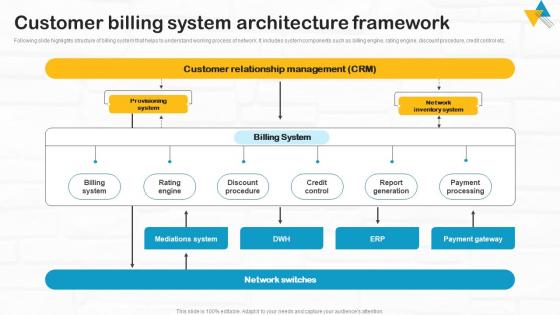
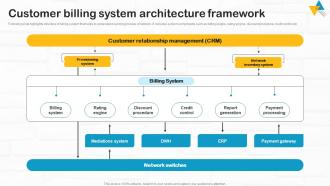
Following slide highlights structure of billing system that helps to understand working process of network. It includes system components such as billing engine, rating engine, discount procedure, credit control etc.
People who downloaded this PowerPoint presentation also viewed the following :
Developing Utility Billing Customer Billing System Architecture Framework with all 6 slides:
Use our Developing Utility Billing Customer Billing System Architecture Framework to effectively help you save your valuable time. They are readymade to fit into any presentation structure.





FAQs for Developing Utility Billing Customer Billing
Modern utility billing systems feature automated meter reading, real-time usage tracking, flexible rate structures, integrated customer portals, and advanced analytics capabilities. These technologies streamline operations by eliminating manual processes, enabling dynamic pricing models, and delivering enhanced customer experiences, with many utilities finding that automated systems reduce billing errors while significantly improving operational efficiency and customer satisfaction.
Utility billing systems integrate with smart metering technologies through automated data collection protocols, real-time consumption tracking, and advanced analytics platforms that process usage information continuously. These integrated systems enable utilities to deliver accurate billing, predictive maintenance alerts, and dynamic pricing models, while customers receive detailed usage insights and faster service resolution, ultimately streamlining operations and enhancing customer experiences.
Essential security measures include multi-factor authentication, end-to-end encryption, role-based access controls, regular security audits, and PCI DSS compliance protocols. These safeguards work together by preventing unauthorized access, protecting data transmission, and ensuring regulatory compliance, with many utilities finding that comprehensive security frameworks ultimately enhance customer trust while reducing breach risks and operational vulnerabilities.
Data analytics enhances utility billing systems through predictive consumption forecasting, usage pattern analysis, fraud detection algorithms, demand response optimization, and customer segmentation capabilities. These analytical tools enable utilities to streamline billing accuracy, reduce operational costs, and deliver personalized customer experiences, while identifying revenue leakage and optimizing resource allocation across residential and commercial accounts.
A utility billing system improves customer engagement and satisfaction by providing transparent billing details, self-service portals, multiple payment options, real-time usage tracking, and automated notifications. These features streamline customer interactions while enabling utilities to deliver faster query resolution, personalized energy insights, and proactive service communications, ultimately enhancing customer experiences and reducing operational costs.
Automation revolutionizes utility billing by eliminating manual meter readings, reducing processing time, and minimizing human errors through smart meters and automated data collection systems. These technologies enable companies to generate accurate bills faster, handle customer inquiries more efficiently, and allocate resources strategically, with many utilities finding significantly reduced operational costs and enhanced customer satisfaction.
Regulatory compliance requirements significantly shape utility billing system design through mandatory data security protocols, standardized rate structures, transparent billing formats, and audit trail capabilities. These frameworks ensure systems accommodate complex tariff calculations, customer protection measures, and reporting standards, while enabling utilities to adapt to evolving regulations and maintain operational efficiency across diverse service territories.
Common challenges include data migration complexities, integration with existing infrastructure, staff training requirements, customer communication during transitions, and ensuring regulatory compliance. These implementation hurdles can be minimized through phased rollouts, comprehensive testing protocols, and strategic change management, with many utilities finding that thorough planning and stakeholder engagement ultimately delivers smoother transitions and enhanced operational efficiency.
User-friendly interfaces improve billing accessibility by simplifying navigation, providing clear visual data representation, and enabling self-service options like payment scheduling and usage tracking. Through intuitive design and mobile optimization, utility companies streamline customer interactions, reduce support calls, and enhance satisfaction, with many organizations finding that accessible interfaces ultimately deliver improved payment rates and stronger customer relationships.
Cloud-based utility billing systems deliver enhanced scalability, reduced infrastructure costs, automatic software updates, improved data security, and seamless remote access capabilities compared to on-premises solutions. These systems enable utility companies to streamline operations, minimize IT maintenance overhead, and accelerate customer service delivery, with many organizations finding that cloud adoption ultimately provides greater flexibility and competitive advantage in an increasingly digital landscape.
Utility billing systems support diverse payment methods through online portals, mobile apps, automatic bank transfers, credit card processing, and traditional mail-in options. These integrated payment solutions enhance customer satisfaction by offering convenient choices, reduce collection costs through automated processing, and improve cash flow management, with many utilities finding that multiple payment channels significantly increase on-time payment rates and overall customer retention.
Real-time billing enhances cash flow management by accelerating payment cycles, reducing outstanding receivables, and enabling immediate revenue recognition from consumption patterns. This approach streamlines operational efficiency through automated meter readings, dynamic pricing adjustments, and predictive analytics, with many utilities finding that faster billing cycles improve customer satisfaction while significantly reducing administrative overhead and collection costs.
Organizations should approach legacy billing system migration through comprehensive data auditing, phased implementation strategies, and robust testing protocols to minimize service disruptions. Financial institutions and utility companies increasingly adopt hybrid approaches, running parallel systems during transition periods, while ensuring staff training and customer communication plans are prioritized, ultimately delivering enhanced operational efficiency and improved customer experiences.
When choosing a utility billing software vendor, consider system scalability, integration capabilities, regulatory compliance features, customer support quality, and implementation timelines. Additionally, evaluate the vendor's industry experience, data security measures, and customization options, with many utilities finding that vendors offering cloud-based solutions, automated meter reading integration, and comprehensive reporting tools deliver enhanced operational efficiency and improved customer experiences.
Utility billing systems contribute to sustainability by enabling smart meter integration, time-of-use pricing, energy consumption analytics, and paperless billing processes. These technologies help utilities optimize resource distribution, encourage conservation behaviors, and reduce operational waste, while customers gain real-time insights into usage patterns, ultimately delivering lower environmental impact and enhanced operational efficiency across the energy sector.
-
Visually stunning presentation, love the content.
-
The slides are remarkable with creative designs and interesting information. I am pleased to see how functional and adaptive the design is. Would highly recommend this purchase!