


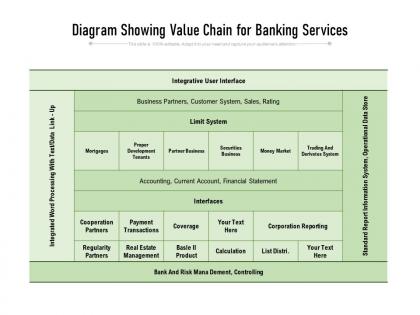
Diagram showing value chain for banking services




Try Before you Buy Download Free Sample Product
 Impress Your
 Audience
 100%
100% Editable
 Save Hours
 of Time


Our Diagram Showing Value Chain For Banking Services are topically designed to provide an attractive backdrop to any subject. Use them to look like a presentation pro.
People who downloaded this PowerPoint presentation also viewed the following :
Diagram showing value chain for banking services with all 2 slides:
Use our Diagram Showing Value Chain For Banking Services to effectively help you save your valuable time. They are readymade to fit into any presentation structure.

FAQs for Diagram showing value chain
So you've got two main buckets here - primary stuff (customer acquisition, product development, service delivery, support) and then all the backend activities like tech infrastructure, risk management, compliance, HR. Primary activities directly make customers happy, while the backend keeps things from falling apart. Honestly, most companies are terrible at seeing where they're bleeding money or frustrating customers. Map out what you're actually doing right now first - I bet you'll find weird bottlenecks everywhere. It's basically like an assembly line but for financial services. The whole goal is figuring out where to cut costs or make the customer experience less painful.
Look, tech integration basically automates your whole banking workflow and connects all your departments with real-time data. AI chatbots now handle most customer questions (honestly they're weirdly good at it), plus digital onboarding means no more paperwork hell for new accounts. Your risk, compliance, and service teams can all see the same updated info instantly - which is huge. The analytics help you make credit decisions way faster too. Oh, and here's the thing - don't try to fix everything at once. Find your worst bottlenecks first, that's where you'll actually see results worth bragging about.
Honestly, customer relationships are everything in banking. Without them, you're just another bank competing on rates and that's brutal. Trust is huge - people don't just hand over their money to anyone, right? Plus, when you've got solid relationships, acquiring new customers costs way less and you can actually cross-sell products (that's where the real money is). The data you get from knowing your customers well? Game changer for everything from new products to managing risk. I'd focus on building those relationships from day one. It might seem slow at first, but it pays off across your whole operation.
So basically banks can dig into their data to find where things get stuck and predict what customers want next. Transaction patterns show when to staff branches better. Predictive models catch loan defaults early - which honestly saves everyone a headache. Customer journey tracking makes onboarding way smoother too. The cool part? Connect all this stuff and you'll actually see which products make money versus the ones that don't. My advice though - don't go crazy at first. Just pick something like credit approvals, use whatever data you've got, then expand.
Honestly, the data silo thing is brutal - departments just can't share info properly. Legacy systems make it worse since everything's so old and clunky. Compliance slows you down at every turn, though I get why banks need all those regulations. Customer experience becomes a nightmare when you're trying to connect different touchpoints seamlessly. Staff pushback is probably the worst part though. People hate changing workflows they've used forever, and who can blame them really? Before doing anything else, map out what you currently have. Sounds boring but you'll be shocked at how messy things actually are.
Look, compliance is basically like having speed bumps everywhere in banking - annoying but keeps you from legal disasters. KYC slows down customer onboarding, AML monitoring adds friction to transactions, and don't even get me started on waiting for regulatory approval on new features. It's genuinely one of the most frustrating parts of the business. Compliance eats up maybe 10-15% of your operating budget too. But here's what I learned the hard way - bake it into your processes from day one instead of scrambling to add it later. You'll actually end up moving faster.
Look, risk management is what stops your banking operations from completely imploding. Credit risk, fraud, compliance nightmares - all that stuff lurks at every stage of your value chain. Customer onboarding? Risk. Loan processing? More risk. Payment systems? You get it. Without proper controls, you're basically gambling with regulatory disasters and huge losses waiting to happen. Map out where problems could pop up at each step, then build monitoring that catches issues early. Trust me, it's way cheaper than dealing with the mess afterward. Flying blind never ends well in banking.
Honestly, most banks just copy each other instead of figuring out what makes them actually different. Map out your whole customer journey first - every single touchpoint. Then rate which steps you're genuinely better at than competitors. Maybe it's your loan approval speed, maybe your mobile app doesn't suck. Whatever it is, go all-in on those 2-3 things and stop trying to be amazing at everything. The boring operational stuff? Automate it or outsource it. I've seen banks waste tons of resources on activities that don't matter to customers at all. Focus on what sets you apart.
Look, fintech partnerships are honestly a game-changer for banks. Instead of spending years building your own AI risk tools or instant payment systems, you just partner with someone who's already nailed it. Smart fintechs are killing it with younger customers too - they actually know how to make mobile banking not suck. The speed thing is huge. While you're stuck in committee meetings, they're shipping new features. My advice? Figure out what's breaking in your operations first, then find a fintech that's already solved that exact problem. Way easier than reinventing the wheel.
Look, when you streamline your operations, customers notice right away. Faster loan approvals, smoother account openings - all that stuff makes people way happier. You're also not wasting cash on those annoying manual processes that drive everyone crazy (seriously, who has time for that?). The money you save can go toward better rates or new tech. Happy customers stick around and tell their friends. Oh, and here's something cool - if you track processing times alongside satisfaction scores, the connection becomes super obvious. It's honestly one of those things that seems too simple but actually works.
So globalization is totally changing how banks think about their operations. They can now handle transactions in India while serving customers in New York - geographic boundaries don't really matter anymore. Pretty crazy when you think about it. Banks are chasing cost savings by sourcing functions globally, but honestly, it comes with headaches too. Regulatory compliance gets messy when you're operating across multiple countries. Plus cybersecurity becomes way more complex. My advice? Figure out which parts of your operations could actually benefit from global sourcing first. Then map out what regulatory hoops you'll need to jump through.
Honestly, you can bake sustainability into pretty much every step of your banking process. Pick suppliers who actually care about the environment and diversity - that's your foundation right there. Digitize everything possible (bye-bye paper!), make your branches more energy efficient, and get your IT systems running greener. For customers, roll out sustainable loans, ESG investments, maybe some carbon tracking tools. The key is making it feel natural, not like some forced "eco" add-on that nobody wants. I'd audit where you are now and grab 2-3 easy wins you can knock out this quarter.
I'd start with just 3-4 metrics so you don't overwhelm yourself. Revenue per customer and cross-sell ratios are obvious ones - they show if the integration is actually working. Customer lifetime value matters too. Operational stuff like transaction volumes across your chain segments will tell you a different story though. Oh, and customer satisfaction scores are honestly way more predictive than most people think. You can always layer on things like cost-to-serve ratios later once you see what's actually moving things for your setup. Time-to-market for new offerings is another good one to watch.
Honestly, customer feedback is like having a cheat sheet for fixing your bank's problems. People literally tell you what's broken - loan apps that crash, account opening that takes forever, whatever's bugging them most. Look for patterns in complaints to figure out your biggest pain points. Short surveys work better than long ones (nobody has time for that). Social media monitoring catches stuff too. The key is actually doing something with what you hear - track which fixes actually improve your satisfaction scores. Don't just collect feedback and let it sit there gathering dust.
Honestly, you need to watch AI supply chain financing and embedded banking - that's where things are moving fast. Banks aren't even acting like traditional banks anymore, they're just quietly integrated into business platforms. Real-time data is changing everything too. Instead of looking at old financial statements, they can approve credit instantly based on what's actually happening with cash flow. Pretty wild if you think about it. ESG stuff is pushing tons of innovation in lending. Oh, and definitely spy on your competitors' fintech partnerships - that's literally where all the disruption starts.
No Reviews