


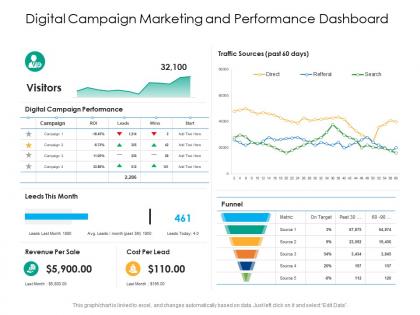
Digital campaign marketing and performance dashboard




Try Before you Buy Download Free Sample Product
 Impress Your
 Audience
 100%
100% Editable
 Save Hours
 of Time


Our Digital Campaign Marketing And Performance Dashboard are topically designed to provide an attractive backdrop to any subject. Use them to look like a presentation pro.
People who downloaded this PowerPoint presentation also viewed the following :
Digital campaign marketing and performance dashboard with all 2 slides:
Use our Digital Campaign Marketing And Performance Dashboard to effectively help you save your valuable time. They are readymade to fit into any presentation structure.
FAQs for Digital campaign marketing
Core digital marketing analytics metrics include click-through rates, conversion rates, cost per acquisition, return on ad spend, and customer lifetime value. These metrics enable marketers to optimize budget allocation, refine targeting strategies, and adjust creative elements in real-time, with many organizations finding that data-driven campaigns deliver significantly higher ROI and more precise audience engagement.
Businesses can effectively track user behavior across multiple channels by implementing unified analytics platforms, cross-device tracking pixels, customer data platforms, and attribution modeling tools. These technologies streamline data collection by consolidating touchpoints, enabling real-time insights, and creating comprehensive customer journey maps, with many organizations finding that integrated analytics ultimately delivers enhanced targeting precision and significantly improved ROI measurement.
A/B testing enables marketers to compare different versions of campaigns, landing pages, email subject lines, and ad creatives to determine which performs better through statistical analysis. By systematically testing elements like call-to-action buttons, headlines, and layouts, organizations can increase conversion rates by 10-25%, with e-commerce and SaaS companies finding that continuous testing delivers measurable revenue growth and enhanced customer engagement.
Organizations leverage customer segmentation in digital marketing by analyzing behavioral data, demographic patterns, purchase history, and engagement metrics to create targeted audience groups. Through analytics tools, businesses can personalize content delivery, optimize ad spend across segments, and tailor messaging strategies, with many retailers and financial services finding that segmented campaigns deliver significantly higher conversion rates and customer lifetime value.
Best practices for setting up Google Analytics include defining clear conversion goals, implementing proper UTM parameter tracking, configuring enhanced ecommerce tracking, setting up custom audiences, and establishing relevant dashboard views. These configurations enable marketers to measure campaign ROI, attribution paths, and customer journey touchpoints effectively, with many organizations finding that strategic goal alignment and consistent tagging protocols ultimately deliver actionable insights and improved campaign optimization.
Social media analytics help shape content strategy by revealing audience preferences, optimal posting times, engagement patterns, content performance metrics, and demographic insights. These data-driven findings enable marketers to create more targeted campaigns, adjust messaging for different platforms, and allocate resources strategically, with many brands finding that analytics-informed content delivers significantly higher engagement rates and conversion outcomes.
Attribution models revolutionize customer journey understanding by tracking touchpoints across channels, measuring interaction effectiveness, and revealing conversion paths that traditional analytics miss. Through multi-touch attribution, marketers can identify which campaigns, content, and channels truly drive conversions, enabling strategic budget reallocation, enhanced targeting precision, and ultimately delivering higher ROI while optimizing customer acquisition costs.
Website traffic pattern analysis reveals user behavior insights, conversion path optimization opportunities, content performance metrics, peak engagement periods, and demographic targeting data. These analytics enable businesses to streamline marketing spend, enhance user experiences, and identify high-converting channels, with many organizations finding that strategic traffic analysis delivers improved ROI and competitive advantage.
Digital marketing analytics help identify ROI by tracking conversion rates, customer acquisition costs, and revenue attribution across channels like social media, email, and paid advertising. Through advanced attribution modeling and customer journey mapping, businesses can determine which channels deliver the highest returns, optimize budget allocation, and eliminate underperforming campaigns, ultimately maximizing marketing efficiency and profitability.
Digital marketing analytics must consider customer consent, data transparency, purpose limitation, and security protection when collecting personal information. Companies should implement privacy-by-design approaches, obtain explicit permissions for data usage, and ensure customers understand how their information supports personalized experiences, with many organizations finding that transparent data practices ultimately build stronger customer trust and competitive advantage.
Predictive analytics enhances targeting and personalization by analyzing customer behavior patterns, purchase history, and engagement data to forecast future actions and preferences. Through machine learning algorithms, retailers and e-commerce platforms deliver personalized product recommendations, optimize ad spend, and create targeted campaigns, ultimately improving conversion rates and customer experiences while reducing marketing costs.
**INPUT**: What tools are most effective for visualizing digital marketing analytics data? **OUTPUT**: Effective digital marketing analytics visualization tools include Google Data Studio, Tableau, Power BI, Looker, and Adobe Analytics, each offering customizable dashboards and real-time reporting capabilities. These platforms streamline campaign performance tracking by integrating multiple data sources, automating report generation, and delivering interactive visualizations, with many marketing teams finding that consolidated dashboards ultimately enhance decision-making speed and strategic optimization across channels.
Businesses measure email marketing effectiveness through open rates, click-through rates, conversion tracking, bounce rates, and unsubscribe metrics, while advanced analytics examine customer lifetime value and segmentation performance. These comprehensive measurements enable organizations to optimize subject lines, personalize content, and refine targeting strategies, ultimately delivering higher engagement rates and improved ROI across their digital marketing initiatives.
Common pitfalls include misinterpreting correlation as causation, focusing solely on vanity metrics, ignoring attribution windows, and making decisions based on incomplete data sets. Many organizations find that these analytical errors lead to misallocated budgets and ineffective campaigns, while proper interpretation enables strategic resource allocation, improved ROI measurement, and more targeted customer acquisition efforts.
Integrating AI and machine learning into analytics processes enhances marketing outcomes by enabling predictive customer behavior analysis, real-time campaign optimization, and automated personalization at scale. These technologies streamline decision-making through advanced pattern recognition, dynamic content delivery, and intelligent budget allocation, with many retail and e-commerce organizations finding significantly improved conversion rates and customer engagement.
-
Great designs, really helpful.
-
Great designs, really helpful.
-
Colors used are bright and distinctive.
-
Presentation Design is very nice, good work with the content as well.
-
Excellent Designs.