


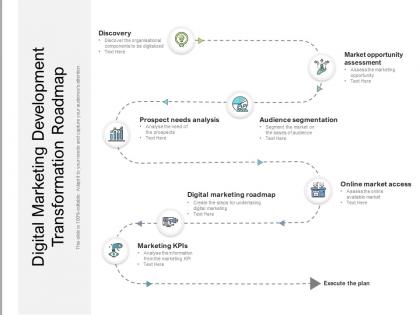
Digital marketing development transformation roadmap




Try Before you Buy Download Free Sample Product
 Impress Your
 Audience
 100%
100% Editable
 Save Hours
 of Time


Identify ideas that are highly feasible with our Digital Marketing Development Transformation Roadmap. Be able to judge different inputs.
People who downloaded this PowerPoint presentation also viewed the following :
Digital marketing development transformation roadmap with all 2 slides:
Be acclaimed as a good judge with our Digital Marketing Development Transformation Roadmap. Impress folks by your insistence on being fair.
FAQs for Digital marketing
Key elements include data analytics integration, customer journey mapping, marketing automation platforms, omnichannel content strategy, and performance measurement frameworks. These components work together by centralizing customer insights, personalizing touchpoints across channels, and optimizing campaign effectiveness, with many organizations finding that strategic integration ultimately delivers improved ROI and enhanced customer experiences.
Organizations measure digital marketing transformation effectiveness through key performance indicators like conversion rates, customer acquisition costs, return on ad spend, engagement metrics, and customer lifetime value. These metrics enable businesses to track campaign performance, optimize resource allocation, and demonstrate ROI across channels, with many companies finding that integrated analytics platforms streamline measurement while delivering actionable insights for strategic decision-making.
Data analytics serves as the foundation of digital marketing transformation by enabling precise audience targeting, campaign optimization, performance measurement, and predictive insights. Through advanced analytics platforms, organizations can track customer journeys, personalize content delivery, and allocate budgets more effectively, with many companies finding that data-driven strategies deliver significantly higher ROI and competitive advantage.
Businesses align digital marketing transformation goals with overall objectives by establishing shared KPIs, integrating customer data across departments, and ensuring marketing initiatives directly support revenue targets and growth strategies. This strategic alignment enables organizations to streamline resource allocation, enhance customer experiences, and accelerate market expansion, with many companies finding that synchronized digital efforts deliver measurable competitive advantage and operational efficiency.
Essential technologies for digital marketing transformation include marketing automation platforms, customer data platforms (CDPs), artificial intelligence and machine learning tools, omnichannel analytics systems, and cloud-based content management solutions. These technologies streamline campaign execution, personalize customer experiences, and optimize resource allocation, with many organizations finding that strategic integration ultimately delivers enhanced targeting capabilities and measurable competitive advantage.
Consumer behaviors significantly shape digital marketing transformation by driving demand for personalized experiences, omnichannel engagement, real-time interactions, and mobile-first strategies. As purchasing patterns shift toward social commerce, voice search, and instant gratification, organizations increasingly adapt their digital frameworks, automation tools, and data analytics capabilities, ultimately delivering more targeted campaigns and enhanced customer experiences across all touchpoints.
Organizations face significant challenges including legacy system integration, employee skill gaps, data silos across platforms, budget constraints, and resistance to cultural change. These obstacles often overwhelm marketing teams transitioning from traditional approaches, with many companies finding that successful transformation requires strategic planning, comprehensive training programs, and phased technology adoption to ultimately deliver streamlined operations and enhanced customer engagement.
Small businesses can leverage digital marketing transformation through social media marketing, content creation, email campaigns, search engine optimization, and local online listings. These cost-effective strategies enable targeted customer engagement, brand visibility, and measurable results, with many small retailers and service providers finding that consistent digital presence ultimately delivers increased sales and competitive advantage without significant upfront investment.
Social media significantly accelerates digital marketing transformation by enabling real-time customer engagement, data-driven personalization, and multi-channel campaign integration. Through social platforms, organizations streamline audience targeting, enhance brand visibility, and automate customer interactions, with many retail and financial services companies finding that social integration delivers faster conversion rates and deeper customer insights, ultimately providing competitive advantage in increasingly digital-first markets.
Personalization enhances digital marketing transformation by delivering targeted content, customized user experiences, and data-driven messaging that resonates with individual customer preferences and behaviors. Through advanced analytics and AI-driven segmentation, organizations across retail, financial services, and healthcare achieve higher engagement rates, improved conversion metrics, and stronger customer loyalty, ultimately delivering competitive advantage in increasingly crowded digital markets.
Marketing teams need data analytics capabilities, content creation expertise, social media proficiency, marketing automation knowledge, and customer experience design skills to navigate digital transformation successfully. These competencies enable organizations to leverage customer insights, create personalized campaigns, and automate processes across multiple channels, with many companies finding that upskilled teams deliver significantly improved ROI and customer engagement.
Businesses maintain authenticity during digital transformation by preserving core brand values across all digital touchpoints, ensuring consistent messaging, and maintaining transparent customer communications. Through strategic content planning and employee training, companies like Patagonia and Ben & Jerry's successfully translate their authentic brand voice into digital channels, ultimately strengthening customer trust and loyalty.
Companies should establish clear KPIs, ensure cross-functional team alignment, implement phased technology rollouts, invest in employee training, and maintain consistent customer messaging throughout the transformation process. These practices enable organizations to minimize disruption while maximizing adoption rates, with many retail and financial services companies finding that structured change management ultimately delivers improved campaign performance and stronger customer engagement.
Cross-functional collaboration is essential for digital marketing transformation, enabling seamless integration between marketing, IT, sales, data analytics, and customer service teams. This strategic alignment streamlines campaign execution, enhances data sharing, and accelerates decision-making processes, with many organizations finding that unified teams deliver significantly improved customer experiences and measurable competitive advantage.
Current trends shaping digital marketing transformation include artificial intelligence-powered personalization, voice search optimization, interactive content formats, omnichannel customer experiences, and privacy-first data strategies. These technologies streamline campaign targeting, enhance customer engagement, and deliver measurable ROI, with many organizations finding that strategic integration across multiple touchpoints ultimately drives competitive advantage in increasingly dynamic markets.
No Reviews