


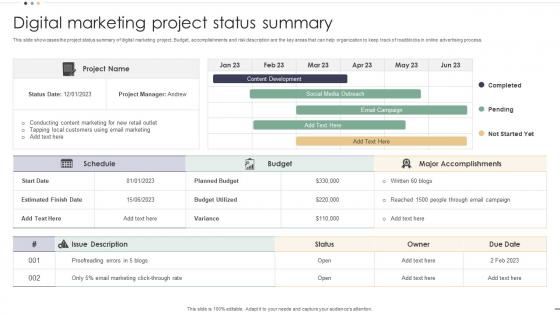
Digital Marketing Project Status Summary




Try Before you Buy Download Free Sample Product
 Impress Your
 Audience
 100%
100% Editable
 Save Hours
 of Time


This slide showcases the project status summary of digital marketing project. Budget, accomplishments and risk description are the key areas that can help organization to keep track of roadblocks in online advertising process.
People who downloaded this PowerPoint presentation also viewed the following :
Digital Marketing Project Status Summary with all 6 slides:
Use our Digital Marketing Project Status Summary to effectively help you save your valuable time. They are readymade to fit into any presentation structure.





FAQs for Digital Marketing
Honestly, skip the vanity stuff like follower counts - they don't pay the bills. Focus on conversion rate, CPA, and ROAS since those actually show if you're making money. Click-through rates and engagement tell you if people care about your content. I'd also watch bounce rate and time on page. If visitors bail immediately, something's wrong with your site. Oh and website traffic obviously matters too. Stick to maybe 5-7 metrics and check weekly. Trust me, tracking more than that just makes you crazy with all the data. Been there.
Pick one day and stick to it - I do Fridays because people actually read them before weekend mode kicks in. Use the same simple format every time: what got done, what's stuck, what's next. Don't just say "making progress" though, that's useless. Give them real numbers - budget, timeline changes, actual deliverable status. Be honest about delays too, they'll appreciate the transparency way more than sugarcoating. Oh, and set up some kind of dashboard they can check themselves so you're not constantly answering "how's it going?" messages.
Honestly, start with something like Asana or Trello - they're lifesavers for tracking all your campaign stuff. Google Analytics is obviously huge for the actual performance data, though fair warning, you'll probably become obsessed with checking it (I definitely do). Slack works great for keeping the team in the loop, especially if you connect it to your project tools. Oh, and if you're doing social, Hootsuite shows engagement as it happens. Pro tip: set up automated reports so you're not manually pulling data every five minutes. Trust me, your sanity will thank you later.
Look, first figure out what actually matters to the business - revenue goals, getting new customers, expanding into new markets, whatever's stressing out the executives. I used to get caught up in vanity metrics like impressions (total waste of time honestly). Every campaign needs to tie back to real business results - lead gen, brand awareness in target markets, keeping customers around. Map your tactics directly to those bigger objectives. Oh and set up regular check-ins with stakeholders to review how you're doing against business goals, not just marketing numbers.
Focus on conversion rates, cost per acquisition, and return on ad spend - those actually tell you if people are buying, not just clicking around. Click-through rates matter too, but honestly? Don't get sucked into vanity metrics like follower count (I've been there lol). Time on page and bounce rate give you decent insights about engagement. The real test is how well you're turning ad dollars into actual revenue. Set your benchmarks before you launch anything, then check performance weekly. Short sentences work. But tracking efficiently separates successful campaigns from money pits.
Honestly, just tackle whatever's blocking other people first - those hard deadlines aren't gonna move. After that, focus on the stuff that'll actually move your KPIs instead of getting lost in the weeds. I always catch myself obsessing over making graphics perfect when I should be nailing down strategy first (so annoying but true). Do your audience research and campaign setup before you even think about creating like 10 different ad variations. Quick tip: make a simple urgent vs important grid and start with the top-right corner. The pretty stuff can wait.
Ugh, don't be that person who says "everything's fine" when your project is literally on fire. Bad news doesn't get better with age, so call out problems early instead of hoping they'll fix themselves (spoiler: they won't). Skip the corporate word salad that makes people's eyes glaze over. Give them real numbers and actual dates they can work with. And seriously, stop burying the important stuff in massive paragraphs - nobody has time to hunt for what actually matters. Your stakeholders need to make decisions, so make it easy for them.
So basically you don't have to wait till everything's done to see if you're screwing up. Set up weekly check-ins where you actually look at your numbers and ask your team what's working. When something's clearly bombing, pivot fast. When it's crushing it, throw more resources at it. Think of it like... I dunno, checking your phone's GPS every few minutes instead of just hoping you're going the right way? Honestly, most people skip this step and then wonder why their campaigns tank. Start small - just review your main metrics once a week and make tiny adjustments.
So analytics is basically how you figure out if your marketing is working or just eating your money. Track stuff like click rates, conversions, how much it costs to get customers - yeah it's a ton of numbers but whatever. This data shows you what's killing it vs what sucks. Honestly, starting campaigns without setting up tracking first is like driving blindfolded. You'll just be guessing which ads work. Oh and don't get scared by all the metrics at first - took me forever to understand half of them. Just focus on the basics and you're good.
Break your project down into specific tasks first - way better than just guessing at the whole thing. I always tack on like 20-30% extra time because clients will definitely find ways to slow things down (feedback loops are the worst). Don't assume your team's free all day either - check their actual availability. Past projects are gold for reference if you've got them. Your team should help with estimates since they know the work better than you do. Oh, and set up checkpoints early so you can pivot when stuff inevitably goes wrong.
Honestly, just start simple and don't go overboard. Slack's perfect for quick team chats - way better than endless email chains. I'd grab Asana for tracking all your campaign deadlines and tasks. Google Docs is a lifesaver when everyone needs to edit stuff at once. Oh, and if you're doing creative work, Figma lets people drop comments right on the designs which saves so much back-and-forth. Zoom's obvious for meetings, but Loom's clutch for recording quick explainer videos when numbers get confusing. Pick one tool per thing though - too many options just stresses everyone out.
ROI is pretty straightforward - take your revenue, divide by what you spent, then multiply by 100. So $3,000 revenue on a $1,000 spend = 200% ROI. The real pain is tracking everything correctly though, especially after all those iOS privacy updates screwed things up. Set up UTM parameters and pixel tracking to follow the customer journey. Connect your CRM too if you can. Oh, and don't just look at immediate sales - lifetime value matters way more for understanding what's actually profitable long-term.
Start with a risk register - basically just list out what could go wrong like budget issues, creative delays, algorithm changes, whatever. Give each one a probability and impact score so you know what's actually worth worrying about. Always build in buffer time and money because trust me, something will definitely break. Regular check-ins help catch stuff early. Have backup plans for the big risks. Oh and document everything as you go - future you will thank you when you need to explain why things took longer or cost more.
Honestly, you've gotta bake flexibility right into your plan from day one. Check market indicators weekly and set trigger points for when you need to pivot - like if competitors make big moves or the economy shifts. COVID taught me this lesson the brutal way when it completely wrecked our strategy! Have backup scenarios already mapped out. I'd keep about 20% of your budget in reserve for quick shifts (learned that one too). Schedule team check-ins every two weeks so you're staying ahead of changes instead of scrambling after they hit. Way better than playing catch-up later.
Honestly, just keep talking to them - even boring weekly updates beat going dark. Trust me, I bombed this once by assuming no news was good news. Wrong move! Get them involved in decisions instead of just dumping reports on them. Set up dashboards they can peek at whenever (saves you from constant "how are we doing?" emails). Always connect your updates to actual business results, not vanity metrics. Oh, and here's the thing - ask what they think about next steps. Don't just tell them your plan. Makes them feel like partners instead of babysitters.
-
They guys always go the extra mile to meet the expectations of their customers. Almost a year has been associated with them.
-
Innovative and creative templates with high-quality designs. Helped me with my presentation as the slides were easy to edit.