


Digital transformation and business transformation good ppt example




Try Before you Buy Download Free Sample Product
 Impress Your
 Audience
 100%
100% Editable
 Save Hours
 of Time


Digital transformation and business transformation are two of the most important topics in business today. As the world becomes more digitized, businesses must adapt or risk becoming obsolete. Digital transformation helps companies keep up with the latest trends and technologies, while business transformation helps them re-evaluate and change their processes and operations to stay competitive.SlideTeam’s digital transformation templates will help you get up to speed on the latest trends and technologies in just minutes. With our easy-to-use tools, you can create high-quality presentations that will help convince your team or clients of the need for change. Download our templates today to get started on your own business transformation journey.
People who downloaded this PowerPoint presentation also viewed the following :
Digital transformation and business transformation good ppt example with all 5 slides:
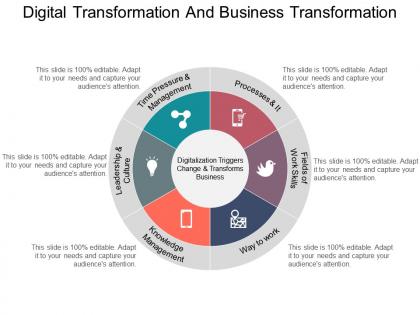
Convince folks to be accommodating with our Digital Transformation And Business Transformation Good Ppt Example. It helps bring about consensus.

FAQs for Digital transformation and business transformation
Honestly, get leadership on board first or you're screwed from the start. Your team needs training - they'll either make this work or totally tank it. Data infrastructure has to be solid too. Build processes around what customers actually want, not what sounds good in meetings. Culture-wise, people gotta be cool with messing up and trying again quickly. Oh, and don't skip change management or everyone will hate you. Start small though - pick one thing to test instead of going crazy trying to fix everything. Way less painful that way.
Look, you gotta track the obvious stuff first - revenue, cost savings, how fast you're getting new customers. Basic operational improvements too. But here's the thing, those numbers don't tell you everything. Employee happiness matters just as much, honestly. Same with customer experience scores and whether you can pivot quickly when the market shifts. Set your baselines before changing anything - that's crucial. Then pick maybe 5-7 metrics that actually align with what you're trying to accomplish. Check them quarterly, not obsessively. Oh, and don't go overboard with data - you'll drown in spreadsheets and miss the bigger picture.
Leadership makes or breaks this stuff, honestly. Without them setting clear vision and backing it with actual budget, you're dead in the water. I've watched so many companies just dump new software on people and wonder why nothing changes - it's painful to see. Your leaders have to be out there showing why this matters, not just talking about it. They need to bulldoze through old processes too, even the ones people are weirdly attached to. Short version: if leadership isn't visibly championing the whole thing and clearing roadblocks, don't expect much.
Honestly, most change management fails because people feel blindsided. Get everyone involved early - don't just announce what's happening. Explain why this helps *them*, not just the business (learned this the hard way lol). Give proper training instead of dumping new systems on people overnight. Find a few enthusiastic people in each team to champion the changes. The big thing though? Actually listen when people push back. They usually have valid points. Nobody likes feeling powerless, so make them part of building the solution. Oh, and patience - rushing this stuff never works.
Honestly, the biggest pain is people just hating change - your team will fight you on everything. Budget's always tight too, and those ancient legacy systems? Total money pit but you can't just rip them out. Data silos drive me crazy - marketing can't talk to sales, sales can't talk to ops, it's a mess. Plus there's like a million tech options and they all claim to be "game-changing." My advice? Don't try to boil the ocean. Pick one small thing, actually make it work, then build from there. Way less overwhelming.
Honestly, stop thinking of data as just an IT headache - it's way more strategic than that. Get your governance sorted first (who owns what, access rules, data flows between systems). But here's the thing - don't go crazy trying to fix everything at once. Pick one project that'll actually move the needle and prove this stuff works. Clean data quality is huge because fixing garbage later? Total nightmare and costs a fortune. Oh, and make sure your team can actually read the insights you're creating. What's the point otherwise, right?
Honestly, start with cloud and data analytics - that's your bread and butter right there. Automation tools are clutch too. Everyone's going crazy over AI/ML stuff (and yeah, some of it's actually worth the hype). You absolutely need solid cybersecurity because one breach and you're screwed. Mobile platforms and APIs help everything talk to each other, which sounds boring but is super important. IoT might matter depending on what you do. Oh, and don't just chase whatever's trendy - figure out what you actually need first, then build from there.
Honestly, treat customer feedback like your GPS during digital transformation. Don't wait until the end to ask what people think - that's when fixes get super expensive. I swear, half the companies I know build these "revolutionary" features that nobody actually wants lol. Set up surveys and user testing early so you can pivot fast when something isn't working. Analytics help too, but real user conversations tell you way more. Pick your customers' biggest 3 pain points and start there. Way better than guessing what'll make them happy.
So basically when you go digital, you're opening up tons of new ways for hackers to get in - cloud stuff, IoT devices, everyone working from home now. Traditional security just doesn't cut it anymore. You need that zero-trust thing where you're constantly checking who's accessing what. All your data's flying around everywhere too, so encryption becomes huge. It's honestly like playing whack-a-mole sometimes - fix one thing, another pops up. Build security right into whatever you're doing from the start. Trying to add it later? Total nightmare and way more expensive.
Honestly, it changes everything about how teams function. People collaborate way more through digital tools, and decisions happen faster since everyone can access the data they need. Some employees absolutely love having that kind of power at their fingertips. Others? Not so much - there's always pushback with change. But here's the thing: when you actually include people in planning the transformation instead of just throwing new software at them, engagement goes through the roof. Work becomes less of a hassle and more meaningful. I mean, nobody wants to feel like technology is happening TO them, you know?
Honestly, AI and IoT are what actually make digital transformation work instead of just being buzzwords. Your IoT sensors collect real-time data from equipment, then AI analyzes it to predict when stuff's gonna break or optimize your supply chain automatically. It's like finally connecting your physical operations to your digital systems so they can talk to each other. The whole thing bridges that gap between doing everything manually and having smart, connected workflows. My advice? Don't try to overhaul everything at once - just pick one annoying process you're already dealing with and see how these technologies can fix it.
First things first - audit what you've got so you know exactly what mess you're dealing with. APIs and middleware are your best friends here; they'll bridge old and new systems without the nightmare of ripping everything out at once. Focus on whatever gives you the biggest business win first. Always run systems in parallel during switches so you don't totally screw yourself if something goes sideways (learned that one the hard way). Get IT and business folks on the same page about timelines early - I swear miscommunication tanks these projects way more than actual tech problems. Oh, and document everything religiously.
Start with whatever eats up most of your time - that's where you'll actually see results. Google Workspace and Canva are solid starting points without breaking the bank. Don't make the mistake I've seen tons of small biz owners make by buying fancy software they never touch. Pick one thing, get everyone used to it, then move on. Cloud stuff is great because it grows with you (plus no IT headaches). Oh, and definitely ask your team what's actually broken - they're the ones dealing with these processes daily and know what needs fixing first.
GDPR and data privacy stuff is the big headache - also consent management. Your AI systems can't be biased against certain groups, which is trickier than it sounds. Employment law gets messy when you're automating jobs away. Get HR involved early, trust me on that one. Don't forget accessibility compliance and cybersecurity regs. Transparency about customer data usage is non-negotiable. The ethical side of AI decision-making is honestly where most companies screw up. Talk to legal before you build anything, not after.
Honestly, going digital with your supply chain is pretty wild - you get real-time tracking of everything from inventory to shipments. Way better than constantly reacting to problems after they hit. Machine learning helps predict demand (though it's not perfect, obviously), and automation cuts down on warehouse mistakes. The cool part is you can actually pivot fast when stuff goes sideways. My advice? Start small with your most critical processes first. Don't go crazy trying to overhaul everything at once - that's how you end up with a mess.
-
Easily Understandable slides.
-
Very unique, user-friendly presentation interface.