


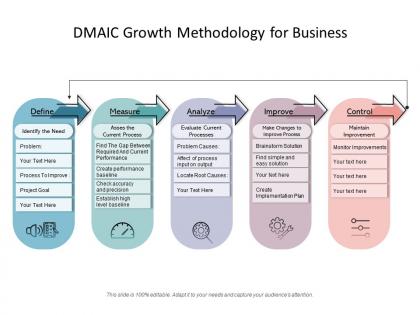
Dmaic growth methodology for business




Try Before you Buy Download Free Sample Product
 Impress Your
 Audience
 100%
100% Editable
 Save Hours
 of Time


Build glamorous aspirations with our DMAIC Growth Methodology For Business. They combine beauty and brains.
People who downloaded this PowerPoint presentation also viewed the following :
Dmaic growth methodology for business with all 2 slides:
Beauty and brains harmonize on our DMAIC Growth Methodology For Business. They ensure brilliant fashion.
FAQs for Dmaic growth
The DMAIC process comprises five interconnected phases: Define (problem identification and project scope), Measure (baseline data collection), Analyze (root cause identification), Improve (solution implementation), and Control (sustainability measures). These phases work sequentially, with each building upon previous insights, enabling organizations to systematically eliminate defects, reduce variation, and achieve measurable process improvements while maintaining long-term operational excellence.
DMAIC adapts effectively to service industries by focusing on process standardization, customer experience metrics, and workflow optimization rather than physical defect reduction. While manufacturing emphasizes tangible quality control, service sectors like healthcare, banking, and hospitality leverage DMAIC to streamline customer interactions, reduce service delivery times, and enhance satisfaction scores, ultimately delivering competitive advantage through consistent service excellence.
Common pitfalls include inadequate problem definition, insufficient data collection, rushing through phases, lack of stakeholder buy-in, and poor change management practices. Organizations often struggle with maintaining project momentum, selecting inappropriate metrics, or failing to sustain improvements long-term, with many companies finding that thorough training and leadership commitment significantly enhance DMAIC success rates.
DMAIC project success is defined through specific, measurable outcomes that address the original problem statement, typically including cost reduction, quality improvements, cycle time decreases, or customer satisfaction gains. Organizations measure success by comparing baseline metrics to post-implementation results, with many manufacturing and service companies finding that 20-30% improvement in key performance indicators demonstrates project effectiveness and strategic value.
**INPUT**: What tools and techniques can enhance each phase of the DMAIC process? **OUTPUT**: DMAIC phases benefit from statistical process control, root cause analysis, control charts, process mapping, and regression analysis techniques. These methodologies streamline operations by identifying bottlenecks, measuring performance gaps, and implementing sustainable solutions, with manufacturing and healthcare organizations finding that systematic application ultimately delivers reduced defects and enhanced operational efficiency. [Word count: 52 words]
DMAIC serves as Six Sigma's core problem-solving methodology, providing the structured Define, Measure, Analyze, Improve, Control framework that guides quality improvement projects from identification through sustainment. This systematic approach enables organizations to achieve Six Sigma's ultimate goal of reducing defects to 3.4 per million opportunities, with manufacturing, healthcare, and financial services finding that DMAIC's disciplined structure delivers measurable results and sustainable process improvements.
DMAIC effectively translates to non-manufacturing sectors like healthcare, financial services, and retail by focusing on process improvement rather than physical production. Banks use it for loan approval streamlining, hospitals for patient flow optimization, and service companies for customer experience enhancement, ultimately delivering operational efficiency and competitive advantage across diverse organizational functions.
Data analysis serves as the foundation for both Measure and Analyze phases, involving baseline performance measurement, process capability assessment, statistical analysis, and root cause identification. Through comprehensive data collection and advanced analytical techniques, organizations can quantify current state performance, identify process variations, and pinpoint improvement opportunities, ultimately enabling data-driven decisions that enhance operational efficiency and deliver measurable business outcomes.
Gathering sufficient data for the Define phase involves collecting customer feedback, historical performance metrics, process documentation, stakeholder interviews, and operational reports. These data sources help organizations clearly articulate the problem scope, establish baseline measurements, and define project boundaries, with many teams finding that comprehensive upfront data collection ultimately streamlines subsequent analysis phases.
Stakeholder engagement strategies include regular communication updates, involving key personnel in problem definition, establishing cross-functional project teams, providing DMAIC training to relevant staff, and creating feedback loops at each phase. These approaches streamline buy-in by ensuring transparency, shared ownership, and collaborative problem-solving, with many organizations finding that early stakeholder involvement ultimately delivers faster implementation and sustained process improvements.
DMAIC contributes to continuous improvement by establishing a structured methodology for identifying problems, measuring performance gaps, analyzing root causes, implementing solutions, and controlling processes to sustain gains. Through this systematic approach, organizations streamline operations, reduce defects, and enhance customer satisfaction, with many companies finding that regular DMAIC cycles ultimately deliver measurable cost savings and operational excellence.
DMAIC focuses on improving existing processes through Define, Measure, Analyze, Improve, and Control phases, while DMADV creates new processes using Define, Measure, Analyze, Design, and Verify phases. DMAIC optimizes current operations by identifying inefficiencies and implementing targeted improvements, whereas DMADV develops entirely new systems, with organizations increasingly leveraging both methodologies to enhance operational excellence.
Projects are prioritized through business impact assessment, resource availability analysis, strategic alignment evaluation, and ROI potential measurement. Organizations typically focus on initiatives addressing critical customer pain points, operational bottlenecks, and cost reduction opportunities, with many finding that projects delivering measurable financial benefits within six months create the strongest foundation for sustained DMAIC adoption.
Root cause analysis within DMAIC's Analyze phase is crucial because it identifies the fundamental sources of process variations and defects, rather than merely addressing symptoms. Through statistical analysis, fishbone diagrams, and hypothesis testing, organizations systematically uncover underlying issues affecting quality, with many manufacturing and service companies finding that proper root cause identification reduces problem recurrence by 70-80%, ultimately delivering sustainable improvements and competitive advantage.
Team dynamics significantly impact DMAIC project effectiveness by influencing collaboration quality, problem-solving depth, and implementation success rates across all five phases. Strong team dynamics enable diverse expertise integration, accelerate root cause identification, and streamline solution development, while poor dynamics create communication barriers, delay decision-making, and reduce stakeholder buy-in, ultimately determining whether organizations achieve sustainable process improvements.
No Reviews