


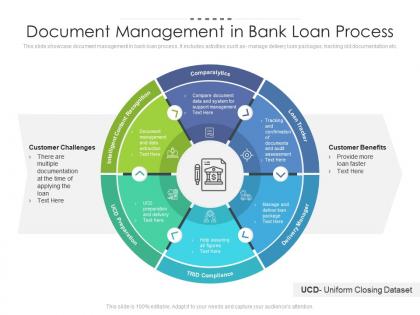
Document management in bank loan process




Try Before you Buy Download Free Sample Product
 Impress Your
 Audience
 100%
100% Editable
 Save Hours
 of Time


This slide showcase document management in bank loan process. It includes activities such as manage delivery loan packages, tracking old documentation etc.
People who downloaded this PowerPoint presentation also viewed the following :
Document management in bank loan process with all 2 slides:
Use our Document Management In Bank Loan Process to effectively help you save your valuable time. They are readymade to fit into any presentation structure.

FAQs for Document management in
Document management streamlines bank loan processes by automating document collection, verification, and storage while reducing manual handling and processing delays. Through digital systems, banks accelerate loan approvals, minimize compliance risks, and enhance customer experiences, with many financial institutions finding that automated workflows reduce processing times by 60-70% while improving accuracy.
Banks ensure regulatory compliance through automated document workflows, real-time audit trails, standardized templates, encrypted storage systems, and integrated compliance monitoring tools. These technologies streamline adherence to regulations like Basel III and GDPR by automatically flagging missing documentation, maintaining detailed access logs, and enabling instant regulatory reporting, ultimately reducing compliance risks while accelerating loan processing timelines.
Common challenges in document management during loan approval include incomplete documentation, version control issues, manual verification delays, compliance tracking difficulties, and poor interdepartmental communication. These obstacles significantly slow approval timelines and increase operational costs, with many banks finding that streamlined digital workflows reduce processing time by 60-70% while enhancing regulatory compliance and customer satisfaction.
Digital transformation revolutionizes bank document management by automating processing workflows, enabling real-time verification, and integrating systems across departments for seamless information flow. Through cloud-based platforms and AI-powered analysis, banks streamline loan approvals, reduce processing times, and enhance compliance tracking, ultimately delivering faster customer services and operational efficiency while minimizing manual errors.
Critical loan application documents include financial statements, tax returns, bank statements, employment verification letters, and credit reports. These documents enable banks to assess creditworthiness, verify income stability, and evaluate repayment capacity through comprehensive financial analysis, with many financial institutions finding that streamlined document collection significantly accelerates approval timelines while maintaining rigorous risk assessment standards.
Automated document management systems revolutionize loan processing by digitizing paperwork, streamlining verification workflows, and enabling real-time collaboration between departments. These technologies significantly reduce processing times from weeks to days, minimize manual errors, and enhance regulatory compliance, with many banks finding that automated systems deliver faster loan approvals and improved customer experiences while reducing operational costs.
Banks should adopt end-to-end encryption, role-based access controls, automated backup systems, audit trail monitoring, and compliance-ready archival solutions for secure document management. These practices streamline loan processing by reducing retrieval times, ensuring regulatory compliance, and minimizing security breaches, with many financial institutions finding that strategic document workflows ultimately deliver faster loan approvals and enhanced customer experiences.
Document management significantly influences customer experience by streamlining application processes, reducing approval times, and minimizing paperwork burdens through digital submission and automated verification systems. Banks implementing comprehensive document management find that customers experience faster loan decisions, transparent status tracking, and seamless communication, ultimately delivering enhanced satisfaction and competitive advantage in financial services.
Integrating electronic signatures in bank loan processes delivers faster approvals, reduced operational costs, enhanced customer experience, improved compliance tracking, and streamlined document workflows. Financial institutions utilizing e-signature technology report significantly shorter loan processing times, decreased paper handling expenses, and higher customer satisfaction rates, while maintaining robust security standards and audit trails that ultimately strengthen their competitive position in digital banking.
Banking document management relies on optical character recognition (OCR), cloud-based storage platforms, automated workflow systems, digital signature technologies, and AI-powered document processing solutions. These technologies streamline loan processing by extracting data automatically, enabling secure remote access, and reducing manual verification time, with many financial institutions finding that integrated systems deliver faster loan approvals and enhanced customer experiences.
Banks leverage data analytics in document management by analyzing patterns in loan applications, automating risk assessment through document verification algorithms, and identifying inconsistencies across borrower submissions. Through machine learning models, financial institutions can predict default probabilities more accurately, streamline approval processes, and enhance fraud detection capabilities, ultimately delivering faster loan decisions and improved portfolio performance.
Banks should implement end-to-end encryption, multi-factor authentication, role-based access controls, regular security audits, and compliance with regulations like GDPR and PCI DSS. These measures streamline loan processing while protecting sensitive financial data, with many financial institutions finding that robust security frameworks ultimately enhance customer trust and operational efficiency.
Document version control significantly affects loan processing accuracy by ensuring loan officers work with current financial statements, updated credit reports, and latest application documents, preventing decisions based on outdated information. Through automated version tracking systems, banks streamline document workflows, reduce processing errors, and maintain regulatory compliance, with many financial institutions finding that proper version control accelerates loan approvals while minimizing risk exposure.
Bank staff require training in system navigation, document classification protocols, compliance requirements, workflow automation, and security procedures. Comprehensive programs should cover loan-specific processes like application tracking, document verification, and audit trail management, with many financial institutions finding that hands-on practice with real scenarios enhances adoption and operational efficiency.
Document management systems facilitate communication between borrowers and lenders by providing centralized platforms for real-time document sharing, automated status updates, and secure messaging capabilities. These systems streamline interactions through instant notifications, version control, and mobile accessibility, enabling faster loan approvals while reducing back-and-forth communications, ultimately delivering enhanced transparency and improved customer experiences throughout the lending process.
-
Enough space for editing and adding your own content.
-
Best way of representation of the topic.
-
Out of the box and creative design.