


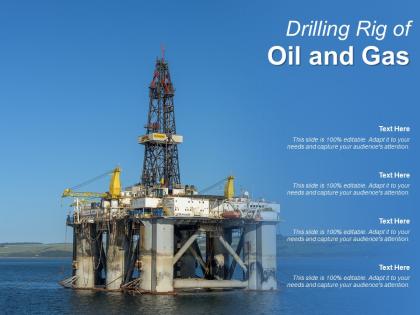
Drilling rig of oil and gas




Try Before you Buy Download Free Sample Product
 Impress Your
 Audience
 100%
100% Editable
 Save Hours
 of Time


Did you know that 90% of people present at a presentation would rather listen than read? Therefore you have to create powerful presentations using few words and that?s what professionally designed Drilling Rig Of Oil And Gas do.
People who downloaded this PowerPoint presentation also viewed the following :
Drilling rig of oil and gas with all 6 slides:
Assess the effort of individuals involved with our Drilling Rig Of Oil And Gas. Be able to analyze the journal.





FAQs for Drilling rig of
**INPUT**: What are the main components of a drilling rig and their functions? **OUTPUT**: Main drilling rig components include the derrick for supporting drill strings, rotary table for turning operations, mud pumps for circulation, blowout preventers for safety control, and power systems for operational energy. These integrated systems streamline extraction processes by enabling precise depth control, maintaining wellbore stability, and ensuring operational safety, with energy companies finding that modern automated rigs significantly enhance drilling efficiency and reduce operational costs. **Word count**: 60 words
Drilling rigs vary significantly in design based on their operational environment and drilling depth requirements, including land-based rotary rigs, offshore platform rigs, jack-up rigs, and mobile truck-mounted units. These specialized configurations enable energy companies to optimize extraction efficiency across diverse geological conditions, from shallow onshore wells to deep-water offshore reserves, ultimately delivering enhanced operational flexibility and resource accessibility.
Drilling rig safety measures include blowout preventers, gas detection systems, emergency shutdown procedures, personal protective equipment, and comprehensive safety training programs. These protocols enhance worker protection by minimizing explosion risks, preventing falls, ensuring proper equipment handling, and maintaining emergency preparedness, with offshore and onshore operations finding that rigorous safety implementations significantly reduce accidents while improving operational efficiency and regulatory compliance.
The choice of drilling rig significantly impacts extraction efficiency by determining drilling speed, depth capabilities, and operational precision across various geological formations. Modern rigs equipped with advanced automation and rotary systems enable faster penetration rates, reduced downtime, and enhanced safety protocols, with offshore and unconventional shale operations finding that strategic rig selection ultimately delivers lower operational costs and higher production yields.
Environmental considerations for drilling rigs include air emissions, water contamination risks, soil disruption, noise pollution, and waste management challenges. These impacts require comprehensive mitigation strategies through advanced filtration systems, containment protocols, and restoration practices, with many energy companies finding that proactive environmental management ultimately delivers regulatory compliance, community acceptance, and sustainable operational advantages.
Technology revolutionizes modern drilling rig operations through automated drilling systems, real-time data analytics, remote monitoring platforms, predictive maintenance tools, and advanced safety sensors. These innovations streamline operations by reducing human error, optimizing drilling parameters, and minimizing downtime, with many oil and gas companies finding that technological integration ultimately delivers faster drilling times, lower operational costs, and enhanced worker safety.
Drilling rigs are maintained through scheduled inspections, preventive maintenance protocols, real-time monitoring systems, component replacement programs, and rigorous safety checks to minimize downtime and operational risks. Oil and gas companies increasingly implement predictive maintenance technologies and digital monitoring platforms, enabling proactive repairs, extending equipment lifespan, and ultimately delivering enhanced drilling efficiency and reduced operational costs.
Drilling rig location selection depends on geological surveys, resource accessibility, environmental regulations, infrastructure proximity, and transportation logistics. These factors work together to ensure operational efficiency and cost-effectiveness, with many oil and gas companies finding that strategic positioning near existing pipelines, roads, and processing facilities significantly reduces project timelines and delivers competitive advantages in resource extraction markets.
Automation has revolutionized drilling rig operations by enabling remote monitoring, automated pipe handling, real-time data analysis, and predictive maintenance systems. Through advanced sensors and AI-driven controls, oil and gas companies streamline drilling processes, reduce human error, and enhance safety protocols, while significantly minimizing operational costs and delivering faster, more precise drilling operations.
Common drilling challenges include equipment failures, wellbore instability, fluid circulation issues, formation pressure complications, and environmental hazards. These operational difficulties can be minimized through advanced monitoring systems, predictive maintenance protocols, and real-time data analysis, with many drilling companies finding that proactive risk management ultimately delivers reduced downtime and enhanced safety performance.
Drilling rigs adapt to geological formations through advanced rotary systems, specialized drill bits, adjustable weight-on-bit controls, and real-time formation monitoring technologies. These systems enable operators to modify drilling parameters, bit selection, and mud composition based on rock hardness and formation characteristics, with offshore and onshore operations finding that adaptive drilling significantly reduces operational costs while enhancing extraction efficiency.
Recent drilling rig design trends include automated drilling systems, enhanced safety technologies, modular construction, digital monitoring capabilities, and environmental compliance features. These innovations streamline operations by reducing manual intervention, minimizing downtime, and optimizing resource extraction, with many oil and gas companies finding that modern rigs deliver significantly improved efficiency and regulatory compliance.
Crew training and management significantly enhance drilling rig effectiveness by ensuring operational safety, reducing equipment downtime, and optimizing drilling performance through skilled personnel deployment. Well-trained crews in oil and gas operations deliver faster drilling times, fewer accidents, and improved resource extraction efficiency, with many offshore and onshore operators finding that comprehensive training programs ultimately reduce operational costs while maximizing productivity.
Drilling rig operations create significant economic opportunities through job creation, increased tax revenue, local business growth, and infrastructure development in host communities. However, these benefits often come with considerations around environmental impact and resource dependency, with many rural communities finding that strategic planning and diversification help maximize long-term economic advantages while minimizing potential risks.
Regulations and compliance significantly impact drilling rig operations by mandating strict safety protocols, environmental protection measures, and operational standards that vary across jurisdictions. These requirements influence equipment specifications, crew training, waste management, and reporting procedures, with offshore operators finding that compliance costs can represent substantial operational expenses while ultimately delivering enhanced safety records, reduced environmental liability, and improved access to international markets.
No Reviews