


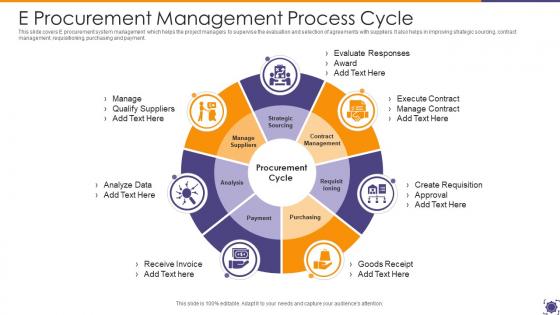
E Procurement Management Process Cycle




Try Before you Buy Download Free Sample Product
 Impress Your
 Audience
 100%
100% Editable
 Save Hours
 of Time


This slide covers E procurement system management which helps the project managers to supervise the evaluation and selection of agreements with suppliers. It also helps in improving strategic sourcing, contract management, requisitioning, purchasing and payment.
People who downloaded this PowerPoint presentation also viewed the following :
E Procurement Management Process Cycle with all 6 slides:
Use our E Procurement Management Process Cycle to effectively help you save your valuable time. They are readymade to fit into any presentation structure.





FAQs for E Procurement
E-procurement delivers cost reduction, enhanced supplier visibility, streamlined approval workflows, improved compliance tracking, and faster procurement cycles. Through automated processes and centralized platforms, organizations achieve 15-20% cost savings, reduce processing time by days, and gain real-time spend analytics, with many enterprises finding that strategic supplier relationships and operational efficiency ultimately provide significant competitive advantage.
E-procurement enhances supplier relationship management by centralizing vendor data, automating communication workflows, and providing real-time performance analytics. Through digital platforms, organizations streamline contract negotiations, track delivery metrics, and maintain transparent payment processes, while enabling suppliers to access order histories and forecasts, ultimately fostering stronger partnerships and reducing procurement cycle times.
Common e-procurement transition challenges include data migration complexities, employee resistance to new workflows, supplier onboarding difficulties, system integration issues, and process standardization requirements. While organizations initially face training costs and temporary productivity dips, many find that addressing these challenges systematically through phased implementation and stakeholder engagement ultimately delivers streamlined operations and enhanced procurement efficiency.
E-procurement improves compliance by automating approval workflows, maintaining detailed audit trails, and enforcing standardized procurement policies across all transactions. Through digital documentation and real-time monitoring, organizations can ensure regulatory adherence, reduce manual errors, and generate comprehensive reports for auditors, ultimately delivering greater transparency and minimizing compliance risks.
Data analytics enhances e-procurement by identifying spending patterns, supplier performance trends, contract compliance gaps, and cost-saving opportunities across organizational purchasing activities. Through predictive analytics and real-time dashboards, procurement teams streamline vendor selection, negotiate better terms, and reduce maverick spending, with many organizations finding significant cost reductions and improved supplier relationships.
E-procurement contributes to cost savings by automating manual processes, reducing paperwork costs, and enabling better supplier negotiations through data analytics. Through digital platforms, organizations streamline approval workflows, minimize administrative overhead, and leverage bulk purchasing opportunities, with many companies finding that automated procurement reduces processing costs by 20-30% while accelerating purchase cycles.
Organizations should prioritize features like automated approval workflows, supplier management capabilities, spend analytics and reporting, integration with existing ERP systems, and comprehensive audit trails when selecting e-procurement software. These features streamline purchasing processes by reducing manual tasks, enhancing supplier relationships, and providing real-time visibility into spending patterns, ultimately delivering cost savings and operational efficiency across the organization.
E-procurement systems enhance inventory management by providing real-time visibility into stock levels, automating reorder points, and integrating supplier data with demand forecasting algorithms. Through predictive analytics and automated workflows, organizations streamline procurement cycles, reduce carrying costs, and minimize stockouts, with many retailers and manufacturers finding that these systems deliver improved cash flow and operational efficiency.
E-procurement significantly enhances sustainability and ethical sourcing by providing enhanced transparency, automated compliance monitoring, comprehensive supplier verification, and detailed environmental tracking throughout supply chains. Through digital platforms, organizations streamline ethical supplier selection, reduce paper waste, monitor carbon footprints, and ensure fair labor practices, with many companies finding that these systems deliver measurable environmental benefits while strengthening stakeholder trust.
Small businesses can leverage e-procurement for competitive advantage by accessing wider supplier networks, automating purchasing processes, and gaining better spend visibility typically reserved for larger enterprises. Through digital platforms, smaller companies streamline procurement cycles, negotiate better pricing through supplier comparison tools, and reduce administrative costs, ultimately enabling them to compete more effectively with established market players.
E-procurement automates purchasing through digital platforms, electronic catalogs, and online workflows, while traditional procurement relies on manual processes, paper documentation, and phone-based communications. Through automated approvals and real-time tracking, organizations streamline vendor management, reduce processing times, and enhance spend visibility, with many companies finding that digital transformation delivers significantly lower administrative costs and better compliance oversight.
Organizations ensure user adoption of e-procurement tools through comprehensive training programs, intuitive interface design, change management support, and clear communication of benefits like streamlined workflows and faster approvals. These strategies enhance engagement by addressing user concerns, providing ongoing support, and demonstrating tangible value, with many companies finding that early user involvement in system design and regular feedback collection ultimately delivers higher adoption rates and improved procurement efficiency.
Essential security measures for e-procurement include multi-factor authentication, data encryption, role-based access controls, regular security audits, and secure vendor portals. These technologies protect sensitive procurement data by preventing unauthorized access, securing financial transactions, and maintaining compliance standards, with many organizations finding that comprehensive security frameworks ultimately reduce fraud risks while enabling faster, more transparent procurement processes.
E-procurement facilitates collaboration by providing centralized platforms where purchasing, finance, operations, and legal teams can access shared workflows, real-time data, and standardized approval processes. These digital systems streamline communication through automated notifications, collaborative vendor evaluations, and transparent procurement tracking, enabling teams to coordinate more effectively while reducing bottlenecks and improving decision-making speed.
Current trends shaping e-procurement technology include AI-powered supplier matching, blockchain for supply chain transparency, cloud-based platforms, mobile procurement apps, and advanced analytics dashboards. These innovations streamline vendor selection, enhance contract compliance, and automate routine purchasing decisions, with many organizations finding that integrated AI and analytics deliver faster procurement cycles and significantly improved cost management across global operations.
-
Superb! The innovative and inspiring template designs provide an edge to the presentation.
-
Kudos to SlideTeam for achieving the high success rate in delivering the top-notch slides.