


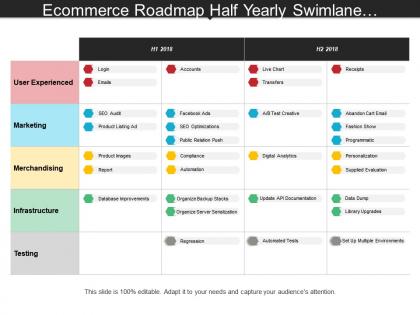
Ecommerce roadmap half yearly swimlane showing accounts live chat digital analytics




Try Before you Buy Download Free Sample Product
 Impress Your
 Audience
 100%
100% Editable
 Save Hours
 of Time


Stimulate to new and inspiring dawn with our e-commerce roadmap half yearly swimlane showing accounts live chat digital analytics PPT layout. They allow you to get firmly back on your feet. Through a swimlane process, we have spread a PowerPoint sheet to demonstrate your half-yearly, live chat digital analytics. Two columns shown here represent the biannual performance of your e-commerce road map. Five parameters are shown in the rows as, user experience, marketing, merchandising, infrastructure, testing. Engaging, colorful dots are shown here to validate important points. Establish your credentials and double your growth. We are here to support you satisfy and enroll your audience with our pre-designed stock. Identify and evaluate the potential effects and conceptualize your ideas with our e-commerce roadmap half yearly swimlane showing accounts live chat digital analytics PPT layout. Awaken to a fresh and exciting dawn with our Ecommerce Roadmap Half Yearly Swimlane Showing Accounts Live Chat Digital Analytics. Get firmly back on your feet.
People who downloaded this PowerPoint presentation also viewed the following :
Ecommerce roadmap half yearly swimlane showing accounts live chat digital analytics with all 5 slides:
Our Ecommerce Roadmap Half Yearly Swimlane Showing Accounts Live Chat Digital Analytics ensure you don't freeze. They enable a continuous flow.



FAQs for Ecommerce roadmap half yearly swimlane showing accounts live
Essential components of an effective eCommerce roadmap include customer journey mapping, technology infrastructure planning, inventory management systems, payment gateway integration, and performance analytics frameworks. These elements work together by streamlining operations, enhancing user experiences, and enabling scalable growth, with many retailers finding that comprehensive roadmaps deliver faster market entry and sustained competitive advantage.
Businesses align eCommerce strategy with company goals by establishing clear KPIs, integrating digital initiatives with existing operations, and ensuring technology investments support broader objectives like market expansion or customer retention. Through strategic planning frameworks, companies streamline resource allocation, enhance cross-channel experiences, and leverage data analytics, ultimately delivering measurable growth and competitive advantage across all business units.
Customer feedback serves as a critical foundation for eCommerce roadmap development, directly influencing product features, user experience enhancements, payment options, mobile functionality, and customer service improvements. Through systematic analysis of reviews, surveys, and behavioral data, retailers can prioritize development initiatives that address real pain points, ultimately delivering higher conversion rates and customer satisfaction while maintaining competitive advantage.
Data analytics enhances eCommerce decision-making by providing customer behavior insights, sales pattern analysis, inventory optimization data, and market trend identification. Through predictive analytics and real-time dashboards, retailers streamline product recommendations, personalize marketing campaigns, and optimize pricing strategies, ultimately delivering improved customer experiences and increased revenue growth.
Emerging technologies for eCommerce roadmaps include artificial intelligence for personalization, augmented reality for virtual try-ons, voice commerce, blockchain for secure transactions, and IoT for inventory management. These technologies streamline customer experiences, automate operations, and enhance decision-making capabilities, with many retailers finding that strategic implementation delivers competitive advantages and significantly improved conversion rates.
Market research informs eCommerce feature prioritization by identifying customer pain points, analyzing competitor gaps, tracking user behavior patterns, and validating demand for specific functionalities. Through surveys, analytics, and user testing, retailers can strategically allocate resources to high-impact features like personalized recommendations or streamlined checkout processes, ultimately delivering enhanced customer experiences and increased conversion rates.
Common eCommerce roadmap pitfalls include overcomplicating initial phases, ignoring mobile optimization, underestimating integration complexities, neglecting user experience testing, and failing to plan for scalability. These oversights often derail projects through delayed launches, budget overruns, and poor customer adoption, with many retailers finding that phased approaches and continuous user feedback streamline development while delivering sustainable growth.
Businesses can incorporate sustainability into their eCommerce strategy through eco-friendly packaging, carbon-neutral shipping options, sustainable product sourcing, green supply chain management, and transparent environmental reporting. These initiatives enhance brand reputation while reducing operational costs, with many retailers finding that sustainable practices attract environmentally conscious consumers, ultimately delivering competitive advantage and improved customer loyalty.
Essential eCommerce roadmap KPIs include conversion rates, customer acquisition costs, average order value, customer lifetime value, and cart abandonment rates. These metrics enable organizations to measure progress by tracking revenue growth, optimizing marketing spend, and enhancing user experience, with many retailers finding that consistent KPI monitoring ultimately delivers improved profitability and competitive advantage.
Mobile optimization is critically important in eCommerce roadmaps, as mobile commerce accounts for over 50% of online sales, requiring responsive design, fast loading speeds, and streamlined checkout processes. This strategic focus enables retailers to capture growing mobile traffic, reduce cart abandonment rates, and deliver seamless customer experiences, ultimately driving higher conversion rates and competitive advantage.
Customer retention strategies in eCommerce include personalized email campaigns, loyalty reward programs, targeted product recommendations, seamless customer service experiences, and subscription-based offerings. These approaches enhance retention by delivering tailored shopping experiences, incentivizing repeat purchases, and building long-term relationships, with many retailers finding that personalized engagement significantly increases customer lifetime value and competitive advantage.
eCommerce businesses can integrate multiple sales channels by establishing unified inventory management, consistent brand messaging, synchronized customer data systems, and centralized order processing workflows. Through omnichannel platforms, retailers streamline operations across online stores, marketplaces, social media, and physical locations, while maintaining seamless customer experiences and optimized fulfillment strategies, ultimately delivering enhanced operational efficiency and competitive advantage.
Best practices for managing inventory and supply chain in an eCommerce plan include demand forecasting, automated inventory tracking, supplier diversification, real-time analytics, and integrated logistics platforms. These approaches streamline operations by reducing stockouts, minimizing carrying costs, and enhancing delivery speed, with many retailers finding that strategic inventory optimization ultimately delivers improved customer satisfaction and competitive advantage.
Businesses should adapt their eCommerce roadmap by continuously monitoring consumer behavior, implementing flexible technology architectures, diversifying sales channels, and prioritizing mobile-first experiences. Through agile development methodologies and data-driven decision making, companies can pivot strategies quickly, optimize customer journeys, and integrate emerging technologies, ultimately maintaining competitive advantage while delivering enhanced shopping experiences across retail, fashion, and consumer goods sectors.
User experience drives eCommerce success by influencing conversion rates, customer retention, and brand loyalty, making it central to strategic roadmap development. A UX-focused roadmap prioritizes intuitive navigation, streamlined checkout processes, and mobile optimization, with retailers like Amazon and Shopify demonstrating how seamless experiences ultimately deliver higher sales and competitive advantage.
-
Use of icon with content is very relateable, informative and appealing.
-
Presentation Design is very nice, good work with the content as well.