


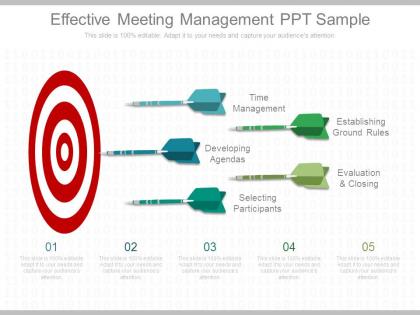
Effective meeting management ppt sample




Try Before you Buy Download Free Sample Product
 Impress Your
 Audience
 100%
100% Editable
 Save Hours
 of Time


You have some wonderful concepts. Put them on air with our Effective Meeting Management Ppt Sample.
People who downloaded this PowerPoint presentation also viewed the following :
Effective meeting management ppt sample with all 7 slides:
Our Effective Meeting Management Ppt Sample cultivate customers. Their belief in you will begin to germinate.

FAQs for Effective meeting
Effective meeting agendas include clear objectives, specific time allocations, detailed topic descriptions, designated speakers or facilitators, and actionable outcomes expected from each discussion point. These components streamline meeting flow by eliminating ambiguity, maintaining focus, and ensuring productive participation, with many organizations finding that structured agendas reduce meeting duration while significantly enhancing decision-making efficiency.
Technology enhances meeting productivity through video conferencing platforms, collaborative document sharing, real-time polling tools, automated scheduling systems, and AI-powered transcription services. These solutions streamline preparation, facilitate seamless remote participation, and capture actionable insights, with many organizations finding that integrated meeting technologies reduce coordination time by 40% while improving follow-through on decisions.
Engagement techniques include interactive polls, breakout discussions, rotating facilitators, visual aids, and time-boxed agenda items. These methods streamline participation by encouraging diverse perspectives, maintaining energy levels, and preventing dominance by single voices, with many organizations finding that structured interaction ultimately delivers higher attendance rates and more actionable outcomes.
Pre-meeting communication establishes clear agendas, defines participant roles, shares relevant materials, and sets realistic expectations for outcomes and deliverables. Through strategic preparation, organizations streamline discussions, minimize time wastage, and enhance decision-making efficiency, with many companies finding that comprehensive pre-meeting coordination ultimately delivers more focused sessions and measurable business results.
Facilitators can manage dominant personalities by establishing clear ground rules, using structured discussion formats like round-robin techniques, and diplomatically redirecting conversations to ensure equal participation. Through strategic approaches like timeboxing contributions, asking open-ended questions to quieter participants, and privately addressing persistent interrupters, meeting leaders can create balanced dialogue while maintaining group dynamics, ultimately delivering more collaborative decision-making and better outcomes for all stakeholders.
Strategies include rotating speaking opportunities, implementing structured discussion formats, using anonymous input methods, establishing clear ground rules, and designating a facilitator to manage participation. These approaches enhance meeting effectiveness by encouraging quieter team members to contribute, preventing dominant personalities from monopolizing discussions, and creating psychological safety, with many organizations finding that diverse input leads to better decision-making and stronger team engagement.
Time management in meetings can be optimized through structured agendas, designated time limits for each topic, active facilitation, and clear action items with deadlines. Organizations across sectors like financial services, healthcare, and manufacturing find that implementing these practices, along with starting punctually and minimizing off-topic discussions, ultimately delivers shorter meetings and improved productivity.
Best practices for documenting meeting minutes include capturing key decisions, action items with assigned owners, discussion summaries, and deadlines in clear, concise language. Effective minutes focus on outcomes rather than verbatim conversations, with many organizations finding that standardized templates and immediate post-meeting distribution enhance accountability, streamline follow-up processes, and ensure strategic initiatives maintain momentum across teams.
Meeting effectiveness is measured through participant feedback surveys, action item completion rates, decision implementation timelines, and ROI analysis comparing meeting costs to outcomes achieved. Many organizations track metrics like engagement levels, follow-up communication quality, and whether stated objectives were met, ultimately enabling them to refine future meeting strategies and enhance productivity across teams.
Remote meeting management tools include video conferencing platforms like Zoom and Microsoft Teams, collaborative whiteboards such as Miro and Mural, project management systems like Asana and Trello, and scheduling applications including Calendly and Doodle. These technologies streamline communication, enhance participant engagement, and improve follow-up tracking, with many organizations finding that strategic tool combinations deliver significantly better meeting outcomes and operational efficiency.
Follow-up is crucial for meeting effectiveness, transforming discussions into actionable outcomes through documented decisions, assigned responsibilities, clear deadlines, and progress tracking mechanisms. This systematic approach ensures accountability, prevents miscommunication, and maintains project momentum, with many organizations finding that structured follow-up processes significantly improve implementation rates and ultimately deliver measurable results across teams.
Conflict resolution techniques include active listening, reframing discussions around shared goals, encouraging all perspectives, implementing structured dialogue protocols, and using neutral facilitation approaches. These methods enhance meeting productivity by transforming disagreements into collaborative problem-solving opportunities, with many organizations finding that structured conflict management ultimately delivers stronger team alignment and more innovative solutions.
Meeting timelines can be established through pre-meeting agenda distribution with specific time allocations, designated timekeeper roles, and clear start-end boundaries communicated to all participants. Organizations across sectors like consulting, healthcare, and financial services streamline operations by implementing structured meeting protocols, automated scheduling tools, and follow-up accountability measures, ultimately delivering improved productivity and resource efficiency.
Collaborative meeting environments emerge through clear agendas, defined objectives, inclusive participation opportunities, psychological safety, and structured facilitation techniques. These elements work together by encouraging diverse perspectives, minimizing dominant voices, and establishing ground rules for respectful dialogue, with many organizations finding that strategic preparation and active moderation ultimately deliver higher engagement and more innovative solutions.
Organizations can assess meeting necessity by evaluating whether the objective requires real-time collaboration, if all invitees genuinely contribute to the decision-making process, and whether the desired outcome can be achieved through alternative communication methods. Many companies implement pre-meeting criteria checklists and designated meeting-free periods, ultimately reducing unnecessary gatherings while enhancing productivity and employee satisfaction across departments.
-
Awesome presentation, really professional and easy to edit.
-
Best Representation of topics, really appreciable.