


Efficient Financial Roadmap For Education Sector




Try Before you Buy Download Free Sample Product
 Impress Your
 Audience
 100%
100% Editable
 Save Hours
 of Time


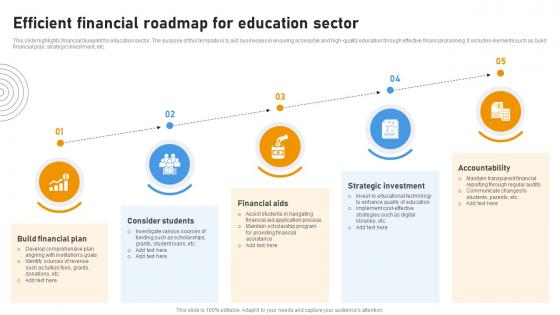
This slide highlights financial blueprint for education sector. The purpose of this template is to aid businesses in ensuring accessible and high-quality education through effective financial planning. It includes elements such as build financial plan, strategic investment, etc.
People who downloaded this PowerPoint presentation also viewed the following :
Efficient Financial Roadmap For Education Sector with all 9 slides:
Use our Efficient Financial Roadmap For Education Sector to effectively help you save your valuable time. They are readymade to fit into any presentation structure.








FAQs for Efficient Financial Roadmap
Effective financial planning education programs include budgeting fundamentals, investment strategies, retirement planning, risk management, and debt management principles. These components work together by building comprehensive financial literacy, enabling participants to make informed decisions, and ultimately delivering improved financial outcomes, with many educational institutions and corporations finding that structured programs significantly enhance long-term financial wellness and decision-making capabilities.
Financial literacy enhances personal finance decision-making by providing essential knowledge about budgeting, investing, debt management, and risk assessment, enabling individuals to evaluate options objectively and avoid costly mistakes. Through improved understanding of compound interest, credit scores, and investment strategies, people make more informed choices about retirement planning, mortgage decisions, and emergency fund allocation, ultimately building long-term wealth and financial security.
Technology revolutionizes financial planning education through interactive simulations, AI-powered personalized learning paths, virtual reality scenarios, and real-time market data integration. These digital tools enable students and professionals to practice complex financial strategies in risk-free environments, accelerate comprehension through adaptive learning, and ultimately deliver more engaging educational experiences that prepare learners for today's increasingly sophisticated financial landscape.
Educators can tailor financial planning curricula by adapting content complexity, teaching methods, and real-world applications to developmental stages, incorporating age-appropriate tools like games for children, budgeting apps for teens, and investment simulations for adults. This approach enhances learning retention across demographics, with many educational institutions finding that customized curricula deliver better financial literacy outcomes and practical application skills.
**INPUT**: What are the best practices for teaching budgeting skills in financial planning education? **OUTPUT**: Best practices for teaching budgeting skills include hands-on exercises with real scenarios, interactive software simulations, goal-setting frameworks, expense tracking methods, and regular progress reviews. These approaches enhance learning by connecting theoretical concepts to practical applications, with many educational institutions finding that combining digital tools with personalized coaching delivers improved financial literacy and long-term behavioral changes among students. [Word count: 58 words]
Real-life case studies can be integrated through interactive workshops analyzing actual client scenarios, role-playing exercises using anonymized financial situations, and collaborative projects examining market downturns or investment successes. These methods enhance learning by connecting theoretical concepts to practical applications, with many financial institutions finding that students develop stronger analytical skills, better decision-making capabilities, and increased confidence when handling complex financial planning challenges.
Common misconceptions about financial planning include believing it's only for wealthy individuals, requiring large initial investments, being too complex for average earners, and that professional advice is unnecessary. Financial planning education helps clarify that budgeting, saving, and investing can start with modest amounts, with many individuals finding that structured learning enables better decision-making, ultimately delivering improved financial security and long-term wealth building.
Financial planning education supports diverse socioeconomic backgrounds by offering accessible resources, culturally relevant content, and flexible delivery methods tailored to varying income levels and learning preferences. Through community partnerships, multilingual materials, and sliding-scale programs, educational institutions and financial organizations deliver targeted workshops, online courses, and peer mentoring, ultimately enhancing financial literacy and economic mobility across communities.
Financial planning education significantly enhances long-term financial wellness by building budgeting skills, investment knowledge, debt management strategies, and retirement planning capabilities. Through structured learning programs, individuals develop disciplined saving habits, make informed investment decisions, and avoid costly financial mistakes, with many finding that early education delivers sustained wealth accumulation and financial security throughout their lives.
Financial planning concepts can be effectively conveyed through presentation templates by incorporating visual budgeting frameworks, interactive cash flow models, goal-setting timelines, risk assessment matrices, and investment comparison charts. These structured templates streamline complex financial education by transforming abstract concepts into digestible visual formats, with many financial advisors, educational institutions, and corporate training programs finding that standardized presentation frameworks significantly enhance client comprehension and engagement.
Effective strategies include interactive case studies, real-world budgeting simulations, guest speakers from financial institutions, peer-to-peer learning workshops, and gamified investment challenges. These approaches enhance engagement by connecting theoretical concepts to practical scenarios, with many educators finding that students retain financial principles more effectively when they can immediately apply budgeting and investment strategies to relatable situations.
Financial planning education significantly influences career choices by enhancing analytical skills, risk assessment capabilities, and strategic thinking across multiple industries. Professionals with this background often pursue roles in investment banking, corporate finance, consulting, and entrepreneurship, while those in other fields leverage financial literacy for better decision-making, ultimately delivering enhanced career mobility and competitive advantage in an increasingly complex business environment.
**INPUT**: What are the most significant barriers to accessing financial planning education? **OUTPUT**: Significant barriers include high costs of courses and certifications, limited availability of quality programs, complex industry jargon, and inadequate foundational knowledge requirements. While these challenges present obstacles, many institutions are increasingly offering online platforms, flexible payment options, and simplified curricula, ultimately delivering more accessible pathways and enhanced career opportunities for aspiring financial professionals. **Word count: 56 words**
Partnerships with community organizations enhance financial education initiatives by expanding reach, building trust through local credibility, and providing culturally relevant programming tailored to specific demographics. These strategic collaborations enable financial institutions and educators to access established networks, leverage community leaders as advocates, and deliver programming through trusted venues like libraries and community centers, ultimately creating more impactful and sustainable financial literacy outcomes.
**INPUT**: What metrics can be used to evaluate the effectiveness of financial planning education programs? **OUTPUT**: Effectiveness metrics include participant knowledge assessments, behavioral change tracking, financial goal achievement rates, program completion statistics, and long-term financial health improvements. These measurements enable organizations to evaluate learning outcomes, monitor practical application of concepts, and assess real-world impact, with many educational institutions and corporate training programs finding that combining quantitative results with qualitative feedback delivers comprehensive program optimization and enhanced participant financial literacy outcomes. [Word count: 60 words]
-
Loved the collection. Editing the presentation was seamless with their templates.
-
Placing an order on SlideTeam is very simple and convenient, saves you a lot of your time.