


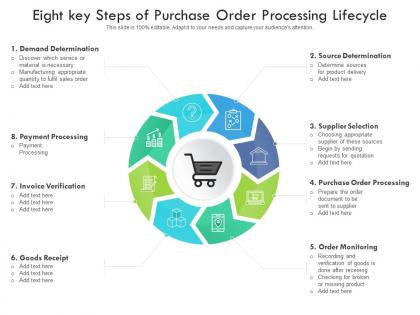
Eight key steps of purchase order processing lifecycle




Try Before you Buy Download Free Sample Product
 Impress Your
 Audience
 100%
100% Editable
 Save Hours
 of Time


Our Eight Key Steps Of Purchase Order Processing Lifecycle are topically designed to provide an attractive backdrop to any subject. Use them to look like a presentation pro.
People who downloaded this PowerPoint presentation also viewed the following :
Eight key steps of purchase order processing lifecycle with all 2 slides:
Use our Eight Key Steps Of Purchase Order Processing Lifecycle to effectively help you save your valuable time. They are readymade to fit into any presentation structure.
FAQs for Eight key steps of purchase
The purchase order processing lifecycle includes requisition creation, vendor selection, purchase order generation, approval workflows, order transmission, goods receipt, invoice verification, and payment processing. These stages streamline procurement operations by ensuring proper authorization, maintaining vendor relationships, and enabling accurate financial tracking, with many organizations finding that automated workflows significantly reduce processing time and enhance compliance across departments.
Automation improves purchase order processing efficiency by eliminating manual data entry, accelerating approval workflows through digital routing, and enabling real-time tracking across the entire lifecycle. Through intelligent systems, organizations streamline vendor communications, reduce processing times from days to hours, and minimize errors, with many companies finding that automated workflows deliver cost savings and enhanced supplier relationships.
Vendor management plays a critical role throughout the purchase order processing lifecycle by maintaining supplier databases, negotiating contract terms, monitoring performance metrics, and ensuring compliance standards. Through strategic vendor relationships, organizations streamline procurement workflows, reduce costs, and enhance delivery reliability, with many companies finding that effective vendor management ultimately delivers improved operational efficiency and stronger supply chain resilience.
Organizations ensure compliance during purchase order processes by implementing automated approval workflows, mandatory vendor verification protocols, and real-time budget tracking systems. Through integrated compliance software, companies streamline regulatory adherence, enhance audit transparency, and minimize procurement risks, with many financial services and healthcare organizations finding that these strategic controls ultimately deliver faster approvals while maintaining strict regulatory standards.
Common purchase order processing challenges include manual data entry errors, approval bottlenecks, supplier communication gaps, invoice mismatches, and compliance tracking difficulties. These issues can be mitigated through automated workflow systems, digital approval hierarchies, and integrated supplier portals, with many organizations finding that streamlined processes reduce processing time by 60% while enhancing accuracy and supplier relationships.
ERP systems enhance purchase order processing by centralizing data management, automating approval workflows, and providing real-time visibility across departments. Through integrated modules, organizations streamline requisition-to-payment cycles, reduce manual errors, and accelerate vendor communications, with many manufacturing and retail companies finding that seamless ERP integration ultimately delivers faster procurement cycles and improved cost control.
Key metrics for purchase order processing performance include cycle time from creation to approval, processing accuracy rates, supplier response times, cost per transaction, and approval bottlenecks. These measurements enable organizations to streamline operations by identifying delays, reducing manual errors, and optimizing vendor relationships, with many procurement teams finding that tracking these metrics delivers faster processing times and significant cost reductions.
Data analytics transforms purchase order management by enabling predictive demand forecasting, automated supplier performance evaluation, real-time spend analysis, and intelligent exception handling. Through advanced analytics, organizations streamline procurement cycles, reduce costs by 15-20%, and enhance supplier relationships, with many manufacturing and retail companies finding that data-driven insights ultimately deliver faster order processing and strategic competitive advantage.
Businesses maintain purchase order accuracy through automated validation systems, standardized approval workflows, real-time inventory integration, and multi-level verification checkpoints before processing. These systems streamline operations by eliminating manual data entry errors, ensuring proper authorization protocols, and cross-referencing supplier information, ultimately delivering reduced procurement costs and enhanced vendor relationships while minimizing costly order discrepancies.
An effective purchase order process significantly enhances supply chain management by improving demand forecasting, reducing lead times, and minimizing inventory costs. Through streamlined workflows and automated approvals, organizations achieve better supplier relationships, enhanced visibility across procurement activities, and faster response times to market changes, ultimately delivering operational efficiency and competitive advantage in increasingly complex global supply chains.
Communication between departments enhances purchase order processing by enabling real-time visibility, reducing approval bottlenecks, and minimizing errors through shared information systems. When procurement, finance, and operations collaborate seamlessly, organizations streamline vendor negotiations, accelerate invoice matching, and improve budget tracking, ultimately delivering faster procurement cycles and better supplier relationships.
Common purchase order processing tools include ERP systems like SAP and Oracle, procurement platforms such as Coupa and Ariba, automated workflow software, and integrated accounting solutions like QuickBooks and NetSuite. These technologies streamline operations by automating approvals, reducing manual errors, and enhancing vendor communication, with many organizations finding that strategic implementation delivers faster processing times and improved financial visibility.
The approval process directly influences purchase order fulfillment speed through routing complexity, approval hierarchy levels, and bottleneck identification, with streamlined digital workflows reducing processing time from days to hours. Organizations implementing automated approval systems find that predetermined thresholds, parallel routing, and exception handling accelerate vendor payments and inventory replenishment, ultimately delivering faster procurement cycles and enhanced supplier relationships.
Organizations should establish automated tracking systems, implement approval workflows, maintain centralized vendor databases, set clear procurement policies, and conduct regular audit reviews. These practices streamline operations by reducing processing delays, minimizing errors, and enhancing budget visibility, with many companies finding that systematic PO management delivers significant cost savings and improved supplier relationships.
International regulations significantly impact purchase order processing through compliance requirements, documentation standards, tax obligations, and cross-border trade restrictions that vary by jurisdiction. Global companies must navigate customs declarations, export controls, anti-corruption laws, and data privacy regulations, with many organizations finding that automated compliance systems streamline adherence while reducing regulatory risks and processing delays.
-
Understandable and informative presentation.
-
Topic best represented with attractive design.
-
Editable templates with innovative design and color combination.
-
Visually stunning presentation, love the content.