


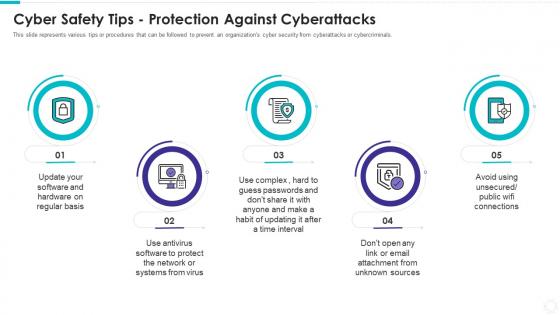
Electronic information security cyber safety tips protection against cyberattacks




Try Before you Buy Download Free Sample Product
 Impress Your
 Audience
 100%
100% Editable
 Save Hours
 of Time


This slide represents various tips or procedures that can be followed to prevent an organizations cyber security from cyberattacks or cybercriminals.
People who downloaded this PowerPoint presentation also viewed the following :
Electronic information security cyber safety tips protection against cyberattacks with all 6 slides:
Use our Electronic Information Security Cyber Safety Tips Protection Against Cyberattacks to effectively help you save your valuable time. They are readymade to fit into any presentation structure.





FAQs for Electronic information security cyber safety tips
The most common cyber threats include ransomware attacks, phishing schemes, malware infections, data breaches, and insider threats. These security challenges target organizations across industries, with financial services and healthcare sectors particularly vulnerable, ultimately compromising sensitive data, disrupting operations, and requiring significant investment in enhanced cybersecurity measures and employee training programs.
Organizations can effectively train employees through interactive simulations, regular phishing tests, role-specific workshops, gamified learning modules, and continuous awareness campaigns. These approaches enhance security culture by making training engaging and relevant, with many companies finding that hands-on scenarios and real-world examples significantly reduce human error incidents while strengthening overall organizational resilience.
Encryption protects sensitive data by converting information into unreadable code that requires specific keys to decrypt, making it useless to unauthorized users even if intercepted. Through advanced encryption protocols, organizations in banking, healthcare, and retail can secure customer transactions, medical records, and financial data, ultimately delivering regulatory compliance and competitive advantage while minimizing costly data breach risks.
Phishing attacks work by deceiving users through fraudulent emails, websites, or messages that mimic legitimate organizations to steal credentials, financial information, or personal data. Effective prevention strategies include employee training programs, multi-factor authentication, email filtering systems, and regular security awareness updates, with many organizations finding that combining technological solutions with human education significantly reduces successful attacks and enhances overall security posture.
A robust incident response plan includes preparation protocols, detection mechanisms, containment procedures, eradication steps, recovery processes, and lessons learned documentation. These components work together by establishing clear roles, enabling rapid threat identification, and minimizing damage through systematic response workflows, with many organizations finding that structured incident management significantly reduces recovery time and operational disruption.
Businesses can assess cybersecurity vulnerabilities through comprehensive security audits, penetration testing, vulnerability scanning, risk assessments, and employee security training evaluations. These strategic approaches enable organizations to identify weak points in networks, systems, and processes, while establishing robust defense mechanisms that ultimately deliver enhanced protection, regulatory compliance, and competitive advantage in an increasingly digital landscape.
Regulations like GDPR significantly enhance cybersecurity practices by mandating data encryption, breach notification protocols, access controls, regular security audits, and privacy-by-design frameworks. These requirements drive organizations to strengthen their security infrastructure, implement comprehensive risk management strategies, and establish robust incident response procedures, ultimately delivering improved data protection and competitive advantage in an increasingly regulated digital landscape.
Multi-factor authentication delivers enhanced security, reduced breach risk, regulatory compliance, improved user trust, and streamlined access management across organizations. Through layered verification processes, businesses significantly minimize unauthorized access, protect sensitive data, and reduce potential financial losses, with many financial institutions and healthcare providers finding that MFA implementation ultimately strengthens their competitive advantage while meeting compliance requirements.
Organizations can ensure secure remote work environments through multi-factor authentication, encrypted VPN connections, endpoint security solutions, regular security training, and zero-trust network architectures. These comprehensive security measures streamline protection by minimizing unauthorized access, securing data transmission, and monitoring device compliance, with many financial services and healthcare institutions finding that layered security approaches ultimately deliver enhanced operational resilience and regulatory compliance.
Emerging cybersecurity threats include AI-powered attacks, ransomware-as-a-service, supply chain vulnerabilities, IoT device exploitation, and cloud security breaches. These sophisticated threats target financial services, healthcare systems, and manufacturing networks through automated phishing, deepfake social engineering, and zero-day exploits, ultimately requiring organizations to adopt proactive, multi-layered defense strategies for competitive resilience.
Zero trust architecture enhances security by requiring continuous verification of every user, device, and network connection, eliminating assumptions about internal network safety, and implementing granular access controls based on identity and context. This approach significantly reduces breach impact through micro-segmentation, real-time monitoring, and adaptive authentication, with many financial institutions and healthcare organizations finding that zero trust delivers faster threat detection, minimized lateral movement, and ultimately stronger protection against sophisticated cyberattacks.
Essential cybersecurity monitoring tools include Security Information and Event Management (SIEM) systems, Intrusion Detection Systems (IDS), endpoint detection and response platforms, network traffic analyzers, and vulnerability scanners. These technologies enhance organizational security by identifying suspicious activities, automating threat responses, and providing real-time visibility, with many enterprises finding that integrated monitoring solutions significantly reduce response times and minimize potential breaches.
Small businesses can implement affordable cybersecurity through employee training programs, regular software updates, strong password policies, basic firewall protection, and cloud-based security solutions. Many retail stores, dental practices, and consulting firms find that combining free antivirus software with employee awareness training and automated backup systems delivers significant protection while minimizing costs, ultimately enabling competitive operations without major security investments.
Artificial intelligence plays a pivotal role in modern cybersecurity by enabling automated threat detection, predictive risk analysis, behavioral monitoring, and rapid incident response. Through machine learning algorithms, organizations streamline security operations by identifying anomalies in real-time, minimizing false positives, and accelerating threat remediation, with many financial institutions and healthcare providers finding that AI-driven security delivers enhanced protection while reducing operational costs.
Organizations should handle data breaches through immediate containment, forensic assessment, stakeholder notification, and regulatory compliance reporting, while implementing enhanced security measures and recovery protocols. This systematic approach enables businesses to minimize operational disruption, maintain customer trust, and meet legal requirements, with many companies finding that transparent communication and swift remediation ultimately strengthen their cybersecurity posture.
-
Easy to edit slides with easy to understand instructions.
-
Excellent design and quick turnaround.