


Elliptic Curve Cryptography Ecc Asymmetric Algorithm Encryption For Data Privacy In Digital Age It




Try Before you Buy Download Free Sample Product
 Impress Your
 Audience
 100%
100% Editable
 Save Hours
 of Time


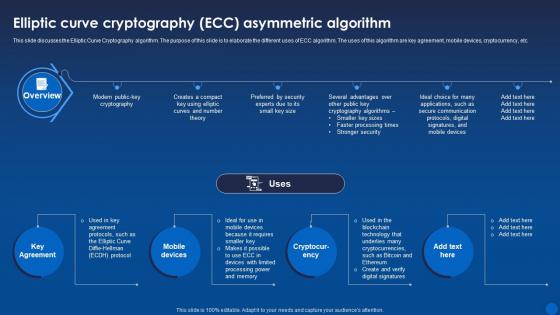
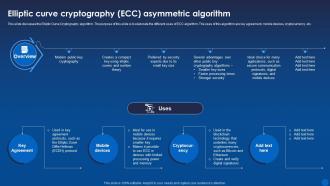
This slide discusses the Elliptic Curve Cryptography algorithm. The purpose of this slide is to elaborate the different uses of ECC algorithm. The uses of this algorithm are key agreement, mobile devices, cryptocurrency, etc.
People who downloaded this PowerPoint presentation also viewed the following :
Elliptic Curve Cryptography Ecc Asymmetric Algorithm Encryption For Data Privacy In Digital Age It with all 9 slides:
Use our Elliptic Curve Cryptography Ecc Asymmetric Algorithm Encryption For Data Privacy In Digital Age It to effectively help you save your valuable time. They are readymade to fit into any presentation structure.








FAQs for Elliptic Curve Cryptography Ecc Asymmetric Algorithm Encryption For Data Privacy In
Elliptic curve cryptography relies on mathematical principles including the algebraic structure of elliptic curves over finite fields, point addition operations, scalar multiplication, and the discrete logarithm problem's computational difficulty. These mathematical foundations enable organizations in banking, healthcare, and secure communications to achieve robust encryption with smaller key sizes, faster processing speeds, and reduced computational overhead, ultimately delivering enhanced security efficiency while maintaining strong cryptographic protection in increasingly digital business environments.
Elliptic curve cryptography delivers equivalent security to RSA using significantly smaller key sizes, with a 256-bit ECC key providing comparable protection to a 3,072-bit RSA key. This efficiency enables faster processing, reduced bandwidth requirements, and lower computational overhead, making ECC increasingly attractive for mobile applications, IoT devices, and cloud services where resource optimization directly translates to cost savings and enhanced performance.
Elliptic curve cryptography delivers superior security with smaller key sizes, faster processing speeds, reduced computational overhead, lower memory requirements, and enhanced battery efficiency compared to traditional methods like RSA. These advantages prove particularly valuable for mobile devices, IoT systems, and blockchain applications, with many financial institutions and telecommunications companies finding that ECC enables robust security while minimizing resource consumption and operational costs.
Elliptic curve cryptography leverages the discrete logarithm problem by making it computationally infeasible to reverse elliptic curve point multiplication, where finding the scalar multiplier from known points becomes exponentially difficult. This mathematical complexity enables secure digital signatures, key exchanges, and encrypted communications across banking, healthcare, and e-commerce platforms, ultimately delivering robust security with smaller key sizes than traditional methods.
The base point serves as the fundamental generator in elliptic curve key generation, acting as the starting point for creating public-private key pairs through scalar multiplication operations. This predetermined point on the curve enables organizations to generate secure cryptographic keys consistently, with financial institutions and healthcare systems finding that standardized base points streamline encryption processes while maintaining robust security across distributed networks.
ECC significantly enhances mobile and IoT device security by delivering robust encryption with minimal computational overhead, reduced battery consumption, and faster processing speeds compared to traditional cryptographic methods. This efficiency enables real-time secure communications in resource-constrained environments, with smartphones, smart home devices, and industrial sensors leveraging ECC to maintain strong security without compromising performance or battery life.
Common elliptic curve algorithms include ECDSA for digital signatures, ECDH for key exchange, EdDSA for enhanced security, and ECIES for encryption applications. These algorithms streamline secure communications in banking, healthcare, and e-commerce by delivering faster authentication, reduced computational overhead, and stronger protection than traditional methods, ultimately enabling organizations to maintain robust security while enhancing user experiences.
ECC implementation has evolved from niche academic research to widespread deployment across secure communications, digital signatures, blockchain networks, mobile applications, and IoT devices. Modern implementations leverage optimized algorithms and hardware acceleration, enabling banks to process faster transactions, healthcare systems to secure patient data more efficiently, and cryptocurrency platforms to maintain robust security with reduced computational overhead, ultimately delivering enhanced performance and stronger protection.
ECC vulnerabilities include weak curve parameters, side-channel attacks, implementation flaws, quantum computing threats, and invalid curve attacks. While these present challenges, many organizations find that proper implementation with standardized curves, regular security audits, and robust key management significantly minimizes risks, ultimately delivering stronger encryption efficiency than traditional methods in an increasingly security-conscious digital landscape.
Organizations should consider computational efficiency, security strength, standardization compliance, implementation complexity, and platform compatibility when selecting elliptic curves for cryptographic applications. Financial institutions and healthcare providers increasingly favor NIST-approved curves like P-256 for regulatory compliance, while tech companies often choose Curve25519 for performance optimization, ultimately balancing security requirements with operational efficiency.
Post-quantum computers threaten elliptic curve cryptography by potentially breaking current encryption through advanced algorithms like Shor's algorithm, which can solve discrete logarithm problems exponentially faster than classical computers. Organizations are increasingly adopting quantum-resistant alternatives including lattice-based cryptography, hash-based signatures, and multivariate cryptographic systems, with financial institutions and government agencies finding that hybrid approaches combining traditional and post-quantum methods deliver enhanced security while maintaining operational efficiency.
**INPUT**: What standardization efforts exist for elliptic curve parameters in cryptographic systems? **OUTPUT**: Major standardization efforts include NIST's FIPS 186-4, ANSI X9.62, IEEE P1363, SEC 2 specifications, and RFC standards from IETF. These frameworks establish secure curve parameters, implementation guidelines, and interoperability protocols, enabling financial institutions, government agencies, and technology companies to deploy consistent cryptographic solutions while maintaining security compliance and operational efficiency across diverse systems. **Word count: 56 words**
Elliptic curve cryptography enhances blockchain security by providing efficient digital signatures, secure key generation, and reduced computational overhead while maintaining strong encryption. Through ECC algorithms, blockchain networks achieve faster transaction verification, lower energy consumption, and enhanced scalability, with many cryptocurrency platforms finding that this integration delivers superior security-to-performance ratios.
Validation methods for elliptic curve implementations include test vector verification, mathematical property checks, side-channel attack testing, formal verification techniques, and compliance with cryptographic standards like FIPS 140-2. These approaches streamline security assurance by detecting implementation flaws, verifying mathematical accuracy, and ensuring resistance to timing attacks, with many financial institutions and government agencies finding that comprehensive validation ultimately delivers robust cryptographic protection and regulatory compliance.
The choice between prime fields and binary fields in ECC significantly impacts both computational efficiency and security implementation, with prime fields offering stronger theoretical security foundations while binary fields enable faster hardware optimization through simpler arithmetic operations. Prime fields dominate in software applications due to their resistance to certain attacks and broader cryptographic community support, while binary fields excel in embedded systems and hardware implementations, with many financial institutions and IoT manufacturers finding that field selection ultimately determines both processing speed and long-term cryptographic resilience.
-
Easy to edit slides with easy to understand instructions.
-
Delighted to see unique and eye-catching PowerPoint designs that are so easy to customize.