


Embedded System Applications And Use Cases Powerpoint Presentation Slides




Try Before you Buy Download Free Sample Product
 Impress Your
 Audience
 100%
100% Editable
 Save Hours
 of Time


Grab our professionally created Embedded System Applications and Use Cases PowerPoint presentation. This PPT bundle briefly explains embedded systems, their structure, evolution journey, components integration evolution, and various types. This section covers embedded systems features and operational and functional attributes, as well as the latest trends and developments in these areas. In addition, this Embedded System Applications and Use Cases PPT contains the real-world use cases and applications of embedded systems in different domains, such as fitness trackers, Global Positioning Systems, ATMs, and factory robots. Also, the Embedded System Evolution PPT templates include the case study of embedded systems in a telecom service provider company to upgrade the telephony modem. Furthermore, the Embedded Systems Operational Attributes PPT slides address the impact of embedded systems on user lives and the environment. It also compares the situation before and after the embedded systems revolution. Moreover, this Embedded System Applications and Use Cases deck comprises a training program, budget, and development budget to develop embedded systems. Lastly, it presents a 30 60 90-day plan, a timeline, a roadmap, and a KPI dashboard. Download our 100 percent editable and customizable template, which is also compatible with Google Slides.
People who downloaded this PowerPoint presentation also viewed the following :
Content of this Powerpoint Presentation
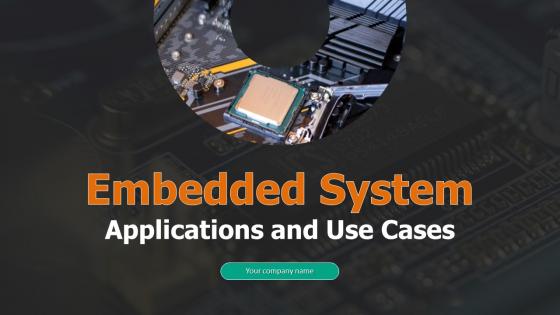
Slide 1: This slide introduces Embedded System Applications and Use Cases. State your company name and begin.
Slide 2: This is an Agenda slide. State your agendas here.
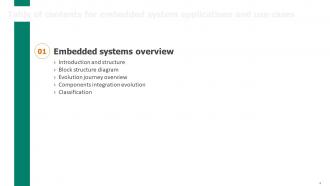
Slide 3: This slide shows Table of Content for the presentation.
Slide 4: This slide shows title for topics that are to be covered next in the template.
Slide 5: This slide outlines the overview of an embedded system and its structure. This slide introduces the embedded systems, their applications, design and components such as memory, CPU etc.
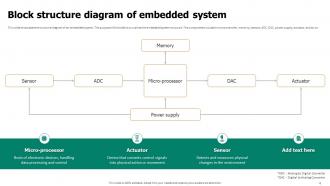
Slide 6: This slide showcases the structure diagram of an embedded system. The purpose of this slide is to outline the embedded system structure.
Slide 7: This slide gives an overview of the embedded systems evolution journey. The purpose of this slide is to trace the evolutionary path of embedded systems.
Slide 8: This slide showcases the evolution of component integration in embedded systems. The purpose of this slide is to describe the development of components used in embedded systems.
Slide 9: This slide categorizes the embedded systems based on the performance of the microcontroller and the functional requirements of the system.
Slide 10: This slide shows title for topics that are to be covered next in the template.
Slide 11: This slide talks about the main characteristics of embedded systems. This slide aims to showcase the salient features of embedded systems, such as dedicated function, real-time operation etc.
Slide 12: This slide describes the operational quality attributes of embedded systems. The purpose of this slide is to give an overview of the operational quality attributes of the embedded system.
Slide 13: This slide showcases the non-operational quality attributes of the embedded systems. The purpose of this slide is to represent the non-operational quality attributes of embedded systems.
Slide 14: This slide shows title for topics that are to be covered next in the template.
Slide 15: This slide showcases the current insights and enhancements in embedded systems. The purpose of this slide is to represent the recent trends and developments in embedded systems.
Slide 16: This slide shows title for topics that are to be covered next in the template.
Slide 17: This slide highlights the real-world uses of embedded systems in different business domains. This slide aims to showcase the applications of embedded systems in various industries.
Slide 18: This slide outlines the applications of embedded systems in central heating systems used in buildings.
Slide 19: This slide describes the use cases of embedded systems in GPS systems. The purpose of this slide is to showcase how embedded systems are helpful in Global Positioning Systems.
Slide 20: This slide outlines the applications of embedded systems in fitness tracker gadgets. The purpose of this slide is to represent the importance of embedded systems in fitness tracker devices.
Slide 21: This slide discusses using embedded systems in Automated Teller Machines for monetary transactions. It highlight the installation of embedded systems in the ATM displays.
Slide 22: This slide represents the applications of embedded systems in factory robots or cobots. The purpose of this slide is to highlight the use of integrated embedded systems in factory robots.
Slide 23: This slide gives an overview of embedded system applications in electric vehicle charging stations.
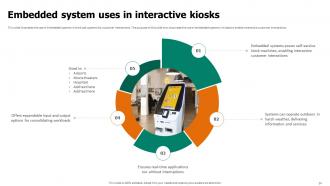
Slide 24: This slide illustrates the use of embedded systems in the kiosk systems for customer interactions. The purpose of this slide is to showcase the use of embedded systems in kiosks.
Slide 25: This slide represents the applications of embedded systems in transit and fare collection systems. It describe how embedded systems are used in the Automated Fare Collection systems.
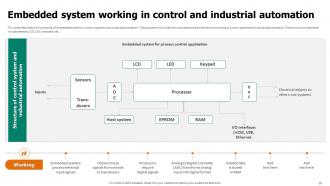
Slide 26: This slide describes the functioning of embedded systems in control systems and industrial automation.
Slide 27: This slide showcases the use cases of embedded systems in biomedical systems. This slide aims to outline the embedded systems applications in the healthcare industry.
Slide 28: This slide describes the applications of embedded systems in data communication systems. It highlight how embedded systems have changed data communications systems over time.
Slide 29: This slide shows title for topics that are to be covered next in the template.
Slide 30: This slide outlines the case study for embedded systems. It gives an overview of the company that implemented embedded software systems to retain its existing customers.
Slide 31: This slide shows title for topics that are to be covered next in the template.
Slide 32: This slide showcases the impact of embedded systems on consumers' routines. The purpose of this slide is to showcase how embedded systems are an integral part of human life.
Slide 33: This slide outlines the positive ecological impact of embedded systems. It represent the positive impact of embedded systems on the environment, such as enhanced energy management etc.
Slide 34: This slide represents the adverse environmental effects of embedded systems. The purpose of this slide is to outline the negative impact of embedded systems on the environment.
Slide 35: This slide shows title for topics that are to be covered next in the template.
Slide 36: This slide showcases the comparison between before and after situations of embedded systems. The purpose of this slide is to outline the before versus after embedded systems situation.
Slide 37: This slide shows title for topics that are to be covered next in the template.
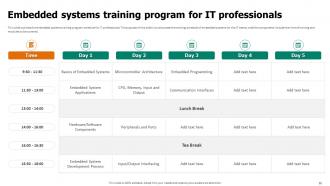
Slide 38: This slide outlines the embedded systems training program schedule for IT professionals.
Slide 39: This slide represents the budget allocation for the embedded systems training program. It outlines the training budget for embedded systems, and the main components.
Slide 40: This slide talks about the embedded systems development budget allocation. This slide highlights the budget allocation for embedded systems development, and the cost components.
Slide 41: This slide shows title for topics that are to be covered next in the template.
Slide 42: This slide describes the 30-60-90-day plan for embedded systems development. The purpose of this slide is to showcase the various steps organizations should take.
Slide 43: This slide shows title for topics that are to be covered next in the template.
Slide 44: This slide outlines the timeline for the embedded systems development in an organization.
Slide 45: This slide shows title for topics that are to be covered next in the template.
Slide 46: This slide represents the performance tracking dashboard for industrial robots with integrated embedded systems.
Slide 47: This slide shows all the icons included in the presentation.
Slide 48: This slide is titled as Additional Slides for moving forward.
Slide 49: This slide presents Different types of attacks on embedded systems.
Slide 50: This slide represents Enhancements in embedded software ion.
Slide 51: This slide presents Hard real time embedded systems structure.
Slide 52: This slide displays Components inside a generic microcontroller.
Slide 53: This slide presents Bar Graph with two products comparison.
Slide 54: This slide depicts Venn diagram with text boxes.
Slide 55: This is a financial slide. Show your finance related stuff here.
Slide 56: This slide contains Puzzle with related icons and text.
Slide 57: This is Our Goal slide. State your firm's goals here.
Slide 58: This is an Idea Generation slide to state a new idea or highlight information, specifications etc.
Slide 59: This slide provides 30 60 90 Days Plan with text boxes.
Slide 60: This slide shows Post It Notes for reminders and deadlines. Post your important notes here.
Slide 61: This is a Thank You slide with address, contact numbers and email address.
Embedded System Applications And Use Cases Powerpoint Presentation Slides with all 69 slides:
Use our Embedded System Applications And Use Cases Powerpoint Presentation Slides to effectively help you save your valuable time. They are readymade to fit into any presentation structure.


















FAQs for Embedded System Applications And Use Cases
Embedded systems are characterized by dedicated functionality, real-time operation, resource constraints, reliability requirements, and integration with hardware components. These systems streamline operations by performing specific tasks efficiently, operating within strict timing parameters, and minimizing power consumption, with industries like automotive, medical devices, and industrial automation finding that embedded solutions ultimately deliver enhanced performance and cost-effective operations.
Embedded systems differ from general-purpose computers through specialized design for specific tasks, real-time processing requirements, resource constraints, and dedicated functionality rather than versatility. These systems streamline operations by integrating hardware and software optimization, minimizing power consumption, and delivering consistent performance, with industries like automotive, medical devices, and industrial automation finding enhanced reliability and efficiency.
Microcontrollers and microprocessors serve as the computational core of embedded systems, with microcontrollers integrating CPU, memory, and I/O peripherals for dedicated applications, while microprocessors offer higher processing power for complex tasks. These components enable manufacturers across automotive, healthcare, and industrial sectors to deliver smarter products, streamlined operations, and enhanced user experiences, ultimately providing significant competitive advantages in increasingly connected markets.
Real-time operating systems enhance embedded systems by providing deterministic task scheduling, precise timing control, and efficient resource management across multiple concurrent processes. Through RTOS implementation, manufacturers in automotive, medical devices, and industrial automation achieve faster response times, improved system reliability, and seamless multitasking capabilities, ultimately delivering enhanced performance and competitive advantage in increasingly complex applications.
C and C++ dominate embedded systems programming due to their low-level hardware control, memory efficiency, and minimal runtime overhead, with Assembly language used for critical performance sections. Python and Rust are increasingly adopted for rapid prototyping and system-level security respectively, while Java finds application in enterprise IoT devices, ultimately delivering optimized performance and reliable operation across automotive, medical, and industrial automation sectors.
Designers ensure power efficiency in embedded systems through low-power microcontrollers, dynamic voltage scaling, sleep mode optimization, efficient algorithms, and strategic component selection. These techniques enable manufacturers in automotive, IoT, and medical device sectors to extend battery life, reduce operational costs, and meet stringent energy regulations, ultimately delivering competitive products with enhanced performance and lower maintenance requirements.
Primary challenges in designing embedded systems for IoT applications include power consumption optimization, connectivity reliability, security vulnerabilities, resource constraints, and scalability requirements. These challenges are particularly critical in manufacturing, healthcare, and smart city deployments, where organizations must balance performance with efficiency, ultimately delivering cost-effective solutions while maintaining robust security and seamless integration across increasingly complex IoT ecosystems.
Hardware and software co-design approaches improve system performance by enabling simultaneous optimization of both components, reducing communication overhead, and maximizing resource utilization throughout development. This strategic combination allows engineers to create more efficient embedded solutions for automotive control systems, medical devices, and IoT applications, ultimately delivering faster processing speeds, lower power consumption, and enhanced functionality.
Embedded systems in connected environments face unique security challenges including limited computational resources for encryption, difficulty in updating firmware remotely, physical tampering vulnerabilities, weak authentication protocols, and inadequate network security measures. These constraints create significant risks in sectors like automotive, healthcare devices, and industrial IoT, where security breaches can compromise critical operations, ultimately requiring specialized security frameworks that balance protection with performance limitations.
Simulation tools aid embedded systems development by enabling virtual testing, reducing hardware dependencies, and accelerating design iterations before physical prototyping. These platforms allow engineers to validate functionality, optimize performance, and identify potential issues early in development cycles, with automotive and IoT manufacturers finding that simulation significantly reduces development costs and time-to-market while enhancing system reliability.
Current trends shaping embedded systems include edge computing, AI/ML integration, IoT connectivity, real-time processing capabilities, and enhanced security protocols. These advancements streamline operations by enabling faster data processing, reducing latency, and improving autonomous decision-making, with industries like automotive, healthcare, and manufacturing finding significant competitive advantages through smarter, more responsive embedded solutions.
Developers implement safety-critical considerations through redundant hardware architectures, real-time operating systems with deterministic scheduling, fail-safe mechanisms, and rigorous testing protocols including hardware-in-the-loop simulations. These approaches enable automotive systems to meet ISO 26262 standards while delivering enhanced vehicle safety, predictable performance under critical conditions, and regulatory compliance, with many manufacturers finding that systematic safety integration ultimately reduces liability risks and accelerates market approval processes.
**INPUT**: What testing methodologies are most effective for verifying embedded system performance? **OUTPUT**: Effective embedded system testing methodologies include unit testing, integration testing, hardware-in-the-loop simulation, real-time performance testing, and stress testing under various environmental conditions. These approaches enable organizations to streamline validation processes, minimize costly post-deployment failures, and enhance system reliability, with many manufacturers finding that comprehensive testing ultimately delivers faster time-to-market and competitive advantage. [Word count: 58 words]
Wireless communication protocols enhance embedded systems functionality by enabling remote monitoring, real-time data transmission, and seamless device connectivity across networks. These protocols streamline operations in smart manufacturing, healthcare monitoring, and automotive systems, with many organizations finding that wireless integration reduces infrastructure costs, accelerates deployment timelines, and ultimately delivers greater operational flexibility and scalability.
AI and machine learning advancements influencing embedded systems include edge computing processors, neural network accelerators, real-time inference engines, adaptive algorithms, and energy-efficient architectures. These technologies streamline performance by enabling local data processing, reducing latency, and minimizing bandwidth requirements, with automotive, healthcare, and industrial IoT sectors finding that intelligent embedded systems deliver faster response times and enhanced operational efficiency.
-
I looked at their huge selection of themes and designs. They appeared to be ideal for my profession. I'm sure I'll grab a few of them.
-
Easy to edit slides with easy to understand instructions.