


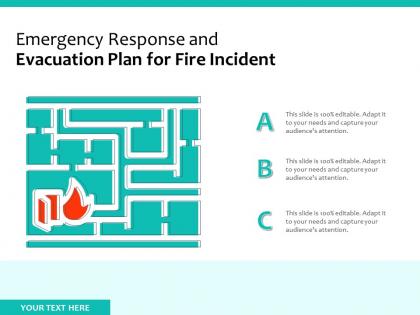
Emergency response and evacuation plan for fire incident




Try Before you Buy Download Free Sample Product
 Impress Your
 Audience
 100%
100% Editable
 Save Hours
 of Time


Our Emergency Response And Evacuation Plan For Fire Incident are topically designed to provide an attractive backdrop to any subject. Use them to look like a presentation pro.
People who downloaded this PowerPoint presentation also viewed the following :
Emergency response and evacuation plan for fire incident with all 2 slides:
Use our Emergency Response And Evacuation Plan For Fire Incident to effectively help you save your valuable time. They are readymade to fit into any presentation structure.

FAQs for Emergency response and evacuation plan
Every fire evacuation plan should include clear evacuation routes, designated assembly points, emergency contact information, roles and responsibilities for staff, and regular training schedules. These elements work together by ensuring swift coordination during emergencies, minimizing confusion through predetermined pathways, and establishing accountability systems, with many organizations finding that comprehensive plans significantly reduce evacuation times and enhance overall safety outcomes.
Organizations effectively communicate fire evacuation plans through comprehensive training sessions, visual signage at key locations, digital platforms, and regular drills that reinforce procedures. Through strategic placement of evacuation maps, mobile alerts, and multilingual materials, companies enhance safety awareness, reduce response times, and ensure compliance, with many finding that combining traditional signage with digital communication ultimately delivers broader coverage and faster emergency response across diverse workplace environments.
Employee training serves as the foundation of effective fire evacuation plans, ensuring staff understand evacuation routes, alarm signals, assembly points, and their specific responsibilities during emergencies. Through regular drills and comprehensive safety education, organizations across industries like manufacturing, healthcare, and retail enhance response times, reduce panic-driven errors, and ultimately deliver safer workplace environments while minimizing potential casualties and business disruption.
Technology enhances fire evacuation plans through smart sensors, automated alert systems, real-time tracking applications, digital mapping solutions, and AI-powered route optimization. These innovations streamline emergency response by providing instant notifications, monitoring occupant locations, and dynamically adjusting evacuation paths based on fire spread patterns, ultimately delivering faster evacuations and improved safety outcomes.
Common pitfalls include inadequate exit route planning, insufficient staff training, poor signage placement, neglecting accessibility requirements, and infrequent plan updates. These oversights significantly compromise safety effectiveness by creating confusion during emergencies, delaying evacuations, and failing compliance standards, with many organizations finding that regular drills and comprehensive staff education ultimately deliver faster response times and enhanced workplace safety.
Fire evacuation plans should be reviewed annually at minimum, with updates triggered by building modifications, occupancy changes, staff turnover, or regulatory updates. Many organizations conduct quarterly drills and semi-annual reviews, finding that regular assessment ensures compliance, enhances employee preparedness, and ultimately delivers faster evacuation times and improved safety outcomes.
Fire evacuation drills should include alarm testing, designated evacuation routes, assembly point procedures, headcount verification, and communication protocols. These comprehensive exercises enhance preparedness by simulating real emergency conditions, training staff on proper exit procedures, and identifying potential bottlenecks, with many organizations finding that regular drills significantly reduce evacuation times and improve overall safety outcomes.
Businesses can accommodate individuals with disabilities through designated evacuation assistants, accessible exit routes, visual and audible alarm systems, emergency communication devices, and personalized evacuation procedures. These comprehensive measures ensure inclusive safety protocols, with many organizations finding that proactive accessibility planning enhances overall emergency response effectiveness while demonstrating organizational commitment to employee welfare and regulatory compliance.
Legal requirements for fire evacuation plans in commercial buildings include OSHA compliance for employee safety procedures, local fire code adherence for exit routes and signage, ADA accessibility standards for disabled occupants, regular drill documentation, and emergency coordinator designation. These regulations vary by jurisdiction and building type, with hospitals, schools, and high-rises facing stricter standards, ultimately ensuring occupant safety while minimizing legal liability for property owners.
Fire evacuation plans are tailored by analyzing each facility's unique occupant needs, structural layout, equipment requirements, and operational constraints. Hospitals prioritize patient mobility assistance and medical equipment protection, while schools focus on rapid student assembly and teacher accountability systems, with both requiring specialized route signage, communication protocols, and staff training that addresses their specific populations and regulatory requirements.
Effective ways to assess fire evacuation plan effectiveness include conducting post-incident debriefings, analyzing evacuation times, reviewing communication protocols, examining route efficiency, and gathering feedback from evacuees and emergency responders. These assessment methods enable organizations to identify bottlenecks, enhance safety procedures, and streamline future evacuations, ultimately delivering improved emergency preparedness and regulatory compliance across facilities.
Geographic location significantly influences fire evacuation plans through climate-specific fire risks, local building codes, terrain considerations, and regional emergency response capabilities. Areas prone to wildfires, earthquakes, or extreme weather require specialized procedures, while urban versus rural settings demand different evacuation routes and coordination methods, ultimately ensuring plans address location-specific hazards and available resources effectively.
Clear evacuation routes should feature multiple exit paths, prominent signage with illuminated arrows, unobstructed pathways at least 44 inches wide, and floor markings for low-visibility conditions. These elements streamline emergency response by reducing confusion, minimizing bottlenecks, and ensuring accessibility compliance, with many organizations finding that regular route testing and staff training ultimately delivers faster evacuation times and enhanced safety outcomes.
Signage and communication tools can be optimized through clear visual indicators, multilingual displays, audio announcements, mobile alerts, and digital wayfinding systems. These technologies streamline evacuation by providing real-time directions, reducing confusion during emergencies, and ensuring accessibility compliance, with many hospitals and office buildings finding that integrated communication systems significantly enhance response times and overall safety outcomes.
Collaboration with local fire departments enhances evacuation plans through expert risk assessments, customized evacuation route optimization, joint training exercises, and real-time emergency response coordination. This partnership enables organizations like hospitals, schools, and manufacturing facilities to reduce response times, improve safety protocols, and ensure regulatory compliance, ultimately delivering more effective emergency preparedness and potentially life-saving outcomes.
-
Excellent work done on template design and graphics.
-
Easy to edit slides with easy to understand instructions.
-
Awesomely designed templates, Easy to understand.
-
Very unique, user-friendly presentation interface.