


Employee Engagement And Satisfaction KPI Dashboard Implementing Employee Engagement Strategies





Try Before you Buy Download Free Sample Product
 Impress Your
 Audience
 100%
100% Editable
 Save Hours
 of Time


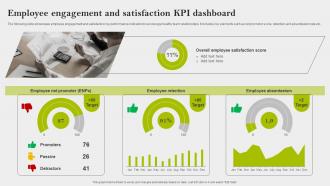
The following slide showcases employee engagement and satisfaction key performance indicators to encourage healthy team relationships. It includes key elements such as net promotor score, retention and absenteeism rate etc.
People who downloaded this PowerPoint presentation also viewed the following :
Employee Engagement And Satisfaction KPI Dashboard Implementing Employee Engagement Strategies with all 7 slides:
Use our Employee Engagement And Satisfaction KPI Dashboard Implementing Employee Engagement Strategies to effectively help you save your valuable time. They are readymade to fit into any presentation structure.





FAQs for Employee Engagement And Satisfaction KPI Dashboard Implementing
Employee engagement KPI dashboards should include employee satisfaction scores, retention rates, absenteeism percentages, productivity metrics, and pulse survey results. These metrics streamline workforce management by identifying engagement trends, predicting turnover risks, and measuring cultural health, with many organizations finding that comprehensive dashboards ultimately deliver improved performance and reduced recruitment costs.
Organizations can effectively measure employee engagement through KPIs including employee satisfaction scores, retention rates, absenteeism levels, productivity metrics, and participation rates in company initiatives. These measurements enable companies to identify engagement gaps, track improvement trends, and implement targeted strategies, with many businesses finding that regular pulse surveys combined with performance analytics ultimately delivers enhanced workplace culture and competitive advantage.
Visualizing employee engagement data on dashboards enables real-time monitoring, trend identification, faster decision-making, improved transparency, and enhanced strategic planning across organizations. These visual tools streamline HR analytics by highlighting engagement patterns, retention risks, and performance correlations, with many companies finding that dashboard visibility ultimately delivers stronger workforce management and competitive talent retention advantages.
Employee engagement KPIs should be updated monthly for core metrics like satisfaction scores and retention rates, with quarterly deep-dive reviews for strategic planning. This balanced approach enables organizations to track real-time pulse changes while maintaining perspective on longer-term trends, with many companies finding that monthly updates combined with quarterly strategic reviews deliver optimal responsiveness without survey fatigue.
Employee feedback serves as the foundation for identifying relevant engagement metrics, determining appropriate measurement frequencies, and establishing meaningful benchmark targets that reflect actual workplace experiences. Through surveys, focus groups, and continuous listening platforms, organizations can discover which factors most significantly impact their workforce satisfaction, retention rates, and productivity levels, ultimately ensuring their dashboard measures what truly matters rather than generic metrics that may not resonate with their specific organizational culture.
Technology enhances Employee Engagement KPI dashboards through real-time data integration, automated survey collection, predictive analytics, interactive visualizations, and mobile accessibility. Advanced platforms enable HR teams to track engagement metrics across departments seamlessly, identify trends through machine learning algorithms, and deliver personalized insights, ultimately streamlining decision-making processes while providing managers with actionable intelligence for improved workforce satisfaction.
Most reliable data sources for employee engagement KPIs include pulse surveys, performance management systems, HR information systems, exit interview data, and real-time feedback platforms. These sources streamline tracking by combining quantitative metrics with qualitative insights, anonymous feedback mechanisms, and behavioral analytics, with many organizations finding that integrating multiple touchpoints delivers comprehensive engagement visibility and actionable workforce intelligence.
Organizations align employee engagement KPIs with business objectives by connecting engagement metrics to productivity indicators, retention rates, customer satisfaction scores, and revenue targets through strategic measurement frameworks. This alignment enables companies to demonstrate how engagement initiatives directly impact operational efficiency, reduce turnover costs, and enhance customer experiences, with many finding that engaged teams deliver significantly higher performance and competitive advantage.
Challenges include data accuracy concerns, survey response bias, contextual interpretation gaps, benchmark comparison difficulties, and translating metrics into actionable insights. While dashboards streamline data visualization, organizations often find that engagement scores require careful analysis of underlying factors, departmental variations, and temporal trends, ultimately demanding strategic interpretation skills to drive meaningful workplace improvements and avoid misguided policy decisions.
Organizations ensure dashboard accuracy through regular data validation, automated quality checks, standardized survey methodologies, and real-time monitoring systems that flag inconsistencies or anomalies. By implementing multi-source verification, conducting periodic audits, and establishing clear data governance protocols, companies like financial services firms and healthcare organizations maintain reliable engagement metrics, ultimately delivering actionable insights and strategic decision-making capabilities.
Remote work engagement KPIs include employee satisfaction scores, virtual meeting participation rates, collaboration tool usage metrics, project completion times, and peer connection frequency assessments. These metrics enable organizations to monitor productivity, team cohesion, and morale across distributed teams, with many companies finding that tracking both quantitative outputs and qualitative feedback delivers comprehensive insights into remote workforce engagement and operational efficiency.
An Employee Engagement KPI Dashboard helps identify improvement areas by tracking metrics like satisfaction scores, turnover rates, absenteeism patterns, performance indicators, and feedback sentiment across departments and teams. These comprehensive analytics enable HR leaders to pinpoint specific issues, whether in management practices, workplace culture, or resource allocation, while delivering targeted interventions that enhance retention and productivity.
**INPUT**: What strategies can be implemented to increase employee participation in engagement surveys? **OUTPUT**: Effective strategies include anonymous survey platforms, multi-channel communication campaigns, leadership endorsements, mobile-friendly formats, and incentive programs tied to participation goals. These approaches enhance response rates by addressing privacy concerns, ensuring accessibility, and demonstrating organizational commitment, with many companies finding that transparent communication about survey outcomes ultimately drives higher engagement and trust. [Word count: 56 words]
Benchmarking against industry standards provides crucial context for engagement metrics, enabling organizations to identify performance gaps, set realistic targets, and prioritize improvement initiatives effectively. By comparing turnover rates, satisfaction scores, and productivity metrics against sector-specific benchmarks, companies can validate their strategies, justify investments in engagement programs, and ultimately achieve competitive advantage through data-driven talent management decisions.
Visualization tools transform engagement KPIs through interactive dashboards, heat maps, trend charts, gauge meters, and color-coded scorecards that instantly communicate performance levels. These visual formats enable executives, HR leaders, and managers to quickly identify engagement patterns, spot declining areas, and track improvement initiatives across departments, ultimately delivering faster decision-making and more strategic workforce investments.
-
A fantastic collection of templates. I'll likely use this as my go-to resource for future templates and support.
-
SlideTeam makes creating presentations easy. Unlimited products, premium quality designs and affordable.