


Employee involvement balanced scorecard powerpoint presentation slides




Try Before you Buy Download Free Sample Product
 Impress Your
 Audience
 100%
100% Editable
 Save Hours
 of Time


A balanced scorecard provides a holistic approach to management in tracking the employees engagement level. Our PowerPoint Presentation covers various scorecards which will assist the organization in increasing employee satisfaction levels and lowering absenteeism rates. Check out our professionally designed Employee Involvement Balanced Scorecard template that the company can use to address employees commitment, punctuality, and absenteeism score. The PowerPoint presentation covers an evaluation balanced scorecard, through which managers can rate employees based on different factors, including human relations, professionalism, and work habits. Moreover, the employee involvement balanced scorecard will assist the company in calculating the engagement scores of various teams such as sales, marketing, HR, and finance. Lastly, it covers scorecards that firms can use to highlight employee involvement scores in different months and employee net promoter score. Book a free demo with our research team and customize this 100 percent editable scorecard template based on your business needs now.
People who downloaded this PowerPoint presentation also viewed the following :
Content of this Powerpoint Presentation
Slide 1: This slide displays title i.e. 'Employee Involvement Balanced Scorecard'.
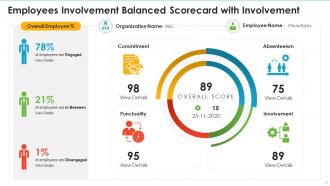
Slide 2: This slide presents Employees Involvement Balanced Scorecard with Involvement.
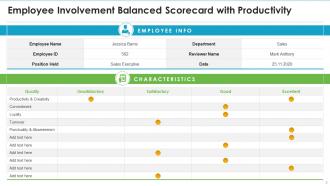
Slide 3: This slide exhibits Employee Involvement Balanced Scorecard with Productivity.
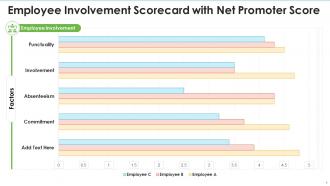
Slide 4: This slide showcases Employee Involvement Scorecard with Net Promoter Score.
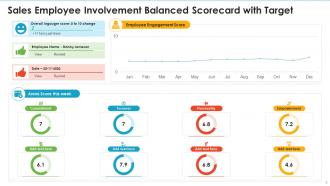
Slide 5: This slide depicts Sales Employee Involvement Balanced Scorecard with Target.
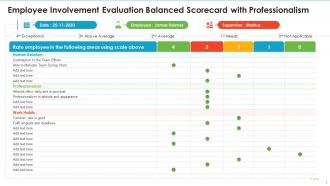
Slide 6: This slide highlights Employee Involvement Evaluation Balanced Scorecard with Professionalism.
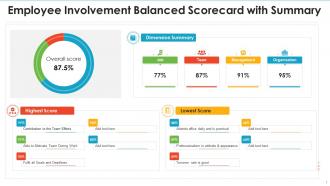
Slide 7: This slide illustrates Employee Involvement Balanced Scorecard with Summary.
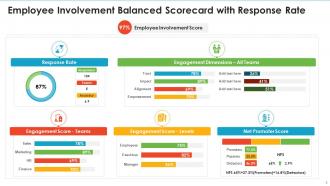
Slide 8: This slide displays Employee Involvement Balanced Scorecard with Response Rate.
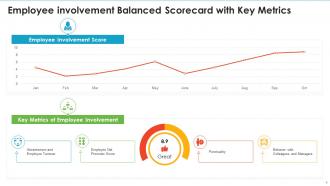
Slide 9: This slide presents Employee involvement Balanced Scorecard with Key Metrics.
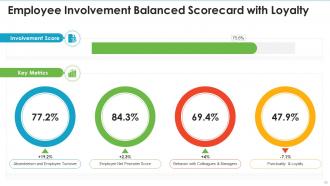
Slide 10: This slide exhibits Employee Involvement Balanced Scorecard with Loyalty.
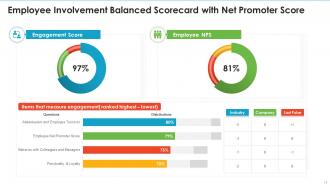
Slide 11: This slide showcases Employee Involvement Balanced Scorecard with Net Promoter Score.
Slide 12: This is the icons slide.
Slide 13: This slide presents title for additional slides.
Slide 14: This slide shows about your company, target audience and its client's values.
Slide 15: This slide depicts 30-60-90 days plan for projects.
Slide 16: This slide shows roadmap.
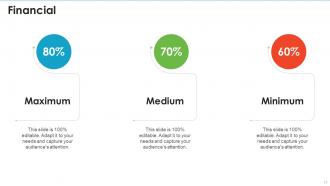
Slide 17: This slide showcases financials.
Slide 18: This slide displays Venn.
Slide 19: This slide displays puzzle.
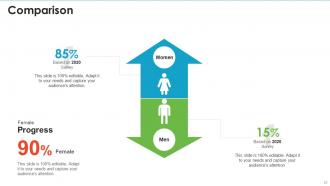
Slide 20: This slide highlights comparison of products based on selects.
Slide 21: This is thank you slide & contains contact details of company like office address, phone no., etc.
Employee involvement balanced scorecard powerpoint presentation slides with all 26 slides:
Use our Employee Involvement Balanced Scorecard Powerpoint Presentation Slides to effectively help you save your valuable time. They are readymade to fit into any presentation structure.






FAQs for Employee involvement balanced scorecard
Employee Involvement Balanced Scorecard KPIs include employee engagement scores, participation rates in improvement initiatives, suggestion implementation percentages, cross-functional collaboration metrics, and retention rates of high-performing staff. These indicators streamline organizational alignment by measuring workforce commitment, innovation contribution, and knowledge sharing effectiveness, with many companies finding that comprehensive employee involvement metrics ultimately deliver enhanced productivity and competitive advantage.
Organizations can measure employee involvement impact through Balanced Scorecard metrics spanning financial performance, customer satisfaction, internal processes, and learning perspectives, incorporating engagement scores, retention rates, productivity measures, and innovation indicators. This comprehensive approach enables companies to track correlations between employee participation and business outcomes across departments, with many finding that higher involvement scores directly correlate with improved operational efficiency and customer experiences.
Strategies to enhance employee engagement within the Balanced Scorecard framework include establishing clear performance metrics aligned with organizational goals, implementing regular feedback mechanisms, creating cross-functional teams for scorecard development, and linking individual objectives to strategic outcomes. These approaches streamline communication between management and staff, foster ownership of results, and enable employees to understand their direct contribution to organizational success, with many companies finding that engaged employees deliver significantly improved performance across all scorecard perspectives.
The Balanced Scorecard facilitates communication by translating involvement initiatives into measurable objectives across financial, customer, internal process, and learning perspectives, creating shared understanding of strategic priorities. Through visual dashboards and regular scorecard reviews, organizations enable transparent dialogue between management and employees about progress, challenges, and opportunities, with many companies finding that this structured approach enhances engagement and accountability.
Leadership plays a crucial role by setting clear strategic vision, establishing accountability frameworks, allocating necessary resources, and modeling collaborative behaviors throughout the scorecard development process. Effective leaders facilitate cross-functional team participation, ensure alignment between employee engagement metrics and organizational objectives, and create supportive environments where feedback drives continuous improvement, ultimately delivering enhanced performance outcomes and competitive advantage.
Organizations align Employee Involvement metrics with strategic objectives by integrating engagement measures across the Balanced Scorecard's four perspectives: financial performance through productivity ratios, customer satisfaction through service quality scores, internal processes through collaboration metrics, and learning through skill development indicators. This strategic alignment enables companies to connect workforce engagement directly to business outcomes, with many finding that engaged employees deliver higher customer retention, operational efficiency, and ultimately sustainable competitive advantage.
Organizations face challenges including resistance to change, unclear performance metrics, insufficient training, poor communication channels, and lack of management commitment when implementing Employee Involvement Balanced Scorecards. These obstacles can be overcome by establishing comprehensive training programs, creating transparent communication frameworks, and securing leadership buy-in, ultimately delivering enhanced employee engagement and improved organizational performance.
Qualitative employee feedback integrates into Balanced Scorecard quantitative measures through structured surveys, focus groups, exit interviews, and pulse assessments that translate insights into measurable metrics like engagement scores, retention rates, and satisfaction indices. These approaches enable organizations to capture nuanced employee perspectives while maintaining data-driven performance tracking, ultimately delivering enhanced workplace culture and improved organizational outcomes.
Organizations can sustain employee involvement through regular feedback loops, continuous training programs, transparent performance communication, recognition systems, and career development pathways aligned with scorecard metrics. These practices work by maintaining engagement momentum, addressing skill gaps proactively, and connecting individual contributions to organizational success, with many companies finding that consistent recognition and growth opportunities significantly enhance long-term participation rates.
Technology enables tracking employee involvement metrics through HR analytics platforms, real-time dashboards, automated survey tools, performance management systems, and integrated data visualization software. These solutions streamline data collection from multiple sources, enhance reporting accuracy, and deliver comprehensive insights into engagement levels, with many organizations finding that automated tracking significantly reduces administrative burden while improving strategic decision-making capabilities.
Successful Employee Involvement Balanced Scorecard implementations include Southwest Airlines' employee engagement metrics, Toyota's continuous improvement participation tracking, and Marriott's staff satisfaction integration across all four BSC perspectives. These organizations streamline performance management by connecting employee contributions to strategic outcomes, measuring participation rates in improvement initiatives, and linking workforce engagement to customer satisfaction scores, ultimately delivering enhanced operational efficiency and competitive advantage.
Organizations should review their Employee Involvement Balanced Scorecard quarterly for performance tracking, with comprehensive annual updates to metrics and strategic alignment. This frequency enables companies to respond to workforce changes, evolving business priorities, and market conditions, while maintaining employee engagement momentum and ensuring scorecard relevance across departments.
Employee training and development can be reflected through learning and growth perspective metrics like training hours completed, skill certifications earned, internal promotion rates, and employee competency assessments. These investments ultimately enhance operational efficiency, improve customer service quality, and drive financial performance, with many organizations finding that strategic workforce development creates sustainable competitive advantage.
Cross-departmental collaboration breaks down silos and creates shared accountability for employee involvement metrics across learning, customer, financial, and internal process perspectives within the Balanced Scorecard. This strategic alignment enables organizations to leverage diverse expertise, streamline communication channels, and accelerate goal achievement, with many companies finding that collaborative approaches deliver enhanced innovation, faster problem-solving, and ultimately stronger competitive advantage.
Organizations can utilize employee surveys to gather insights on engagement levels, identify skill gaps, assess communication effectiveness, and understand workplace satisfaction across departments. These survey results enable leadership to develop targeted learning and growth metrics, refine internal process indicators, and establish employee-focused objectives that drive both individual development and organizational performance, ultimately creating more meaningful involvement strategies.
-
Awesome presentation, really professional and easy to edit.
-
Unique and attractive product design.