


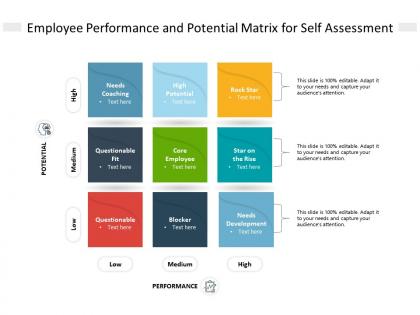
Employee performance and potential matrix for self assessment




Try Before you Buy Download Free Sample Product
 Impress Your
 Audience
 100%
100% Editable
 Save Hours
 of Time


Our Employee Performance And Potential Matrix For Self Assessment are topically designed to provide an attractive backdrop to any subject. Use them to look like a presentation pro.
People who downloaded this PowerPoint presentation also viewed the following :
Employee performance and potential matrix for self assessment with all 2 slides:
Use our Employee Performance And Potential Matrix For Self Assessment to effectively help you save your valuable time. They are readymade to fit into any presentation structure.
FAQs for Employee performance and potential matrix
Key components of an effective employee performance matrix include clear performance metrics, goal alignment with organizational objectives, regular feedback mechanisms, competency assessments, and development planning tools. These elements work together by establishing transparent expectations, tracking progress systematically, and identifying growth opportunities, with many organizations finding that comprehensive matrices ultimately enhance employee engagement and drive measurable productivity improvements.
Organizations can customize performance matrices by identifying key performance indicators that directly support strategic objectives, incorporating role-specific competencies and behavioral expectations, and establishing weighted scoring systems that reflect business priorities. Through tailored metrics aligned with company values, departments can measure both quantitative outcomes and qualitative behaviors, ultimately delivering performance assessments that drive strategic growth and competitive advantage.
Employee performance matrices should include goal achievement rates, quality of work output, collaboration effectiveness, skill development progress, and customer satisfaction scores. These metrics enable organizations to assess both quantitative results and qualitative contributions, with many companies finding that this comprehensive approach streamlines performance reviews while delivering more accurate evaluations and targeted development opportunities.
A performance matrix helps identify high-potential employees by mapping performance ratings against competency levels, leadership skills, and growth trajectory indicators. This strategic assessment enables organizations to pinpoint top performers with advancement potential while highlighting specific skill gaps, ultimately delivering targeted development programs, optimized succession planning, and enhanced talent retention across teams.
Technology streamlines employee performance matrix design through automated data collection, real-time analytics, customizable evaluation frameworks, and integrated feedback systems. These digital solutions enhance accuracy by eliminating manual errors, accelerating review cycles, and providing comprehensive performance insights, with many organizations finding that cloud-based platforms ultimately deliver more consistent evaluations and strategic workforce planning capabilities.
Employee feedback can be integrated through 360-degree reviews, peer evaluations, self-assessments, customer input, and regular check-ins with supervisors. This multi-source approach enables organizations to capture comprehensive performance insights, identify development opportunities, and create more accurate evaluations, while fostering transparency and employee engagement, ultimately delivering improved performance outcomes and stronger organizational alignment.
Common pitfalls include relying on subjective metrics, setting unrealistic benchmarks, inadequate manager training, infrequent feedback cycles, and failing to align individual goals with organizational objectives. These challenges often result in employee disengagement and skewed evaluations, with many organizations finding that regular calibration sessions and clear communication protocols ultimately enhance accuracy and employee satisfaction.
Employee performance matrices should be reviewed quarterly and updated annually, with many organizations conducting mid-year adjustments based on changing business priorities, role evolution, and market conditions. This strategic approach enables managers to track progress consistently, address performance gaps proactively, and align individual contributions with organizational objectives, ultimately delivering enhanced productivity and employee engagement across teams.
Performance matrices contribute to employee motivation and engagement by providing clear expectations, transparent evaluation criteria, regular feedback mechanisms, recognition opportunities, and structured career development pathways. Through visual performance tracking, employees can monitor their progress against specific goals and competencies, while managers can identify high performers for advancement and provide targeted support, ultimately creating a culture of accountability and growth that enhances job satisfaction.
Managers can effectively communicate performance matrix results through one-on-one meetings, transparent feedback sessions, clear goal-setting discussions, and regular check-ins that focus on development opportunities. These structured conversations enable teams to understand their current positioning, identify specific improvement areas, and create actionable development plans, while fostering trust and accountability that ultimately enhances overall organizational performance and employee engagement.
Qualitative metrics in performance matrices focus on subjective behaviors like communication skills, leadership qualities, teamwork, and cultural alignment, while quantitative metrics measure objective data such as sales figures, project completion rates, and customer satisfaction scores. These complementary approaches enable organizations to assess both hard results and soft skills, with many companies finding that combining both delivers comprehensive employee evaluations and strategic workforce insights.
Organizations ensure fairness and objectivity by implementing standardized evaluation criteria, utilizing multiple assessment sources, conducting regular calibration sessions among managers, and establishing transparent review processes with clear documentation requirements. These systematic approaches minimize bias through structured feedback mechanisms, peer evaluations, and data-driven metrics, with many companies finding that consistent training for evaluators and regular matrix audits ultimately deliver more equitable outcomes and enhanced employee trust.
**INPUT**: What strategies can be employed to train managers in utilizing performance matrices effectively? **OUTPUT**: Effective training strategies include comprehensive workshops on matrix interpretation, hands-on practice with real performance data, regular coaching sessions, and integration with existing management development programs. These approaches enhance managerial capabilities by building analytical skills, improving objective evaluation techniques, and fostering data-driven decision making, with many organizations finding that structured training ultimately delivers more consistent performance assessments and better employee development outcomes. **Word count: 60 words**
An employee performance matrix significantly enhances succession planning by providing objective data on employee capabilities, leadership potential, performance trends, and skill gaps across different roles and departments. Through systematic performance tracking, organizations can identify high-potential candidates, assess readiness for advancement, and develop targeted training programs, ultimately ensuring seamless leadership transitions and reduced recruitment costs while maintaining operational continuity.
Best practices for developing performance criteria include ensuring alignment with organizational goals, using measurable and specific metrics, incorporating both quantitative and qualitative indicators, maintaining consistency across roles, and establishing clear expectations. These criteria should reflect job-specific competencies, behavioral standards, and strategic objectives, with many organizations finding that balanced scorecards combining results-driven metrics with developmental elements ultimately deliver more comprehensive employee assessments and improved performance outcomes.
No Reviews