


Employee Role And Responsibilities In Banking Industry




Try Before you Buy Download Free Sample Product
 Impress Your
 Audience
 100%
100% Editable
 Save Hours
 of Time


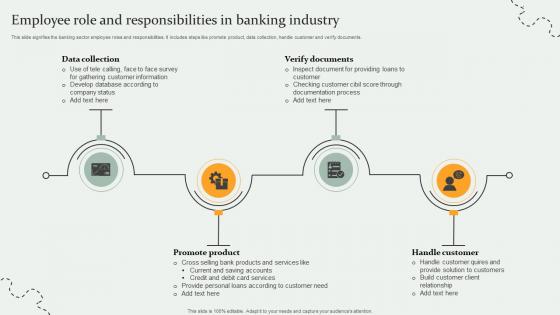
This slide signifies the banking sector employee roles and responsibilities. It includes steps like promote product, data collection, handle customer and verify documents.
People who downloaded this PowerPoint presentation also viewed the following :
Employee Role And Responsibilities In Banking Industry with all 6 slides:
Use our Employee Role And Responsibilities In Banking Industry to effectively help you save your valuable time. They are readymade to fit into any presentation structure.





FAQs for Employee Role And Responsibilities
Key responsibilities include handling customer inquiries, processing account transactions, resolving complaints, promoting banking products, and maintaining accurate records. Through personalized service and product knowledge, representatives enhance customer satisfaction, drive revenue growth through cross-selling opportunities, and build long-term relationships, ultimately delivering improved customer retention and competitive advantage for financial institutions.
Employee roles in risk management directly impact banking stability by identifying potential threats, monitoring compliance with regulatory standards, and implementing preventive measures across all operational levels. Through comprehensive risk assessment protocols, bank employees detect fraud patterns, evaluate loan portfolios, and ensure capital adequacy requirements, ultimately delivering enhanced institutional resilience and customer confidence in an increasingly complex financial landscape.
Essential skills for banking compliance professionals include regulatory knowledge, analytical thinking, attention to detail, communication abilities, and risk assessment expertise. These competencies enable staff to navigate complex financial regulations, conduct thorough audits, and ensure institutional adherence to standards, with many banks finding that strong compliance teams ultimately deliver reduced regulatory penalties, enhanced operational transparency, and sustained competitive advantage in an increasingly regulated environment.
Frontline tellers contribute to customer loyalty by providing personalized service, resolving account issues efficiently, cross-selling relevant products, and creating positive first impressions through professional interactions. Through quick transaction processing, proactive problem-solving, and building genuine relationships, these employees enhance customer experiences, reduce wait times, and increase retention rates, with many banks finding that well-trained tellers significantly boost overall satisfaction scores.
Employees play crucial roles as technology adopters, customer educators, feedback providers, and process champions during banking technology implementations. Through training programs and change management initiatives, bank staff become essential bridges between new systems and customers, helping streamline operations while ensuring seamless service delivery, with many institutions finding that employee engagement significantly accelerates successful technology adoption.
Banking employees can enhance communication skills through active listening training, empathy development, clear verbal articulation, and digital communication proficiency. These approaches streamline client interactions by building trust, reducing misunderstandings, and personalizing service delivery, with many financial institutions finding that improved communication ultimately drives customer satisfaction, retention, and competitive advantage in an increasingly service-focused banking landscape.
Credit analysts evaluate borrower creditworthiness through comprehensive financial analysis, risk assessment, documentation review, market research, and regulatory compliance verification. These professionals streamline lending decisions by analyzing income statements, credit histories, and collateral values, with many banks finding that thorough analyst evaluations significantly reduce default rates while accelerating approval processes for qualified applicants.
Banking employees ensure data security through multi-factor authentication, encrypted communications, strict access controls, regular security training, and compliance monitoring protocols. These safeguards work by limiting system access to authorized personnel, protecting customer information during transactions, and maintaining audit trails, with many financial institutions finding that comprehensive employee training significantly reduces security breaches while enhancing customer trust.
Banking management and leadership differ significantly from other sectors through heightened regulatory compliance requirements, strict risk assessment protocols, and intensive stakeholder accountability measures. While other industries focus primarily on growth and innovation, banking leaders must balance profitability with fiduciary responsibilities, regulatory oversight, and public trust, ultimately delivering sustainable financial services while maintaining institutional stability and customer confidence.
Teamwork among bank employees drives organizational success by enhancing customer service delivery, streamlining operational processes, and ensuring regulatory compliance across departments. Through collaborative efforts, banks achieve faster loan processing, improved risk management, and seamless customer experiences, with many financial institutions finding that cross-functional teams ultimately deliver competitive advantage and operational efficiency.
Bank employees can effectively handle customer conflicts by actively listening to concerns, acknowledging frustrations with empathy, remaining calm under pressure, and focusing on solution-oriented dialogue rather than defensive responses. Through de-escalation techniques and clear communication, banking professionals transform tense situations into relationship-building opportunities, ultimately delivering enhanced customer experiences and stronger institutional trust while maintaining their professional reputation.
Banking institutions typically offer compliance training, regulatory updates, product knowledge sessions, risk management courses, and customer service workshops to ensure employees stay current with evolving standards. These programs often include online modules, in-person seminars, and certification requirements, with many banks finding that continuous education enhances operational efficiency, reduces compliance risks, and ultimately delivers better customer experiences while maintaining regulatory adherence.
Investment banking employees focus on complex financial transactions, mergers and acquisitions, capital raising, and providing strategic advisory services to corporations and institutional clients. In contrast, retail banking staff handle customer-facing services like account management, loan processing, and personal financial guidance, with investment bankers typically working on high-value deals while retail employees streamline everyday banking operations for individual consumers.
Banking employees should prioritize customer confidentiality, conflict of interest disclosure, fair lending practices, transparent fee structures, and regulatory compliance in their daily operations. These ethical foundations enable banks to maintain customer trust, avoid regulatory penalties, and build sustainable relationships, with many financial institutions finding that strong ethical frameworks ultimately deliver competitive advantage and long-term profitability.
Cross-department collaboration enhances service delivery by streamlining communication, reducing processing delays, and enabling comprehensive customer solutions across multiple banking services. When loan officers, customer service representatives, and compliance teams work together seamlessly, banks can expedite loan approvals, resolve complex customer issues more efficiently, and deliver personalized financial solutions, ultimately improving customer satisfaction while reducing operational costs.
-
Topic best represented with attractive design.
-
Thank you SlideTeam for such an excellent service.