


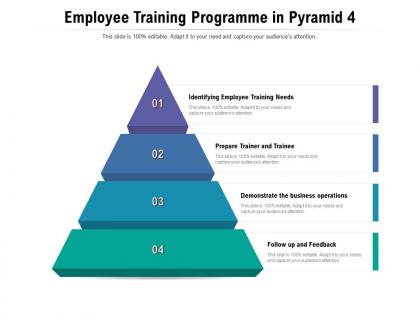
Employee training programme in pyramid 4




Try Before you Buy Download Free Sample Product
 Impress Your
 Audience
 100%
100% Editable
 Save Hours
 of Time


Our Employee Training Programme In Pyramid 4 are topically designed to provide an attractive backdrop to any subject. Use them to look like a presentation pro.
People who downloaded this PowerPoint presentation also viewed the following :
Employee training programme in pyramid 4 with all 2 slides:
Use our Employee Training Programme In Pyramid 4 to effectively help you save your valuable time. They are readymade to fit into any presentation structure.
FAQs for Employee training programme
Effective employee training programs include needs assessment, structured learning modules, hands-on practice opportunities, mentorship components, and continuous evaluation systems. These elements work together by identifying skill gaps, delivering targeted content, and measuring progress, with many organizations finding that comprehensive programs enhance productivity, reduce turnover, and accelerate employee development across departments.
Organizations can assess employee training needs through performance evaluations, skills gap analyses, employee surveys, manager feedback, and industry benchmarking studies. These assessment methods enable companies to identify specific competency deficits, align training with strategic goals, and prioritize development investments, with many organizations finding that systematic needs assessment ultimately delivers more targeted programs and measurable performance improvements.
Technology serves as the backbone of modern employee training programs through learning management systems, virtual reality simulations, AI-powered personalization, mobile learning platforms, and real-time analytics. These digital tools streamline content delivery, enhance engagement through interactive experiences, and enable organizations to track progress while reducing training costs, with many companies finding that technology-driven approaches deliver faster skill development and improved retention rates.
Key metrics include completion rates, knowledge retention scores, skill assessment improvements, employee satisfaction ratings, and job performance indicators. These measurements enable organizations to track learning outcomes, identify skill gaps, and demonstrate ROI through enhanced productivity, reduced turnover, and improved customer service quality, ultimately delivering measurable business value.
Companies ensure training alignment with business objectives by conducting strategic needs assessments, mapping skills gaps to organizational goals, involving leadership in curriculum development, and establishing clear performance metrics. Through regular evaluation cycles and stakeholder feedback, organizations can adjust programs dynamically, with many finding that integrated training approaches deliver measurable improvements in productivity, employee engagement, and competitive positioning.
Best practices for designing engaging training materials include interactive elements, multimedia content, real-world scenarios, microlearning modules, and personalized learning paths. These approaches enhance knowledge retention by incorporating hands-on activities, visual storytelling, and job-specific case studies, with many organizations finding that combining virtual simulations with collaborative exercises ultimately delivers improved performance outcomes and higher completion rates.
Organizations foster continuous learning cultures by implementing mentorship programs, providing regular skill development opportunities, encouraging knowledge sharing sessions, and recognizing learning achievements through rewards systems. Through learning management systems and cross-departmental collaborations, companies like tech firms and financial services create environments where employees actively pursue growth, ultimately delivering enhanced innovation, improved retention rates, and stronger competitive positioning in rapidly evolving markets.
Blended learning approaches combine online modules, in-person workshops, virtual simulations, self-paced coursework, and interactive assessments to maximize training effectiveness. This strategic combination enables organizations to reduce training costs, accommodate diverse learning styles, and deliver more flexible scheduling, while enhancing knowledge retention and ultimately improving employee performance across departments.
Employee feedback integrates into training program development through surveys, focus groups, performance assessments, one-on-one discussions, and post-training evaluations to identify skill gaps and learning preferences. Organizations leverage this input to customize content, delivery methods, and program timing, with many companies finding that employee-driven training initiatives deliver higher engagement rates and improved performance outcomes.
Companies face challenges including budget constraints, employee resistance, scheduling conflicts, measuring ROI, and keeping content current with industry changes. These obstacles can be overcome by implementing phased rollouts, leveraging digital platforms for flexible delivery, creating engaging interactive content, and establishing clear metrics, with many organizations finding that strategic combinations of online and in-person training ultimately deliver better engagement and measurable skill development.
Employee training programs can be customized through visual presentations for visual learners, interactive workshops for kinesthetic learners, audio modules for auditory learners, and self-paced digital content for independent learners. Organizations in healthcare, finance, and manufacturing increasingly find that blended approaches combining multiple formats enhance retention rates, accelerate skill development, and ultimately deliver higher employee engagement and performance outcomes.
**INPUT**: What strategies can enhance knowledge retention among employees after training? **OUTPUT**: Knowledge retention strategies include spaced repetition sessions, microlearning modules, peer mentoring systems, practical application assignments, and regular assessment checkpoints. These approaches enhance retention by reinforcing key concepts, creating multiple learning touchpoints, and enabling hands-on practice, with many organizations finding that combining digital platforms with collaborative learning ultimately delivers improved performance and sustained skill development.
Ongoing support and reinforcement are critical for training effectiveness, as employees typically retain only 10-20% of new skills without follow-up reinforcement, coaching sessions, and practical application opportunities. Through mentoring programs, microlearning modules, and regular check-ins, organizations enhance skill retention, accelerate performance improvements, and maximize training ROI, with many companies finding that sustained support delivers significantly better long-term results than standalone sessions.
Leadership drives employee training success by setting strategic vision, allocating resources, demonstrating commitment through participation, and creating accountability structures that reinforce learning. Through visible engagement and support, leaders foster organizational cultures that prioritize development, with many companies finding that executive participation significantly increases program adoption rates and ultimately delivers enhanced skill development and competitive advantage.
Companies can leverage e-learning platforms to enhance training programs by delivering scalable content, tracking progress analytics, enabling flexible scheduling, and reducing operational costs. These platforms streamline onboarding processes, provide consistent messaging across locations, and offer interactive modules, with many organizations finding that remote accessibility and personalized learning paths ultimately deliver improved employee engagement and faster skill development.
-
Informative presentations that are easily editable.
-
Nice and innovative design.
-
Top Quality presentations that are easily editable.
-
Great experience, I would definitely use your services further.
-
Presentation Design is very nice, good work with the content as well.
-
Really like the color and design of the presentation.
-
Awesomely designed templates, Easy to understand.