


Employee Workload Assessment Report With Action




Try Before you Buy Download Free Sample Product
 Impress Your
 Audience
 100%
100% Editable
 Save Hours
 of Time


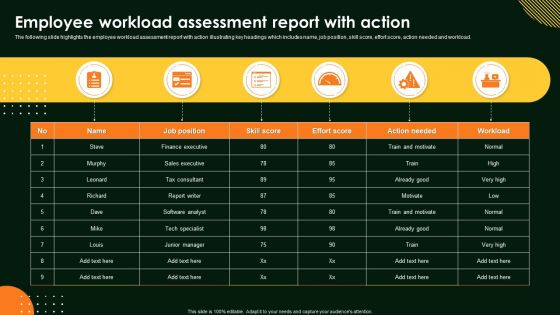
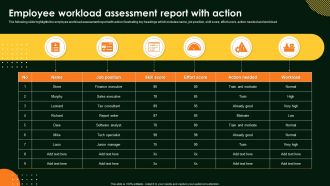
The following slide highlights the employee workload assessment report with action illustrating key headings which includes name, job position, skill score, effort score, action needed and workload.
People who downloaded this PowerPoint presentation also viewed the following :
Employee Workload Assessment Report With Action with all 6 slides:
Use our Employee Workload Assessment Report With Action to effectively help you save your valuable time. They are readymade to fit into any presentation structure.





FAQs for Employee Workload Assessment
Workload assessment tools include time tracking software, project management platforms, employee surveys, performance analytics dashboards, and workload distribution matrices. These methods streamline resource allocation by monitoring task completion rates, identifying bottlenecks, and analyzing productivity patterns, with many organizations finding that strategic workload measurement enhances operational efficiency and reduces employee burnout significantly.
Workload assessment influences productivity by identifying capacity gaps, redistributing tasks more effectively, and preventing burnout through strategic resource allocation. When organizations implement systematic workload evaluation, employees experience reduced stress, improved work-life balance, and clearer performance expectations, ultimately delivering higher engagement levels and enhanced operational efficiency across teams.
Communication serves as the foundation for accurate workload assessment, enabling managers to understand task complexity, time requirements, resource constraints, and employee capacity through regular check-ins and feedback sessions. Through open dialogue, organizations identify bottlenecks, redistribute responsibilities, and adjust project timelines, with many teams finding that transparent communication ultimately delivers better resource allocation and enhanced productivity across departments.
Managers can identify burnout through declining performance quality, increased absenteeism, irritability, missed deadlines, and reduced engagement in meetings or collaborative activities. These warning signs often appear together, with many organizations finding that proactive monitoring through regular one-on-ones, workload audits, and employee feedback surveys enables early intervention, ultimately preserving talent retention and maintaining productivity levels.
Key workload evaluation KPIs include task completion rates, overtime hours, quality metrics, employee utilization percentages, and deadline adherence rates. These indicators work together by revealing productivity patterns, identifying bottlenecks, and measuring resource allocation effectiveness, with many organizations finding that balanced workload tracking ultimately delivers improved employee satisfaction and operational efficiency.
Technology streamlines workload assessment through automated time tracking, AI-powered task analysis, real-time productivity monitoring, and predictive workload forecasting tools. These solutions enable organizations to identify bottlenecks, optimize resource allocation, and prevent employee burnout by delivering data-driven insights, ultimately enhancing operational efficiency and employee satisfaction across teams.
Workload balancing strategies include task redistribution based on capacity, cross-training for flexibility, automated workload monitoring, regular workload reviews, and skill-based task allocation. These approaches streamline team efficiency by preventing burnout, maximizing individual strengths, and ensuring consistent productivity, with many organizations finding that strategic workload management ultimately delivers improved employee satisfaction and enhanced operational performance.
Workload assessments should be conducted quarterly for comprehensive reviews, with monthly check-ins for high-stress departments and real-time monitoring through digital platforms. This strategic combination enables organizations to identify burnout risks early, redistribute resources effectively, and maintain optimal productivity levels, with many companies finding that regular assessments ultimately enhance employee satisfaction and operational efficiency.
Underestimating employee workload creates risks including burnout, decreased productivity, quality deterioration, increased turnover, and missed deadlines that compromise team morale and organizational objectives. These assessment gaps ultimately lead to higher recruitment costs, project delays, and reduced competitive advantage, with many organizations finding that accurate workload evaluation enhances employee satisfaction and operational efficiency.
Employee feedback can be integrated through regular surveys, one-on-one meetings, anonymous reporting systems, workload tracking tools, and team retrospectives. These methods enable organizations to capture real-time insights about task complexity, time constraints, and resource needs, with many companies finding that combining quantitative metrics with qualitative employee input delivers more accurate assessments and improved resource allocation.
Workload assessment significantly reduces employee turnover by identifying burnout risks, redistributing tasks equitably, and ensuring sustainable performance expectations across teams. Through strategic workload management, organizations enhance job satisfaction, improve work-life balance, and create supportive environments, with many companies finding that proactive assessment delivers higher retention rates and reduced recruitment costs.
Cross-departmental collaboration improves workload distribution by enabling resource sharing, identifying skill overlaps, and creating flexible project teams that can adapt to varying demands. Through strategic coordination, departments can redistribute tasks based on capacity and expertise, with many organizations finding that this approach reduces bottlenecks, enhances operational efficiency, and ultimately delivers more balanced workloads across teams.
Legal considerations include compliance with labor laws, overtime regulations, workplace safety standards, anti-discrimination requirements, and employee privacy rights during monitoring. Organizations must ensure workload assessments don't violate wage and hour laws, create hostile work environments, or disproportionately impact protected classes, with many companies finding that transparent, legally-compliant assessment processes ultimately enhance both employee trust and operational efficiency.
Workload assessment contributes to organizational goals by optimizing resource allocation, identifying productivity bottlenecks, and ensuring strategic priorities receive adequate attention. Through systematic workload analysis, organizations streamline operations, reduce employee burnout, and enhance project delivery timelines, with many companies finding that balanced workloads ultimately improve both employee satisfaction and overall business performance.
Best practices for continuous improvement include establishing regular assessment cycles, implementing flexible resource allocation systems, creating cross-training programs, and developing predictive workload models. Through these approaches, organizations streamline operations by identifying bottlenecks early, redistributing tasks efficiently, and building workforce resilience, with many companies finding that systematic workload optimization ultimately delivers enhanced productivity and employee satisfaction.
-
Graphics are very appealing to eyes.
-
Loved the templates on SlideTeam, I believe I have found the go to place for my presentation needs!