


Employers And Employee Expectations Work Quality




Try Before you Buy Download Free Sample Product
 Impress Your
 Audience
 100%
100% Editable
 Save Hours
 of Time


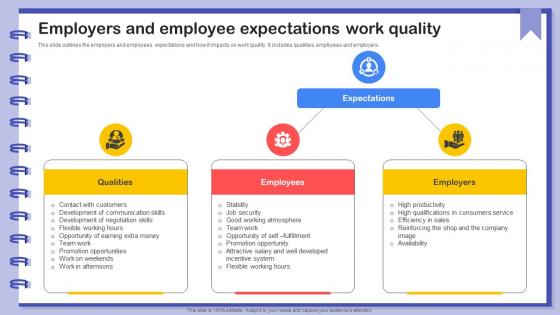
This slide outlines the employers and employees expectations and how it impacts on work quality. It includes qualities, employees and employers.
People who downloaded this PowerPoint presentation also viewed the following :
Employers And Employee Expectations Work Quality with all 9 slides:
Use our Employers And Employee Expectations Work Quality to effectively help you save your valuable time. They are readymade to fit into any presentation structure.








FAQs for Employers And Employee
Key indicators of work quality include accuracy, timeliness, attention to detail, consistency with standards, and alignment with objectives. These indicators enable organizations to maintain client satisfaction, reduce revision cycles, and enhance team productivity, with many professional services firms finding that consistent quality metrics ultimately deliver stronger client relationships and competitive advantage.
Organizations effectively set and communicate work quality expectations by establishing clear performance standards, defining measurable outcomes, providing detailed process guidelines, conducting regular training sessions, and implementing consistent feedback mechanisms. Through structured onboarding programs and ongoing performance reviews, companies in manufacturing, healthcare, and financial services enhance accountability, minimize errors, and ensure consistent deliverables, ultimately delivering improved operational efficiency and customer satisfaction.
Employee training plays a crucial role in achieving high work quality standards by developing essential skills, establishing consistent processes, and reinforcing quality expectations across all organizational levels. Through comprehensive training programs, companies enhance employee competency, reduce errors, and accelerate performance improvement, with many organizations finding that well-trained teams deliver superior customer experiences and maintain competitive advantage.
Feedback mechanisms improve work quality through regular performance reviews, peer evaluations, customer surveys, real-time monitoring systems, and structured coaching sessions. These approaches enable organizations to identify performance gaps, recognize excellence, and provide targeted development opportunities, with many companies finding that systematic feedback loops ultimately deliver higher employee engagement, reduced errors, and enhanced service delivery across all departments.
Work quality directly influences customer satisfaction through reliable products, consistent service delivery, reduced complaints, and enhanced brand reputation. High-quality work translates into increased customer loyalty, positive word-of-mouth referrals, and repeat business, while poor quality results in costly returns, damaged relationships, and competitive disadvantage, ultimately determining long-term profitability and market position.
Work quality expectations vary significantly across sectors, with healthcare and aerospace demanding near-perfect accuracy due to safety implications, while creative industries prioritize innovation and originality over strict compliance. These differences reflect each industry's risk tolerance, regulatory requirements, and customer impact levels, with manufacturing emphasizing consistency and financial services focusing on precision and regulatory adherence, ultimately shaping distinct performance standards and competitive advantages.
Teams commonly face challenges including unclear quality standards, insufficient training, time pressures, inadequate resources, and inconsistent feedback mechanisms when meeting work quality expectations. These obstacles often result in miscommunication, rushed deliverables, and varying performance levels, with many organizations finding that establishing clear protocols, regular training programs, and structured review processes significantly enhances consistency and ultimately delivers improved outcomes across departments.
Technology enhances work quality through automation software, collaborative platforms, data analytics tools, quality management systems, and AI-powered assistance that minimize human error and streamline processes. These solutions enable organizations to maintain consistent standards, accelerate project timelines, and deliver superior outcomes, with many companies finding that strategic technology integration ultimately provides significant competitive advantages while reducing operational costs.
Leadership embodies work quality expectations by modeling excellence, establishing clear standards, providing regular feedback, and investing in team development and training. Through consistent communication and recognition programs, leaders create accountability structures that celebrate high performance, while addressing gaps constructively, ultimately fostering a culture where quality becomes ingrained in daily operations and competitive advantage.
Organizations should track metrics including error rates, customer satisfaction scores, project completion timelines, rework frequency, and compliance adherence rates. These measurements enable businesses to streamline quality processes, enhance operational efficiency, and deliver consistent outcomes, with many companies finding that systematic quality tracking ultimately reduces costs while improving customer experiences and competitive positioning.
Peer reviews contribute to high work quality by fostering accountability, encouraging knowledge sharing, and establishing consistent standards across teams. Through collaborative feedback processes, organizations create transparency around expectations while enabling continuous improvement, with many teams finding that regular peer assessments ultimately enhance both individual performance and collective output quality.
Strategies include setting clear quality benchmarks, implementing staged review processes, leveraging automation tools, establishing priority frameworks, and maintaining regular team feedback loops. These approaches streamline workflows by reducing rework, accelerating approval cycles, and optimizing resource allocation, with many organizations finding that structured processes ultimately deliver faster turnaround times while enhancing overall output quality.
Organizations can recognize high-quality work through performance bonuses, public acknowledgment, career advancement opportunities, flexible work arrangements, and professional development investments. These recognition strategies enhance employee engagement, reduce turnover, and create quality-focused cultures, with many companies finding that combining monetary rewards with growth opportunities delivers stronger motivation and ultimately builds competitive advantage through sustained excellence.
Poor work quality creates cascading effects including reduced team trust, increased workload redistribution, heightened stress levels, declining collaboration, and eroded collective confidence in project outcomes. These dynamics ultimately compromise team cohesion and individual motivation, with many organizations finding that quality issues spread beyond immediate deliverables to affect overall workplace culture and employee retention rates.
Organizations can adapt work quality expectations during rapid change by establishing flexible standards, prioritizing critical outcomes over processes, and maintaining transparent communication about evolving priorities. Through agile frameworks and regular check-ins, companies like healthcare systems during emergencies and financial institutions during market volatility successfully realign quality metrics with current realities, ultimately preserving team morale while delivering essential results.
-
I was confident and well prepared for my presentation for the first time ever. With SlideTeam’s templates, I could deliver one of my best presentations. Will be coming back for more!
-
The design is very attractive, informative, and eye-catching, with bold colors that stand out against all the basic presentation templates.