


Employment Compensation Management Powerpoint Presentation Slides




Try Before you Buy Download Free Sample Product
 Impress Your
 Audience
 100%
100% Editable
 Save Hours
 of Time


Create an efficient payroll system using professionally designed content-ready Employment Compensation Management PowerPoint Presentation Slides. Keep a tab on employee’s financial records such as salaries, bonuses, wages, deductions, etc. Reduce errors and save time in creating payroll entries with the help of employment compensation management PowerPoint presentation slideshow. This deck will help HR managers to make their work easy. It comprises of templates such as recruitment tracker, recruitment budget, employee information management, training management, goal setting & tracking, performance evaluation, leave tracker management, loan management, claim management, etc. These templates are completely customizable. Change color, text, icon, and font size as per your need. Add or remove content from the presentation, if needed. Grab this ready-to-use employment compensation management PPT templates and manage the employee’s salary. Make payroll slips and release salaries on time using payroll management PPT slides. Find favor with customers due to our Employment Compensation Management Powerpoint Presentation Slides. They will be drawn in by your brilliance.
People who downloaded this PowerPoint presentation also viewed the following :
Content of this Powerpoint Presentation
Slide 1: This slide introduces Employment Compensation Management. State Your Company Name and begin.
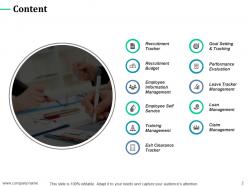
Slide 2: This slide shows Content of the presentation.
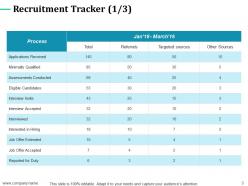
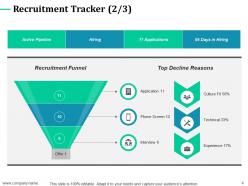
Slide 3: This slide presents Recruitment Tracker. You can change the data as per needs.
Slide 4: This is another slide presenting Recruitment Tracker with recruitment funnel and related text.
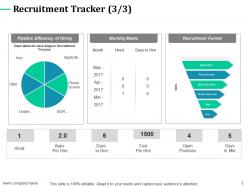
Slide 5: This is another slide showcasing Recruitment Tracker with related charts and tables.
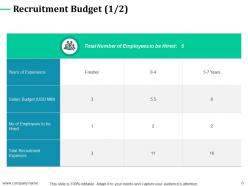
Slide 6: This slide shows Recruitment Budget describing- Years of experience, Salary budget, No. of employees to be hired and Total recruitment expenses.
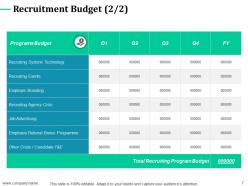
Slide 7: This is another slide on Recruitment Budget with related table and text boxes.
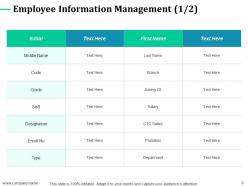
Slide 8: This slide represents Employee Information Management. You can put your employee details like Name, code, grade, designation etc.
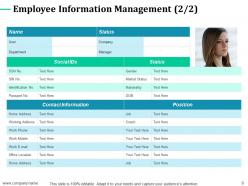
Slide 9: This is another slide that represents Employee Information Management describing employee Name, Status, Contact information, position etc.
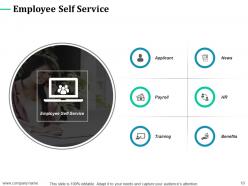
Slide 10: This slide displays Employee Self Service with- Payroll, Applicant, HR, News, Training and Benefits.
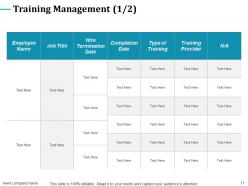
Slide 11: This slide showcases Training Management describing- Employee name, Job title, Hire termination date, Type of training etc.
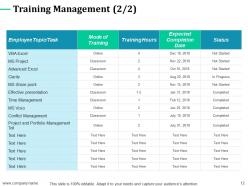
Slide 12: This is another slide showcasing Training Management with- Employee Task, Mode of training, Training hours, Expected completion date and status.
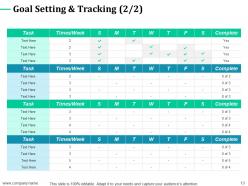
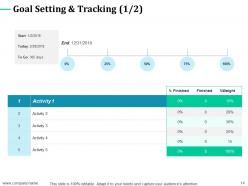
Slide 13: This slide shows Goal Setting & Tracking. Set your goals and its tracking record here.
Slide 14: This is another slide showing Goal Setting & Tracking. Put your tracking details here on daily basis.
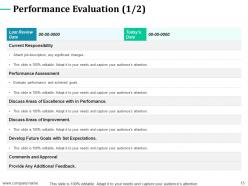
Slide 15: This slide presents Performance Evaluation with- Current responsibility, Performance assessment, Discuss Areas of Excellence with in Performance, Develop Future Goals with Set Expectations etc.
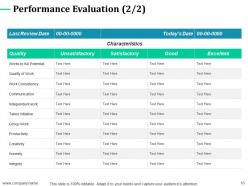
Slide 16: This is another slide presenting Performance Evaluation describing characteristics as Quality, Unsatisfactory, Satisfactory, Good and Excellent.
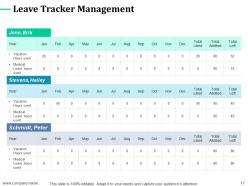
Slide 17: This slide displays Leave Tracker Management to record leaves and holidays of employees.
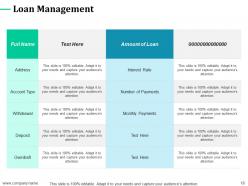
Slide 18: This slide represents Loan Management. This is to record amount of loan, Interest rate, Monthly payments etc.
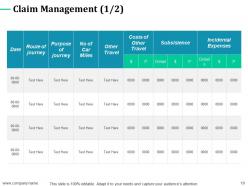
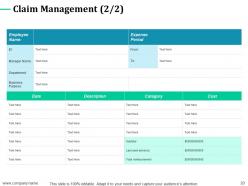
Slide 19: This slide shows Claim Management with related table and text boxes. You can add or edit text as per requirement.
Slide 20: This is another slide on Claim Management describing- Employee information, Expense period, Costs etc.
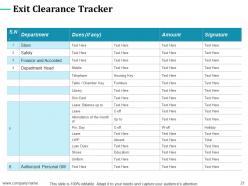
Slide 21: This slide presents Exit Clearance Tracker describing different departments, Dues and other related information.
Slide 22: This slide shows Employment Compensation Management Icons.
Slide 23: This slide reminds about a 15 minutes coffee break.
Slide 24: This slide is titled Additional slides for moving forward. You may change the content as per need.
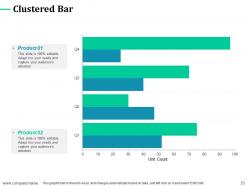
Slide 25: This slide shows Clustered Bar graph chart with two products comparison.
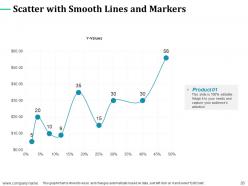
Slide 26: This slide displays Scatter chart with Smooth Lines and Markers.
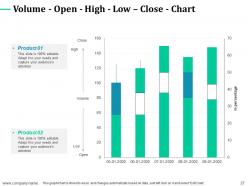
Slide 27: This slide represents Volume - Open - High - Low – Close - Chart of two different products.
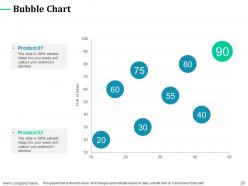
Slide 28: This slide shows Bubble Chart. You can add or edit data as per requirements.
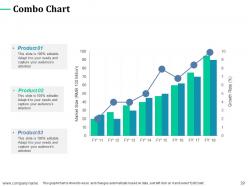
Slide 29: This slide presents Combo Chart with three products comparison.
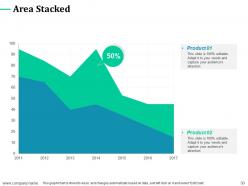
Slide 30: This slide displays Area Stacked chart product/entity comparison, specifications etc.
Slide 31: This slide represents Clustered Column - Line chart with three products comparison.
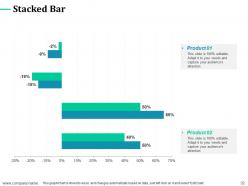
Slide 32: This slide showcases Stacked Bar graph chart in percentage.
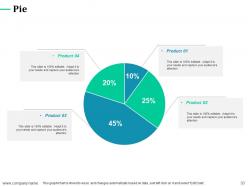
Slide 33: This slide shows Pie chart with four products comparison.
Slide 34: This is Our mission slide with imagery and text boxes to go with.
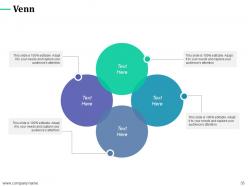
Slide 35: This is a Venn slide with text boxes to show information.
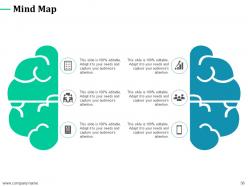
Slide 36: This slide shows Mind Map with related icons and text boxes to go with.
Slide 37: This slide shows a Puzzle with text boxes.
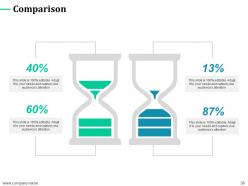
Slide 38: This is a Comparison slide. Show relevant comparing data here.
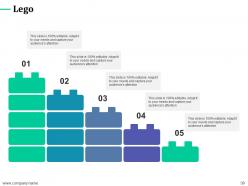
Slide 39: This is a LEGO slide with text boxes to show information.
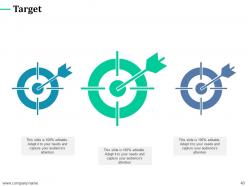
Slide 40: This is a Target slide. State your targets here.
Slide 41: This is a Bulb or Idea slide to state a new idea or highlight specifications/information etc.
Slide 42: This is a Thank You slide with Address# street number, city, state, Contact Number, Email Address.
Employment Compensation Management Powerpoint Presentation Slides with all 42 slides:
Gain an eminent status with our Employment Compensation Management Powerpoint Presentation Slides. They add to the aura of your presence.






FAQs for Employment Compensation Management
Key components include competitive salary structures, performance-based incentives, comprehensive benefits packages, equity compensation options, and regular market benchmarking. These elements work together by attracting top talent, retaining high performers, and aligning employee interests with organizational goals, with many companies finding that strategic compensation management ultimately delivers improved productivity, reduced turnover, and enhanced competitive positioning.
Organizations ensure competitive compensation packages through comprehensive market research, salary benchmarking against industry standards, regular compensation audits, and analysis of competitor offerings. These strategies enable companies to attract top talent, reduce turnover, and maintain competitive positioning, with many finding that combining base salary optimization, performance incentives, and comprehensive benefits ultimately delivers stronger employee retention and enhanced organizational performance in increasingly competitive talent markets.
Internal equity ensures employees with similar roles, skills, and performance receive comparable compensation within the organization, maintaining fairness and reducing pay disparities across departments and positions. This strategic approach enhances employee satisfaction, minimizes turnover, and strengthens retention, with many companies finding that consistent internal pay structures ultimately deliver improved morale, reduced legal risks, and stronger organizational cohesion.
Companies align compensation structures with business goals by linking pay to key performance metrics, incorporating equity-based incentives that reward long-term value creation, and establishing clear connections between individual contributions and organizational objectives. This strategic approach enables businesses to drive desired behaviors, retain top talent, and enhance operational efficiency, with many organizations finding that well-aligned compensation ultimately delivers improved performance and sustainable competitive advantage.
**INPUT**: What are the best practices for conducting a compensation survey? **OUTPUT**: Best practices for conducting compensation surveys include defining clear job benchmarks, selecting relevant industry peers, gathering comprehensive market data, ensuring statistical validity, and maintaining data confidentiality. Through strategic survey design, organizations streamline salary structures, enhance competitive positioning, and improve talent retention, with many companies finding that regular compensation analysis ultimately delivers better recruitment outcomes and reduced turnover costs. *[Word count: 58 words]*
Organizations should approach salary negotiations by researching market rates, establishing clear compensation bands, and maintaining transparency about total compensation packages including benefits, equity, and growth opportunities. This strategic approach enables HR teams to attract top talent while controlling costs, with many companies finding that structured negotiations reduce bias, accelerate hiring decisions, and ultimately deliver better candidate experiences and improved retention rates.
Remote work transforms compensation management by requiring geographic pay adjustments, expanded benefits packages, and new performance metrics beyond traditional office-based evaluations. Organizations increasingly adopt location-based salary bands, enhance digital wellness benefits, and implement flexible compensation structures, with many financial services and tech companies finding that strategic remote compensation policies improve talent retention while managing operational costs across distributed teams.
Performance-based compensation models can be effectively implemented through clear performance metrics, transparent goal-setting processes, regular feedback mechanisms, and fair evaluation criteria aligned with organizational objectives. Organizations across sectors like sales, healthcare, and technology find that combining individual achievements with team-based incentives, supported by robust tracking systems, ultimately delivers improved employee motivation and measurable business results.
Legal considerations in compensation management include equal pay compliance, minimum wage adherence, overtime regulations, benefit mandates, and discrimination prevention across protected classes. These requirements streamline organizational risk management by ensuring fair wage structures, transparent promotion criteria, and compliant benefit offerings, with many companies finding that proactive legal compliance ultimately delivers reduced litigation costs and enhanced employee trust.
Technology and HR software enhance compensation management by automating salary calculations, ensuring pay equity compliance, and streamlining performance-based adjustments across organizations. These systems deliver real-time analytics for strategic decision-making, reduce administrative overhead, and minimize errors, with many companies finding that automated compensation platforms ultimately improve transparency and competitive positioning while reducing processing time significantly.
Managing compensation for lower-performing employees involves performance improvement plans, skill development programs, temporary compensation freezes, role adjustments, and structured feedback systems. These strategies enable organizations to maintain fairness while encouraging growth, with many companies finding that combining targeted training with clear performance metrics ultimately delivers improved productivity and retention, rather than immediate termination.
Benefits and non-monetary incentives comprise crucial compensation components beyond base salary, including health insurance, retirement plans, flexible work arrangements, professional development opportunities, and recognition programs. These elements enhance employee satisfaction, improve retention rates, and reduce recruitment costs, with many organizations finding that comprehensive benefit packages deliver competitive advantage while controlling direct wage expenses in today's talent market.
Organizations can evaluate compensation effectiveness through market benchmarking studies, employee satisfaction surveys, turnover analysis, pay equity audits, and performance correlation assessments. These methods enable companies to identify gaps in competitive positioning, measure employee engagement with current packages, and assess whether compensation strategies drive desired outcomes, with many finding that regular evaluation cycles ultimately enhance retention rates and optimize talent acquisition costs.
Companies can communicate compensation structure transparently through clear pay scales, comprehensive compensation guides, regular salary discussions during reviews, and accessible HR portals detailing benefits and advancement criteria. This approach builds trust, reduces pay inequity concerns, and enhances employee satisfaction, with many organizations finding that transparent communication ultimately delivers improved retention and stronger workplace culture.
Managing compensation during economic downturns presents challenges including budget constraints, talent retention pressures, maintaining equity across roles, balancing cost reduction with employee morale, and adapting pay structures to volatile market conditions. Many organizations find that strategic compensation adjustments, transparent communication, and creative benefit alternatives help navigate these periods while preserving workforce stability and competitive positioning.
No Reviews