


Enabling Automation In Cyber Security Operations Powerpoint Presentation Slides




Try Before you Buy Download Free Sample Product
 Impress Your
 Audience
 100%
100% Editable
 Save Hours
 of Time


Security automation is the process of detecting and preventing cyber threats. With the use of automation technology, the tasks are executed with a reduced human assistance in order to integrate security procedures, applications, and infrastructure. Check out our professionally designed Enabling Automation in Cyber Security Operations PowerPoint presentation. At first, it covers the ineffective security system and its impact on the organization. The PPT also mentions the current state of security level, with security automation architecture and the importance of security automation in business. Additionally, Our Cybersecurity Automation deck mentions the ideal criteria for security automation, including automation tasks, domain security controls, a security process that cant be automated, and the right time to add automation to security. Moreover, this IT Security Automation module includes the security automation stages, security orchestration automation, extended detection, enterprise network IT security automation, security automation integration tools, and unified platform integration. At last, it covers security automation tools, measures security automation success rate, and security automation dashboards. Download this 100 percent editable presentation and get access to our highly researched and skillfully designed product.
People who downloaded this PowerPoint presentation also viewed the following :
Content of this Powerpoint Presentation
Slide 1: This slide introduces Enabling Automation in Cyber Security Operations. State your company name and begin.
Slide 2: This slide states Agenda of the presentation.
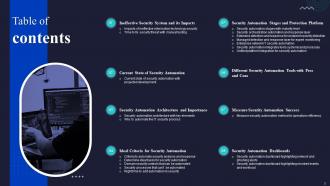
Slide 3: This slide shows Table of Content for the presentation.
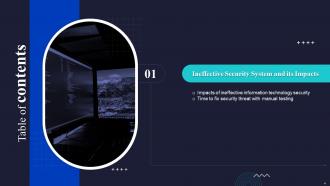
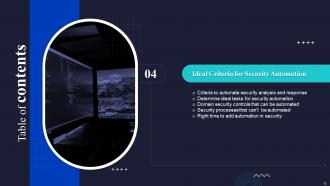
Slide 4: This slide highlights title for topics that are to be covered next in the template.
Slide 5: This slide presents Impacts of ineffective information technology security.
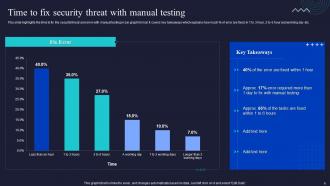
Slide 6: This slide displays Time to fix security threat with manual testing.
Slide 7: This slide highlights title for topics that are to be covered next in the template.
Slide 8: This slide represents Current state of security automation with projected development.
Slide 9: This slide highlights title for topics that are to be covered next in the template.
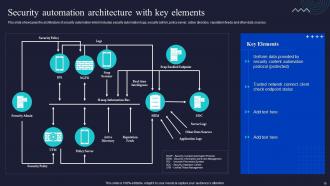
Slide 10: This slide showcases Security automation architecture with key elements.
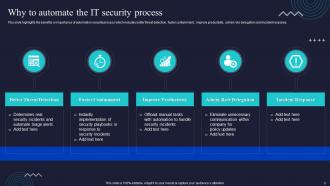
Slide 11: This slide shows Why to automate the IT security process.
Slide 12: This slide highlights title for topics that are to be covered next in the template.
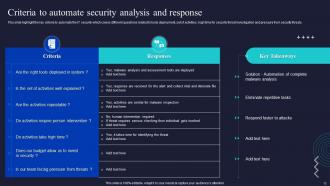
Slide 13: This slide presents Criteria to automate security analysis and response.
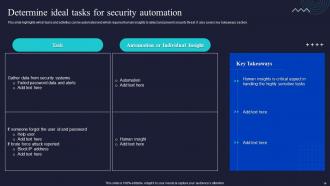
Slide 14: This slide displays Determine ideal tasks for security automation.
Slide 15: This slide represents Domain security controls that can be automated.
Slide 16: This slide showcases Security processes that can’t be automated.
Slide 17: This slide shows Right time to add automation in security.
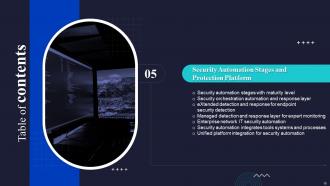
Slide 18: This slide highlights title for topics that are to be covered next in the template.
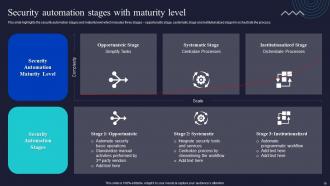
Slide 19: This slide presents Security automation stages with maturity level.
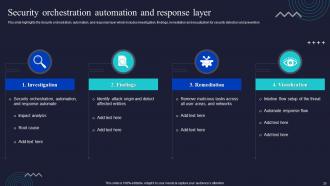
Slide 20: This slide displays Security orchestration automation and response layer.
Slide 21: This slide represents Additional and enhanced protection against scanning attacks.
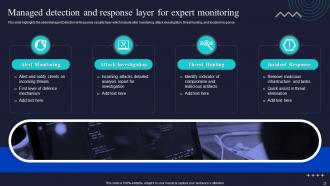
Slide 22: This slide showcases Managed detection and response layer for expert monitoring.
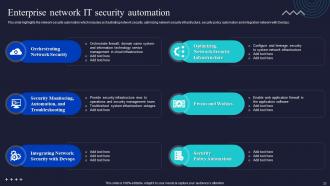
Slide 23: This slide shows Enterprise network IT security automation.
Slide 24: This slide presents Security automation integrates tools systems and processes.
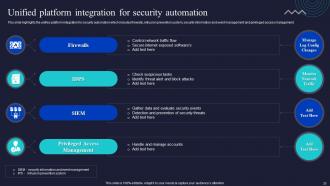
Slide 25: This slide displays Unified platform integration for security automation.
Slide 26: This slide highlights title for topics that are to be covered next in the template.
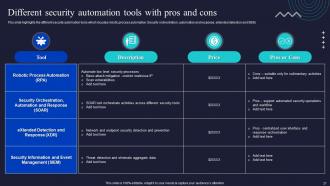
Slide 27: This slide represents Different security automation tools with pros and cons.
Slide 28: This slide highlights title for topics that are to be covered next in the template.
Slide 29: This slide showcases Measure security automation metrics for operations efficiency.
Slide 30: This slide highlights title for topics that are to be covered next in the template.
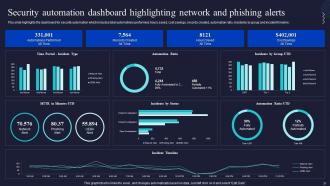
Slide 31: This slide shows Security automation dashboard highlighting network and phishing alerts.
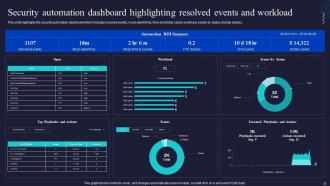
Slide 32: This slide presents Security automation dashboard highlighting resolved events and workload.
Slide 33: This slide contains all the icons used in this presentation.
Slide 34: This slide is titled as Additional Slides for moving forward.
Slide 35: This is About Us slide to show company specifications etc.
Slide 36: This is Our Mission slide with related imagery and text.
Slide 37: This slide depicts Venn diagram with text boxes.
Slide 38: This is Our Team slide with names and designation.
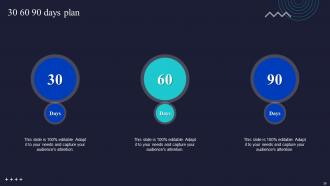
Slide 39: This slide provides 30 60 90 Days Plan with text boxes.
Slide 40: This slide shows Post It Notes. Post your important notes here.
Slide 41: This slide contains Puzzle with related icons and text.
Slide 42: This is a Thank You slide with address, contact numbers and email address.
Enabling Automation In Cyber Security Operations Powerpoint Presentation Slides with all 47 slides:
Use our Enabling Automation In Cyber Security Operations Powerpoint Presentation Slides to effectively help you save your valuable time. They are readymade to fit into any presentation structure.





















FAQs for Enabling Automation In Cyber Security Operations
Key benefits include faster threat detection, reduced response times, enhanced accuracy in identifying vulnerabilities, minimized human error, and improved resource allocation across security teams. Through automated monitoring and incident response, organizations streamline their security operations while enabling staff to focus on strategic initiatives, ultimately delivering stronger protection and operational efficiency in an increasingly complex threat landscape.
Automation enhances real-time threat detection through machine learning algorithms, behavioral analytics, automated scanning, and intelligent monitoring systems that analyze network traffic continuously. These technologies enable security teams to identify anomalies, block malicious activities, and initiate response protocols within seconds, with many financial institutions and healthcare organizations finding significantly faster incident resolution and reduced breach impact.
Automated threat detection significantly reduces incident response times by enabling real-time monitoring, instant alert generation, and immediate threat classification without human intervention. Through machine learning algorithms and behavioral analysis, security teams can identify, prioritize, and contain threats within minutes rather than hours, ultimately minimizing damage while streamlining security operations across increasingly complex network environments.
Machine learning serves as the analytical engine of cybersecurity automation, enabling systems to detect anomalies, predict threats, classify malware, and respond to incidents without human intervention. Through pattern recognition and behavioral analysis, organizations in banking, healthcare, and retail can identify sophisticated attacks, reduce false positives, and accelerate response times, ultimately delivering enhanced security posture and operational efficiency.
Organizations balance automation with human oversight by implementing layered security frameworks where automated systems handle routine threat detection, monitoring, and initial response, while human experts manage complex incident analysis, strategic decision-making, and policy development. This strategic combination enables faster threat response, reduces false positives, and maintains critical human judgment for sophisticated attacks, with many enterprises finding that hybrid approaches deliver enhanced security coverage while optimizing resource allocation.
Common pitfalls include over-relying on automation without human oversight, implementing tools without proper configuration, neglecting regular updates and maintenance, automating processes before understanding them fully, and creating security gaps through poor integration. These challenges can lead to false positives, missed threats, and compliance issues, with many organizations finding that strategic human-automation balance ultimately delivers stronger security postures and operational efficiency.
Automation enhances cybersecurity compliance by continuously monitoring systems, automatically generating audit reports, and ensuring consistent policy enforcement across all network endpoints. Through automated compliance tools, organizations streamline regulatory documentation, reduce manual oversight errors, and maintain real-time adherence to frameworks like GDPR and HIPAA, ultimately delivering faster audit processes and reduced compliance costs.
**INPUT**: Which tools are most effective for automating vulnerability management? **OUTPUT**: Effective vulnerability management automation tools include Nessus, Qualys, Rapid7, OpenVAS, and Greenbone, which streamline scanning, assessment, and remediation processes. These platforms enhance security operations by automatically prioritizing threats, generating actionable reports, and integrating with existing infrastructure, with many organizations finding that automated vulnerability management reduces response times while delivering comprehensive protection. [Word count: 54 words]
Automation significantly reduces cybersecurity management costs by minimizing manual oversight, accelerating threat detection, and streamlining incident response processes. Through automated monitoring and remediation, organizations achieve faster threat neutralization, reduced staffing requirements, and lower operational expenses, with many financial institutions and healthcare providers finding that automation delivers both enhanced security postures and substantial cost savings.
Automation assists threat intelligence gathering by continuously monitoring multiple data sources, correlating threat indicators across networks, and analyzing attack patterns in real-time. Through machine learning algorithms, security teams can process vast amounts of threat data, identify emerging vulnerabilities, and prioritize responses more effectively, ultimately delivering faster threat detection and more strategic security postures.
Best practices for integrating automation into existing cybersecurity frameworks include conducting comprehensive risk assessments, starting with low-risk processes, ensuring seamless integration with current tools, establishing clear governance protocols, and maintaining human oversight for critical decisions. Organizations across finance, healthcare, and retail find that gradual implementation with continuous monitoring enables enhanced threat detection and faster incident response while preserving strategic control over security operations.
Automation facilitates better collaboration by providing centralized threat intelligence dashboards, standardized incident response workflows, and real-time communication channels that keep all team members synchronized. Through automated alert prioritization and shared forensic data, security teams can coordinate responses more effectively, reduce duplicate efforts, and ultimately deliver faster threat resolution while maintaining comprehensive visibility across distributed security operations.
Cybersecurity tasks most suitable for automation include threat detection, vulnerability scanning, incident response, patch management, and log analysis. These automated processes streamline security operations by reducing response times, minimizing human error, and enabling continuous monitoring, with many organizations finding that automation delivers enhanced threat visibility and allows security teams to focus on strategic initiatives requiring human expertise.
Automated phishing detection systems reduce human error by analyzing email patterns, URLs, and sender behaviors in real-time, identifying threats that employees might miss or misinterpret. These systems streamline security responses by flagging suspicious content, quarantining potentially harmful messages, and providing consistent threat assessment, with many financial institutions and healthcare organizations finding that automation delivers faster incident response and significantly enhanced protection against social engineering attacks.
Organizations should track threat detection speed, false positive rates, incident response times, analyst productivity gains, and cost per security event resolved. These metrics enable security teams to measure automation's impact on operational efficiency, resource allocation, and overall security posture, with many enterprises finding that automated systems reduce response times by 60-80% while significantly lowering operational costs.
-
“Detailed and great to save your time.”
-
I am so thankful for all of the templates I've found on your site. They have saved me hours every week and helped make my presentations come alive. Keep up with these amazing product releases!