


Engagement Risk And Job Opportunity Matrix




Try Before you Buy Download Free Sample Product
 Impress Your
 Audience
 100%
100% Editable
 Save Hours
 of Time


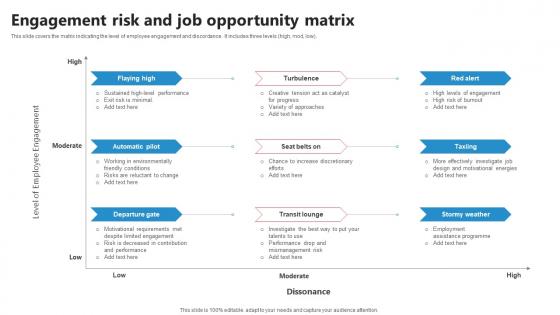
This slide covers the matrix indicating the level of employee engagement and discordance .It includes three levels high, mod, low.
People who downloaded this PowerPoint presentation also viewed the following :
Engagement Risk And Job Opportunity Matrix with all 6 slides:
Use our Engagement Risk And Job Opportunity Matrix to effectively help you save your valuable time. They are readymade to fit into any presentation structure.





FAQs for Engagement Risk And
Key indicators of engagement risk include declining participation rates, reduced communication frequency, missed deadlines, decreased quality of deliverables, and increased resistance to feedback or change initiatives. These warning signs often manifest through lower meeting attendance, delayed responses to critical communications, and diminished collaborative behaviors, with many organizations finding that early identification of these patterns enables proactive intervention strategies, ultimately preventing project derailment and maintaining team productivity.
Organizations can effectively measure engagement risk through employee satisfaction surveys, turnover rate analysis, absenteeism tracking, productivity metrics, and pulse surveys. These measurement approaches enable companies to identify disengagement patterns across departments, predict retention challenges, and implement targeted interventions, with many organizations finding that regular assessment ultimately delivers improved workplace culture and competitive advantage.
Leadership plays a crucial role in mitigating engagement risk by fostering transparent communication, providing clear direction and purpose, recognizing employee contributions, and creating development opportunities. Effective leaders in organizations like healthcare systems, financial services, and manufacturing companies actively listen to team concerns, align individual goals with organizational objectives, and build trust through consistent actions, ultimately delivering higher retention rates, improved performance, and stronger workplace culture.
Common causes of engagement risk in remote and hybrid environments include communication breakdowns, reduced social connections, technology fatigue, unclear expectations, and limited career development opportunities. These challenges particularly affect distributed teams in sectors like consulting, financial services, and technology companies, with many organizations finding that proactive communication strategies, virtual collaboration tools, and structured feedback processes significantly enhance employee connection and ultimately deliver improved retention and productivity outcomes.
Engagement risk significantly undermines organizational performance by reducing employee productivity, increasing turnover rates, and diminishing innovation capacity. When employees lack engagement, organizations experience higher absenteeism, lower quality output, and reduced customer satisfaction, with many companies finding that disengaged workforces ultimately deliver weaker financial results and competitive disadvantage.
Strategies to enhance employee engagement include regular feedback systems, professional development opportunities, flexible work arrangements, recognition programs, and clear career progression paths. These approaches streamline communication, minimize turnover risks, and boost productivity, with many organizations finding that engaged employees deliver significantly better customer experiences, reduce operational costs, and ultimately provide sustainable competitive advantage in increasingly talent-focused markets.
Data analytics identifies potential engagement risks by monitoring employee sentiment patterns, analyzing productivity metrics, tracking communication frequency, and detecting behavioral changes that signal disengagement. Through predictive modeling and real-time dashboards, organizations can spot early warning signs like decreased collaboration, rising absenteeism, or declining performance scores, ultimately enabling proactive interventions before risks escalate.
High engagement risk creates lasting cultural damage through increased turnover, declining productivity, weakened collaboration, and erosion of organizational trust and innovation. These effects compound over time, with many companies finding that disengaged teams become increasingly resistant to change initiatives, ultimately creating toxic work environments that repel top talent and significantly undermine competitive advantage.
Organizations can encourage open communication through regular employee surveys, anonymous feedback systems, focus groups, skip-level meetings, and open-door policies with leadership. These approaches enable managers to identify disengagement early, address workplace concerns proactively, and create psychological safety, with many companies finding that transparent dialogue ultimately reduces turnover and enhances overall organizational performance.
Employee feedback can be gathered through anonymous surveys, one-on-one meetings, focus groups, exit interviews, and pulse surveys to assess engagement risk. These methods enable organizations to identify disengagement patterns, measure satisfaction levels, and uncover retention challenges, with many companies finding that regular feedback collection streamlines intervention strategies and ultimately delivers improved workplace culture and reduced turnover costs.
Cultural differences significantly influence engagement risk perceptions through varying communication styles, hierarchy expectations, feedback preferences, and work-life balance priorities across global teams. Organizations with diverse workforces find that standardized engagement strategies often miss cultural nuances, with many multinational companies increasingly adopting localized approaches that respect regional values while maintaining unified goals, ultimately delivering stronger employee connection and reduced turnover across all markets.
Effective engagement risk monitoring tools include customer analytics platforms, social media sentiment analysis, CRM systems with engagement tracking, predictive analytics software, and real-time feedback management systems. These technologies streamline risk identification by analyzing customer behavior patterns, measuring satisfaction levels, and predicting churn probability, with many organizations finding that integrated platforms deliver enhanced customer retention and competitive advantage.
Employee recognition plays a crucial role in reducing engagement risk by boosting morale, increasing retention, and enhancing productivity across organizations. Through strategic recognition programs, companies strengthen emotional connections, reduce turnover costs, and create positive workplace cultures, with many finding that consistent acknowledgment ultimately drives higher performance and competitive advantage.
Effective onboarding addresses engagement risk through structured orientation programs, clear role expectations, early relationship building with managers and peers, and regular feedback sessions during initial weeks. Companies like Microsoft and Salesforce enhance engagement by assigning dedicated mentors, providing comprehensive training pathways, and conducting frequent check-ins, ultimately reducing turnover and accelerating productivity across new hires.
Best practices for engagement risk assessment in fast-paced industries include implementing automated monitoring systems, establishing real-time data analytics, conducting rapid stakeholder consultations, utilizing agile assessment frameworks, and maintaining continuous risk evaluation processes. These approaches enable organizations to identify potential risks quickly while maintaining operational speed, with many technology and financial services companies finding that streamlined assessment protocols deliver faster decision-making and enhanced competitive positioning.
-
The designs are very attractive and easy to edit. Looking forward to downloading more of your PowerPoint Presentations.
-
“Love it! I was able to grab an exciting proposal because of SlideTeam.”