


Engineering And Construction Business Plan Powerpoint Presentation Slides





Try Before you Buy Download Free Sample Product
 Impress Your
 Audience
 100%
100% Editable
 Save Hours
 of Time


Despite current challenges in specific construction industry sectors, the United States continues to present an excellent medium to long term growth opportunity. In the next four quarters, steady growth is projected for the construction industry in the country. Grab our insightfully designed Engineering and Construction Business Plan. It includes an executive summary, entity details, industry analysis, and financial summary, among other crucial sections. Our Construction industry deck effectively informs prospective clients about the range of services offered by the construction startup. Moreover, it enables clients to assess market scenarios through a thorough SWOT analysis and Porters framework. Moreover, our Remodeling PPT covers various important topics, including customer profiling, geographical analysis, market sizing, etc. It also provides a comprehensive financial plan, incorporating elements like a Profit and Loss statement, revenue model, cash flow analysis, balance sheet statement, and DCF valuation. Lastly, our Residential construction module outlines potential exit options for stakeholders, ensuring a well rounded understanding of the business plan. To gain valuable insights and guidance for the construction industry, download our construction business plan presentation today.
People who downloaded this PowerPoint presentation also viewed the following :
Content of this Powerpoint Presentation
Slide 1: This slide introduces Engineering and Construction Business Plan. Commence by stating Your Company Name.
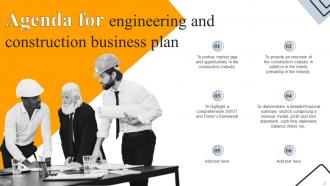
Slide 2: This slide depicts the Agenda of the presentation.
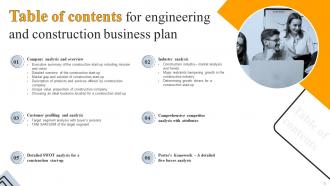
Slide 3: This slide includes the Table of contents.
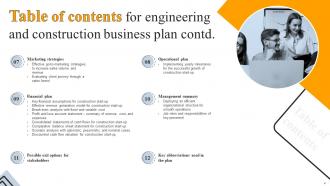
Slide 4: This is yet another slide continuing the Table of contents.
Slide 5: This slide highlights the Title for the Topics to be discussed further.
Slide 6: This slide shows the Executive summary of the construction start-up including mission and vision.
Slide 7: This slide presents a Detailed overview of the construction start-up.
Slide 8: This slide continues the Detailed overview of the construction start-up. The purpose of the slide is to portray organization details.
Slide 9: This slide displays the Market gap and solution of a construction start-up.
Slide 10: This slide shows the Description of products and services offered by construction company.
Slide 11: This slide displays the Unique value proposition of construction.
Slide 12: This slide focuses on Choosing an ideal business location for a construction start-up.
Slide 13: This slide depicts the Heading for the Contents to be covered in the following template.
Slide 14: The purpose of this slide is to conduct a thorough assessment of the construction industry in addition to its market trends.
Slide 15: This sldie continues conducting a thorough assessment of the construction industry in addition to its market trends.
Slide 16: This is yet another slide continuing Market analysis and trends.
Slide 17: This slide portrays the Major restraints hampering the growth in construction industry.
Slide 18: This slide deals with Determining growth drivers for a construction industry.
Slide 19: This slide reveals the Title for the Ideas to be discussed next.
Slide 20: This slide shows the Target segment analysis with buyer’s persona.
Slide 21: This slide covers the Target segment analysis with buyer’s persona.
Slide 22: This slide showcases the TAM SAM SOM of the target segment.
Slide 23: This slide displays the Heading for the Ideas to be covered in the following template.
Slide 24: This slide states the Comprehensive competitor analysis with attribute.
Slide 25: This slide continues the Comprehensive competitor analysis with attributes.
Slide 26: This slide incorporates the Title for the Contents to be discussed next.
Slide 27: This slide states the Detailed SWOT analysis for a construction start-up.
Slide 28: This slide depicts the Heading for the Topics to be covered in the upcoming template.
Slide 29: This slide highlights porter’s framework and its implications in the construction industry.
Slide 30: This slide depicts the Title for the Topics to be discussed further.
Slide 31: This slide deals with Effective go-to-marketing strategies to increase sales volume and revenue.
Slide 32: This slide portrays Effective go-to-marketing strategies to increase sales volume and revenue.
Slide 33: This slide continues the Effective go-to-marketing strategies to increase sales volume and revenue.
Slide 34: This is yet another slide continuing the Effective go-to-marketing strategies to increase sales volume and revenue.
Slide 35: This slide deals with Evaluating client journey through a sales funnel.
Slide 36: This slide includes the Heading for the Contents to be covered in the next template.
Slide 37: This slide focuses on Implementing yearly milestones for successful growth of start-up.
Slide 38: This slide portrays the Title for the Ideas to be discussed next.
Slide 39: This slide states the Key financial assumptions of the organization.
Slide 40: The slide shows the effective revenue model of the construction start-up, which displays the cost incurred and the various sources of income.
Slide 41: This slide illustrates the Break-even analysis with fixed and variable cost.
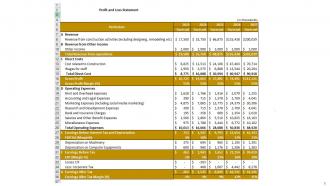
Slide 42: The slides presents the projected profit and loss statement to visualize the platform’s financial performance for the next five years.
Slide 43: The slides continues the projected profit and loss statement.
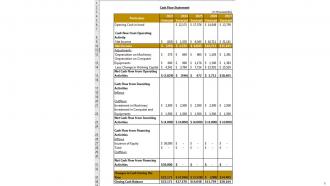
Slide 44: This slide reveals the Consolidated statements of cash flow of the construction start-up.
Slide 45: This slide continues the Consolidated statements of cash flow of the construction start-up.
Slide 46: This slide highlights the Comparative balance sheet statement of the construction start-up.
Slide 47: This slide continues the Comparative balance sheet statement of the construction start-up.
Slide 48: This slide displays the Scenario analysis with optimistic, pessimistic, and nominal cases.
Slide 49: This slide continues the Scenario analysis with optimistic, pessimistic, and nominal cases.
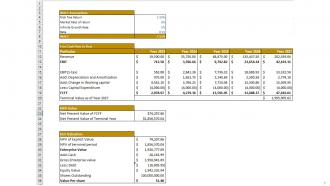
Slide 50: This slide reveals the Discounted cash flow valuation of the construction start-up.
Slide 51: This slide portrays the Heading for the Ideas to be covered next.
Slide 52: The purpose of this slide is to craft a successful hierarchical framework for the firm to ensure smooth operations.
Slide 53: This slide exhibits the Job roles and responsibilities of key personnel.
Slide 54: This slide continues the Job roles and responsibilities of key personnel.
Slide 55: This slide states the Title for the Contents to be discussed next.
Slide 56: This slide represents exit strategy for stakeholders such as IPO, Mergers, Acquisitions, Private offerings, and Venture Capital.
Slide 57: This slide continues the Possible exit options for stakeholders.
Slide 58: This slide depicts the Heading for the Topics to be covered in the forthcoming template.
Slide 59: This slide highlights the Key abbreviations used in the plan.
Slide 60: This is the Icons slide containing all the Icons used in the plan.
Slide 61: This slide is used for depicting some Additional information.
Slide 62: This is the 30 60 90 days plan slide for effective planning.
Slide 63: This is Our team slide. State Your team-related information here.
Slide 64: This is Our goal slide. Mention about your comapny-goals here.
Slide 65: This is the Idea generation slide for encouraging innovative ideas.
Slide 66: This is the Venn diagram slide.
Slide 67: This is the Puzzle slide with related imagery.
Slide 68: This is the Quotes slide for motivation.
Slide 69: This is the Thank You slide for acknowledgement.
Engineering And Construction Business Plan Powerpoint Presentation Slides with all 75 slides:
Use our Engineering And Construction Business Plan Powerpoint Presentation Slides to effectively help you save your valuable time. They are readymade to fit into any presentation structure.






















FAQs for Engineering And Construction Business Plan
So you need the basic stuff: executive summary, company description, market analysis, organization structure, products/services, marketing strategy, funding requests, and financial projections. The exec summary is huge - investors literally decide in those first few paragraphs if they'll keep reading or toss it. Market analysis has to show real research about your competition and customers. Oh, and don't skip operational plans with actual timelines. Honestly, I'd just grab a template online and tweak it for your business. Better to get something down on paper than sit there trying to make it perfect, you know?
Each industry tweaks their business plans based on what actually moves the needle for them. Tech companies obsess over user growth and how fast they can scale. Manufacturing? They're all about supply chains and production capacity. Retail gets crazy detailed about locations and inventory - seriously, mess up your seasonal planning and you're toast. Healthcare and finance companies spend forever on compliance stuff because they have to. Figure out what makes or breaks companies in your space, then beef up those sections of your plan. Oh, and check out competitor filings if they're public - you'll see what they think matters most.
Dude, financial projections are basically what make your business plan legit. Investors want to see you've crunched the numbers - revenue forecasts, expenses, cash flow, profit/loss stuff for like 3-5 years. Total drag to build but they save your ass by catching cash problems early. Plus they prove you actually get how your business works. I learned this the hard way on my first pitch - went in with zero projections and got laughed out. Start conservative with your estimates. Way better to beat expectations than fall short and look like an idiot.
Dude, visuals are everything for business plans. Nobody wants to stare at spreadsheet hell when they could see a clean chart instead. Your fonts and colors need to match - looks way more professional that way. Icons and timelines break up boring text blocks nicely. I'd grab a simple template that fits your brand vibe. Don't get crazy with animations though, that's just distracting. Half the battle is not looking like you threw it together last minute, honestly. The whole point is guiding investors through your story without making their eyes glaze over.
Honestly, most people mess up by being way too optimistic about money stuff - like thinking they'll make millions in year two. Market research gets skipped constantly too. Keep it short though, nobody wants to read 50 pages of fluff. I've seen so many plans that just list product features without explaining how they'll actually beat the competition or turn a profit. That's backwards thinking imo. Don't forget the team section either - investors bet on people, not just ideas. Make every part answer "why should I care?" Works way better.
So startup plans are all about proving your idea works and getting investors excited. You're basically selling a dream with tons of projections since you don't have real data yet. Focus hard on market research and what makes you different. Established companies? Way different story. They've got actual numbers to work with and existing customers. Their plans are more like "here's how we'll grow what's already working" instead of "please believe this will work." Honestly, writing for established businesses is so much easier - you're not making educated guesses about everything. Just match your plan to wherever you're at.
Dude, you absolutely have to do market analysis first. Talk to real people who'd actually buy your stuff - their feedback will save you from disaster later. I've watched so many startups skip this and just... yikes. Figure out who your competitors are and how big the market actually is before you spend a dime. Otherwise your business plan is basically fan fiction. It helps you find opportunities and spot problems early, plus you'll have revenue numbers that don't sound completely made up when you pitch investors. Seriously though, start with customer conversations - everything builds from there.
Definitely spend real time on competitive analysis - don't just throw together a basic list. Map out who you're actually up against, both obvious competitors and sneaky indirect ones. Try their products yourself if you can, seriously makes a huge difference compared to just scrolling their websites. Look at their pricing, how they position themselves, what they suck at. The key is finding those gaps you can actually fill. Skip the generic "we're the best" nonsense. Show exactly how you're different and your actual plan for stealing market share. Honestly, this section can make or break investor interest.
Look at your market size and competition first - that'll give you a reality check on what's actually possible. Set specific targets like "30% revenue increase" instead of vague stuff like "grow bigger." Realistic deadlines are huge too, otherwise you're just setting yourself up to fail. Think about what your team can actually handle and any outside stuff that might mess with your plans (regulations, economy being weird, whatever). Honestly? I've watched so many businesses crash because they ignored basic limits. Just pick your top 3-5 things and work backwards from there.
Dude, storytelling completely changes the game for business plans. Nobody wants to read another boring list of market stats - turn that stuff into an actual story instead. Your solution is the hero, your team guides the journey, and those financial projections? They're showing where you're headed. Real customer examples make everything click. I always tell people to try starting a section with "Imagine if..." and watch how much better it flows. Most investors see dozens of these things, so yours needs to stick. The problem-solution-outcome structure works every time, honestly.
Honestly, just combine both types of research and you'll be fine. Government stats, industry reports, competitor websites - grab all that free stuff first to understand the market. Way cheaper than hiring some fancy research firm (unless you're going after millions in funding). After that, talk to actual people. Surveys work, but I swear phone interviews with potential customers tell you way more. Focus groups are solid too if you can swing it. The whole point is validating what you think you know about your market. Most founders skip the customer conversation part and that's where they mess up.
Honestly, those business planning tools are total lifesavers. LivePlan and Bizplan have templates that basically hold your hand through everything - no more staring at blank pages wondering where to start. The financial stuff used to kill me, but now you just plug in your numbers and boom, projections are done. Plus they sync with QuickBooks and stuff so your real data automatically updates your plan (which is clutch). The collaboration thing is huge too - my co-founder and I can both edit at once instead of that annoying back-and-forth email thing. Start simple though, don't blow money on fancy enterprise versions right away.
Dude, make it story-driven and super tight - these people see like 50 pitches a week. Start with the problem and why it matters RIGHT NOW, then hit solution, market size, traction. Numbers are everything, especially if you've got revenue or users growing. Practice till you can do it in 10-15 minutes max (they will literally cut you off). Honestly, the best founders I've seen just own what they don't know. Be ready for brutal questions about competitors and scaling. But here's the thing - show you're teachable. Ask for their advice on stuff you're stuck on. That's what gets them invested, not just in your company but in YOU.
Honestly, just pick stuff you can actually measure - revenue numbers, how many customers you're getting, when products launch, whatever. Make deadlines real and put someone's name on each thing. I use a basic spreadsheet that everyone can check because vague "we're making progress" updates are the worst. Weekly check-ins work for most stuff, monthly if things move slower. Oh and actually set phone reminders to review this regularly or you'll forget. The milestones have to tie back to your real business goals though, not just busy work that feels productive.
Definitely check out SCORE first - they've got free templates and mentoring that's actually legit. The SBA website has solid planning guides too. If you want something more hand-holdy, LivePlan or Bizplan are decent software options (though they'll cost you). Your local Small Business Development Center does free one-on-one stuff, which is clutch. Oh, and don't sleep on your library - they usually have business databases you can access. Honestly, I'd just grab SCORE's free template and start there. Why pay when you don't have to, right?
-
“I always have a wonderful experience with SlideTeam. It's my ""go to"" when I need a template.”
-
I never had to worry about creating a business presentation from scratch. SlideTeam offered me professional, ready-made, and editable presentations that would have taken ages to design.