

Enterprise DevOps With Agile It Operating Model




Try Before you Buy Download Free Sample Product
 Impress Your
Audience
 100%
Editable
 Save Hours
of Time


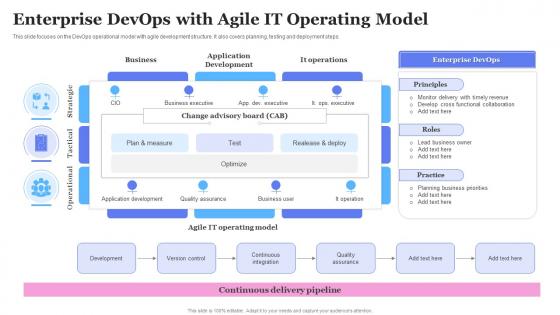
This slide focuses on the DevOps operational model with agile development structure. It also covers planning, testing and deployment steps.
People who downloaded this PowerPoint presentation also viewed the following :
Enterprise DevOps With Agile It Operating Model with all 6 slides:
Use our Enterprise DevOps With Agile It Operating Model to effectively help you save your valuable time. They are readymade to fit into any presentation structure.






FAQs for Enterprise DevOps With Agile
So enterprise DevOps is basically regular DevOps but with a ton more red tape. You're juggling governance, compliance, security - all that fun stuff - across hundreds of teams instead of just yours. Honestly, it can be a nightmare sometimes. The toolchains need to be standardized, policies centralized, and don't even get me started on the documentation requirements. One screw-up costs millions, so everything has to be repeatable and auditable. But teams still want to move fast, which creates this constant tension. My advice? Figure out which compliance rules actually apply to your industry first - half of them probably don't even matter for what you're doing.
Honestly, start with the DORA metrics everyone talks about - deployment frequency, lead time, recovery time, and failure rates. Those give you the technical baseline. But here's the thing, you also need business stuff like customer satisfaction and revenue impact, otherwise you're just optimizing in a vacuum. Set your baselines first before changing anything (learned this the hard way). Then pick maybe 4-6 metrics total - I've seen teams drown in dashboards with like 20 different charts. Focus on what actually moves the needle. Track consistently and don't get cute with the data.
Look, I've watched too many companies dump money into fancy DevOps tools only to crash and burn because nobody wanted to actually work together. The whole dev vs ops thing? That's your real enemy here. You can't just throw technology at a people problem - trust me on this one. Getting teams to share ownership instead of pointing fingers when stuff breaks, that's where the magic happens. Yeah, the culture shift takes way longer than setting up your CI/CD pipeline, but it's literally what makes everything click. Start small though - get some quick wins with cross-team collaboration before trying to revolutionize your entire org.
So the whole point is getting everyone to stop working in their own little bubbles, you know? Pick one project where dev, ops, and security can all use the same tools and dashboards. Suddenly everyone can see what's actually happening instead of guessing. Automation becomes this shared thing that makes people work together rather than blame each other when stuff breaks. Honestly, the biggest win is having the same success metrics - no more competing priorities driving people crazy. Just start small with one cross-functional team and get them on unified tools. You'll notice the difference pretty fast.
Honestly, the biggest pain is gonna be cultural pushback - teams hate sharing their toys. Legacy systems are basically held together with duct tape, so good luck there. Security teams will lose their minds over faster deployments. Oh, and your ops people? They're gonna need serious training on automation stuff they've never touched. Different business units all use random tools too, which is a nightmare. My advice? Don't go crazy trying to fix everything. Pick one small team first and prove it works - way less drama that way.
Dude, automation tools will literally save your sanity. All those repetitive tasks that make you want to pull your hair out? Gone. CI/CD pipelines, testing, deployments - automate it all. Your devs can actually code instead of watching deployments crawl along (seriously, who has time for that?). Ops team gets to do real strategy work. Here's what I'd do: pick your worst manual process first. The one that makes everyone groan. Start there, then keep adding more. You'll be amazed how much time you get back.
Dude, you gotta bake security right into your CI/CD pipeline from day one. Don't let it be an afterthought anymore - that approach is basically dead now. Set up automated scans for vulnerabilities, dependencies, and container images on every single commit. Static code analysis too. Get something like HashiCorp Vault for secrets management (trust me on this one), lock down access controls with least-privilege, and define your infrastructure as code so you can actually track changes. Oh, and make security failures break your build just like any other test would. If it doesn't fail the build, developers won't care about fixing it.
Honestly, cloud tech makes DevOps so much smoother. You can spin up environments instantly instead of waiting around for server approvals. Scaling happens automatically when traffic spikes, and CI/CD pipelines run way faster with their built-in tools. Your whole team can actually work together properly since everything's centralized - no more of that "works fine on my laptop" nonsense. What really sold me was how it kills those old infrastructure headaches that used to block releases for weeks. I'd start with moving your dev and test stuff over first, then you'll get the hang of it pretty quick.
Focus on the DORA metrics - deployment frequency, lead time, mean time to recovery, and change failure rate. They'll actually show you where things are breaking down. Honestly, most teams waste time tracking stuff that looks impressive but doesn't help. Pick 3-4 metrics max and review them weekly with everyone. Make the data visible to your whole team, not buried in some dashboard. Then use what you learn to change your actual process. I've watched too many people get overwhelmed with fancy charts they never use. Start simple and build from there.
Look, get the executives on board first or you're dead in the water. Build teams with people from different departments who actually want this to work - those internal champions will save your butt when everyone starts complaining. Don't go all-in right away though, that's a recipe for disaster. Start small with pilot projects to show it actually works. Oh, and train your people constantly because they're probably freaking out about being replaced. Communication is huge too - keep everyone posted on what's happening, good or bad. Scale up the stuff that works.
Honestly, AI and ML are game-changers for DevOps right now. They handle all the boring automated stuff so you don't have to. Predictive analytics will catch problems before they explode in your face, plus you get automated code reviews and smarter deployment patterns. ML algorithms dig through your performance data and auto-scale resources when needed - or they'll flag weird anomalies you'd totally miss otherwise. It's like having that one coworker who actually pays attention to everything. Start small though - pick one or two AI tools first instead of going crazy and trying to rebuild your whole pipeline at once.
Honestly, microservices are a game changer for deployment flexibility. You can push updates to individual services without taking down everything else - which is clutch when you're moving fast. Teams get to own their stuff completely and choose whatever tech stack makes sense for them. Scaling gets way smarter too since you're only beefing up the parts that actually need it instead of throwing resources at your entire monolith. CI/CD becomes less of a headache with smaller codebases. Just don't skip the monitoring setup first though, or you'll create a debugging nightmare that makes your old system look simple.
Honestly, you've gotta build psychological safety first or nobody will try anything new. People need to know they won't get thrown under the bus when stuff doesn't work out. Do blameless postmortems where you figure out what happened without the blame game. Give teams actual time to experiment - maybe 20% time to mess around with new tools. Hackathons work great for this. Here's the thing though: you have to celebrate the smart failures, not just wins. Some companies even do "failure parties" where teams share what bombed and what they learned from it. Sounds weird but it actually shifts the culture pretty fast.
Honestly, leadership buy-in is everything for DevOps. Without it, you're screwed. Your engineers will be banging their heads against the wall trying to change processes while management fights them every step. Good leaders need to actually get that this isn't just about fancy new tools - it's rewiring how the whole company ships software. They've got to break down silos between teams and back people up when things go sideways (and trust me, they will). I've seen too many transformations fail because executives just nodded along without really committing. Don't even start unless leadership truly understands what they're signing up for.
Stop treating compliance like something you deal with after the fact - bake it straight into your CI/CD pipeline. Security scans, policy checks, audit trails... all of that should happen automatically during deployment. Trust me, I've watched teams crash and burn trying the "move fast, worry about compliance later" thing. It's a disaster every time. Infrastructure as code with guardrails built in will save your butt. Set up continuous monitoring and give your devs pre-approved templates they can actually use without jumping through hoops. Pick your biggest compliance headaches first and automate those - you'll thank yourself later.
-
SlideTeam is a great place for PPT templates. They have many templates on a single topic. It has made my life a lot easier.
-
SlideTeam, Please don’t stop sharing discount coupons! I love your occasional discounts and tend to buy your products around that corner.