


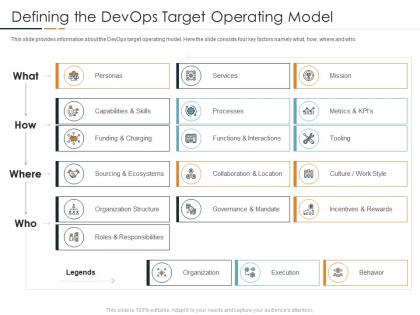
Defining the devops target operating model devops in hybrid model it




Try Before you Buy Download Free Sample Product
 Impress Your
 Audience
 100%
100% Editable
 Save Hours
 of Time


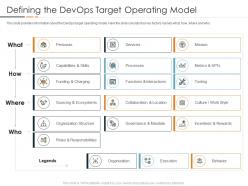
This slide provides information about the DevOps target operating model. Here the slide consists four key factors namely what, how, where and who.
People who downloaded this PowerPoint presentation also viewed the following :
Defining the devops target operating model devops in hybrid model it with all 2 slides:
Use our Defining The DevOps Target Operating Model DevOps In Hybrid Model IT to effectively help you save your valuable time. They are readymade to fit into any presentation structure.
FAQs for Defining the devops target operating model devops in
Traditional development models use sequential phases with distinct handoffs between development and operations teams, while DevOps operating models integrate these functions through continuous collaboration, automated pipelines, and shared responsibilities. DevOps streamlines delivery by enabling faster deployment cycles, enhanced monitoring, and immediate feedback loops, with many organizations finding that this integrated approach reduces time-to-market and operational inefficiencies.
The DevOps operating model enhances collaboration by breaking down traditional silos, establishing shared responsibilities for code deployment, and implementing continuous integration practices that require cross-team coordination. Through automated workflows, joint planning sessions, and shared performance metrics, development and operations teams achieve faster deployment cycles, reduced errors, and improved system reliability, ultimately delivering enhanced customer experiences and competitive advantage.
Essential DevOps tools include version control systems like Git, CI/CD platforms such as Jenkins or GitLab, containerization technologies like Docker and Kubernetes, infrastructure-as-code tools, and monitoring solutions. These technologies streamline development workflows, automate deployment processes, and enhance collaboration between teams, with many organizations finding that strategic tool integration ultimately delivers faster time-to-market and improved operational efficiency.
Organizations can measure DevOps effectiveness through deployment frequency, lead time for changes, mean time to recovery, and change failure rates, alongside business metrics like customer satisfaction and revenue impact. These measurements enable teams to identify bottlenecks, optimize workflows, and demonstrate value, with many enterprises finding that regular assessment drives continuous improvement and competitive advantage.
Automation serves as the backbone of the DevOps operating model, enabling continuous integration, continuous delivery, infrastructure provisioning, testing, and monitoring processes. Through automated pipelines, organizations streamline software releases, reduce manual errors, and accelerate deployment cycles, with many financial services and healthcare institutions finding that automation ultimately delivers faster time-to-market and enhanced operational efficiency.
A DevOps operating model accelerates the software delivery lifecycle by integrating development and operations teams, automating deployment pipelines, and enabling continuous integration and delivery. This collaborative approach significantly reduces release cycles from months to weeks or days, minimizes deployment errors, and enhances product quality, with many organizations finding that streamlined workflows ultimately deliver faster time-to-market and improved customer experiences.
Cultural changes for DevOps adoption include breaking down silos between development and operations teams, fostering collaborative communication, embracing shared responsibility for outcomes, and shifting from blame culture to learning-oriented problem-solving. These transformations enable organizations to accelerate deployment cycles, improve service reliability, and enhance customer responsiveness, with many enterprises finding that cross-functional collaboration ultimately delivers competitive advantage.
A DevOps operating model improves software quality by implementing continuous integration, automated testing, real-time monitoring, and collaborative development practices that catch defects early in the development cycle. Through automated pipelines and shared responsibility frameworks, organizations streamline quality assurance processes, reduce manual errors, and accelerate feedback loops, ultimately delivering more reliable software with fewer production issues.
Organizations face challenges including cultural resistance to collaboration, skills gaps in automation tools, legacy system integration complexities, security compliance concerns, and inadequate toolchain standardization. While these obstacles initially slow adoption, companies in finance, healthcare, and retail find that structured change management, targeted training programs, and phased implementation ultimately deliver faster deployment cycles, improved system reliability, and enhanced operational efficiency across their development lifecycles.
CI/CD serves as the technical backbone of DevOps operating models, automating code integration, testing, and deployment processes to enable rapid, reliable software delivery. This automation streamlines development workflows, reduces manual errors, and accelerates time-to-market, with many organizations finding that CI/CD pipelines ultimately deliver enhanced collaboration between development and operations teams while maintaining consistent quality standards.
Best practices for scaling a DevOps operating model include establishing standardized toolchains, implementing centralized monitoring and governance frameworks, creating cross-functional team structures, and developing comprehensive automation pipelines. These approaches streamline collaboration by ensuring consistent deployment processes, shared knowledge repositories, and unified security protocols across teams, with many organizations finding that strategic automation and cultural alignment ultimately deliver faster release cycles and enhanced operational efficiency.
A DevOps operating model accelerates innovation by breaking down silos between development and operations teams, enabling continuous integration and deployment, and fostering collaborative culture focused on rapid experimentation. Through automated testing, streamlined workflows, and faster feedback loops, organizations can reduce time-to-market significantly, with many enterprises finding that enhanced collaboration ultimately delivers competitive advantage and improved customer experiences.
**INPUT**: What metrics should be tracked to ensure the success of a DevOps operating model? **OUTPUT**: Key DevOps metrics include deployment frequency, lead time for changes, mean time to recovery, change failure rate, and system availability percentages. These measurements streamline operational efficiency by identifying bottlenecks, reducing downtime, and accelerating delivery cycles, with many organizations finding that tracking these metrics ultimately delivers faster releases, improved reliability, and enhanced competitive advantage. *[Word count: 58]*
A DevOps operating model supports cloud-native development by enabling continuous integration, automated deployment pipelines, infrastructure as code, microservices orchestration, and real-time monitoring across distributed systems. Through containerization and API-driven workflows, organizations streamline application scaling, accelerate release cycles, and enhance system resilience, while financial services and e-commerce companies find significantly improved deployment frequency and reduced operational overhead.
Organizations address security concerns in DevOps by integrating security practices throughout the development lifecycle, implementing automated security testing, conducting regular vulnerability assessments, and establishing clear compliance protocols. Through DevSecOps approaches, companies in sectors like banking and healthcare streamline security validation, minimize manual oversight requirements, and accelerate secure deployments, ultimately delivering faster services while maintaining robust protection standards.
-
Best way of representation of the topic.
-
Easy to edit slides with easy to understand instructions.
-
Out of the box and creative design.