

Devops process it devops process flow ppt slides styles




Try Before you Buy Download Free Sample Product
 Impress Your
Audience
 100%
Editable
 Save Hours
of Time


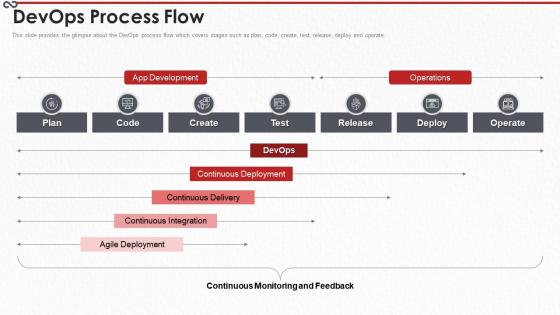
Devops is the process of bringing development and operations teams together to share tools, processes, and practices in order to improve the flow of work between them. by implementing devops, organizations can shorten the cycle time of their software development projects, improve product quality, and increase their ability to respond to customer needs.The SlideTeam devops presentation templates can help you better understand the process flow and get insights about different aspects of DevOps. With our templates, you can create beautiful presentations that will help convince your team or management to adopt DevOps. All of our templates are easy to use and customizable, so you can make them fit your own needs. Don’t miss out on this valuable tool – grab our devOps powerpoint presentation today.
People who downloaded this PowerPoint presentation also viewed the following :
Devops process it devops process flow ppt slides styles with all 6 slides:
Use our DevOps Process IT DevOps Process Flow Ppt Slides Styles to effectively help you save your valuable time. They are readymade to fit into any presentation structure.


FAQs for Devops process it devops process flow
The key stages in the DevOps process flow include planning, coding, building, testing, releasing, deploying, operating, and monitoring. These interconnected phases streamline software delivery by enabling continuous integration, automated testing, and rapid deployment cycles, with many organizations finding that this approach reduces development time by 30-50% while enhancing collaboration between development and operations teams.
Continuous integration improves development efficiency by automatically merging code changes, running automated tests, and detecting conflicts early in the process. This approach streamlines workflows by reducing manual testing overhead, minimizing integration bottlenecks, and enabling faster feedback loops, with many software teams finding that it ultimately delivers shorter release cycles and enhanced product quality.
Automation streamlines the DevOps process flow by eliminating manual tasks, reducing human error, and accelerating deployment cycles through continuous integration, testing, and delivery pipelines. These automated workflows enable development teams to deploy code faster, maintain consistent quality standards, and focus on strategic innovation, with many organizations finding that comprehensive automation delivers significantly improved operational efficiency and competitive advantage.
Monitoring and feedback loops drive DevOps success by providing real-time visibility into application performance, identifying bottlenecks before they impact users, and enabling rapid response to issues. Through continuous monitoring tools, organizations streamline incident resolution, enhance system reliability, and accelerate deployment cycles, with many financial services and e-commerce companies finding that proactive feedback mechanisms significantly reduce downtime while improving customer experiences.
Common DevOps collaboration tools include Slack, Microsoft Teams, Jira, Confluence, GitHub, and Trello for communication and project management. These platforms streamline workflows by enabling real-time messaging, automated notifications, and integrated development environments, with many organizations finding that strategic tool combinations enhance cross-functional teamwork, accelerate deployment cycles, and ultimately deliver improved operational efficiency.
Version control systems enhance DevOps workflows by enabling seamless code collaboration, automated deployment tracking, and branch-based development strategies that streamline integration processes. Through Git-based platforms, development teams accelerate release cycles, minimize deployment conflicts, and maintain comprehensive audit trails, while operations teams gain visibility into code changes, ultimately delivering faster, more reliable software delivery and enhanced team coordination.
Common DevOps implementation challenges include cultural resistance to change, inadequate toolchain integration, insufficient automation expertise, security compliance complexities, and legacy system compatibility issues. These obstacles often create bottlenecks in deployment pipelines, with many organizations finding that investing in comprehensive training, strategic tool selection, and gradual process transformation ultimately delivers smoother workflows and accelerated delivery cycles.
Cultural changes significantly impact DevOps effectiveness by fostering collaboration between development and operations teams, breaking down traditional silos, and promoting shared responsibility for outcomes. Organizations embracing cultural transformation see enhanced communication, faster problem resolution, and increased deployment frequency, with many finding that trust-building and cross-functional teamwork ultimately deliver improved product quality and competitive advantage.
DevOps success metrics include deployment frequency, lead time for changes, mean time to recovery, change failure rate, and system uptime percentages. These measurements enable organizations to track operational efficiency, release velocity, and service reliability across development cycles, with many enterprises finding that consistent monitoring ultimately delivers faster product iterations and enhanced customer experiences.
Continuous delivery automates code through testing and staging, requiring manual approval for production releases, while continuous deployment fully automates releases to production without human intervention. Many financial institutions use continuous delivery for regulatory compliance, whereas tech companies like Netflix leverage continuous deployment for rapid feature releases, ultimately enabling faster innovation cycles and improved customer experiences.
Teams should follow continuous integration with automated testing, infrastructure as code for consistent environments, comprehensive monitoring and logging, collaborative communication practices, and regular feedback loops between development and operations. These practices streamline deployment cycles, reduce manual errors, and enhance system reliability, with many organizations finding that implementing automated pipelines and cross-functional collaboration ultimately delivers faster releases and improved operational efficiency.
Containerization technologies enhance DevOps practices by enabling consistent application deployment, streamlining CI/CD pipelines, and improving resource efficiency across development environments. Through Docker and Kubernetes, organizations automate scaling, minimize infrastructure conflicts, and accelerate release cycles, with many financial services and retail companies finding that containerized workflows reduce deployment time significantly while enhancing operational reliability.
Security protocols integrate into DevOps through automated security scanning, infrastructure as code validation, continuous compliance monitoring, vulnerability assessments, and secure deployment pipelines. These practices enable organizations to identify threats early, streamline security reviews, and maintain consistent protection standards, with many financial services and healthcare institutions finding that integrated security ultimately accelerates delivery while reducing risk exposure.
Teams ensure quality while maintaining speed through automated testing, continuous integration, infrastructure as code, real-time monitoring, and shift-left security practices. These approaches streamline development by catching issues early, reducing manual bottlenecks, and enabling rapid feedback loops, with many organizations finding that automated quality gates ultimately deliver faster releases and more reliable software deployment cycles.
Infrastructure as Code delivers consistency, scalability, version control, rapid provisioning, and reduced human error across environments. Through automated infrastructure management, organizations streamline deployment processes, enhance collaboration between development and operations teams, and achieve faster recovery times, with many enterprises finding that IaC significantly reduces operational costs while enabling more reliable, repeatable infrastructure deployments.
-
Great designs, Easily Editable.
-
Helpful product design for delivering presentation.