


Devops process it agile devops process ppt slides professional




Try Before you Buy Download Free Sample Product
 Impress Your
 Audience
 100%
100% Editable
 Save Hours
 of Time


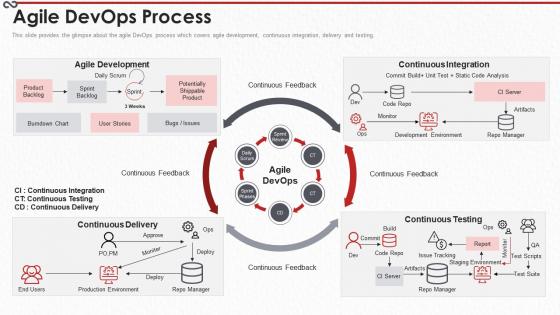
The DevOps process is an agile software development methodology that enables faster, more reliable releases through the use of automation and collaboration. It helps to break down the traditional barriers between development and operations teams, which in turn allows for a more streamlined, efficient process overall. The SlideTeam devops presentation templates can help you get started with your own agile devops process. Our templates are easy to use and provide a framework for getting insights about your team's performance. Download our devOps powerpoint presentation today and see how you and your team can start working more effectively together.
People who downloaded this PowerPoint presentation also viewed the following :
Devops process it agile devops process ppt slides professional with all 6 slides:
Use our DevOps Process IT Agile Devops Process Ppt Slides Professional to effectively help you save your valuable time. They are readymade to fit into any presentation structure.





FAQs for Devops process it agile devops process
So basically there's Plan, Code, Build, Test, Deploy, and Monitor - but honestly they kind of blend together in practice. Planning happens first obviously, then devs write the code. After that you build everything, run tests to catch bugs, push it live, and keep an eye on how it's performing. The whole point is making these steps flow without tons of manual work between each one. Oh and definitely figure out where you're getting stuck right now - like maybe your testing takes forever or deployments are a nightmare. That's probably where you should focus first instead of trying to fix everything at once.
So CI and CD are basically different parts of your deployment pipeline. CI is all about merging code and running tests automatically - catches those "works on my machine" bugs before they become a problem. CD goes further and actually ships your code to production without you having to do it manually. I always think of CI as the safety check. Does your new code play nice with everyone else's? CD is more like "okay, tests passed, let's push this thing live." Honestly, nail down your CI first - get those tests rock solid. Adding CD later is way easier once you trust your testing setup won't let garbage through.
Honestly, automation is what makes DevOps actually worth it. Without it you're just manually deploying stuff like it's 2005 or something. You can automate builds, testing, deployments, monitoring - basically anything that's eating up your time. The cool part is it cuts down on those stupid mistakes we all make when doing repetitive tasks. Plus your team can actually focus on interesting problems instead of babysitting servers. My advice? Don't try to automate everything at once. Just pick whatever manual process is currently making you want to scream and start there.
Start with DORA metrics - deployment frequency, lead time, recovery time, and failure rates. Those are the ones that actually tell you something useful. I used to track like 15 different things and it was a nightmare, so don't do that. Team happiness surveys matter too since miserable devs write crappy code. Get your baseline numbers first, then watch trends instead of freaking out over daily fluctuations. Pick maybe 3 metrics you can grab easily and expand later. Customer feedback's gold too - they'll tell you real quick if your "improvements" aren't working.
Honestly, the worst part is dealing with people who just hate change - cultural resistance is brutal. Legacy systems are a pain too since they weren't designed for this stuff. Good luck finding devs who actually understand ops (or vice versa). Security teams will probably lose their minds over faster deployments, always worried about compliance issues. Oh, and connecting all your tools together? Total headache sometimes. My advice: pick one small team first to show it works, then slowly expand. Way easier than trying to transform everything at once.
So basically when dev and ops actually talk to each other, all that "works on my machine" BS just disappears. Your deployments stop being a nightmare because devs finally get why production is different, and ops understands what the app actually needs. Everything moves faster too - you catch problems early instead of at 2am on a Friday (been there). The feedback loops get so much better. Honestly, just throw both teams into sprint planning together and watch the magic happen. Post-mortems too. Infrastructure problems get solved before they blow up instead of after. Game changer.
So for DevOps tools, I'd start with Git for version control - that's non-negotiable. Then pick either Jenkins or GitHub Actions for CI/CD (I'm partial to GitHub Actions tbh, it's just cleaner). Docker and Kubernetes handle containerization really well. Monitoring stuff like Prometheus and Grafana will save your sanity when things break at 2am. Oh, and definitely learn Terraform or Ansible for infrastructure as code - trust me on this one. The trick isn't using every tool out there though. Pick what your team will actually stick with and build from there when you hit real problems.
Honestly? Culture beats tools every single time in DevOps. Teams that blame each other and work in silos will tank any implementation, doesn't matter how much you spend. You need people who can actually admit when they screw up and share knowledge without being weird about it. I've watched companies drop millions on automation while their teams still hate each other - spoiler alert, it didn't work. Focus on getting dev and ops talking first. Maybe fix how you reward collaboration instead of individual heroics. The CI/CD stuff can wait until people stop throwing each other under the bus.
Start building security into your pipeline from day one - that whole "shift left" thing actually works. Automated scanning tools are your friend for checking code, dependencies, and configs at each step. Don't be like me and leave API keys hanging out in your code like an idiot! Get proper secrets management set up first. Vulnerability assessments and access controls come next, plus you'll want monitoring running constantly. Honestly, the biggest mindset shift is getting everyone to own security instead of dumping it on one team at the end. Pick a couple tools to start with and grow from there.
Honestly, feedback needs to be everywhere in your DevOps pipeline - automated tests catch bugs early, monitoring dashboards show what's actually happening, and user complaints flow straight back to your dev team. Speed is everything here because waiting weeks to find out something's busted is just painful. Set up alerts for the big stuff, track your key metrics, and keep those feedback loops tight between dev, ops, and users. Oh, and definitely automate the data collection wherever you can - manually gathering feedback is a time sink. Start with whatever's most critical and build from there.
So microservices is just chopping up your app into tiny independent pieces - like one handles logins, another does payments, whatever. Each piece can be updated and deployed solo without breaking everything else (thank god). Your teams can work on different parts simultaneously and even use different programming languages if they want. Honestly, it's a game changer for DevOps workflows. One service crashes? The others keep humming along. But seriously, don't go nuts right away - just peel off one obvious chunk of your current app first and see how it goes.
Think of monitoring and logging as your safety net - they catch problems before users start complaining. You'll spot slow queries, failed deployments, weird spikes in traffic. When something breaks at 2am (and it will), those logs become your detective clues to figure out what happened. Good observability means you can push code without sweating bullets about it. Honestly, I've seen teams waste hours debugging issues that proper logging would've solved in minutes. Just start with basic app metrics - response times, error rates, that stuff. Build it up as you go.
Dude, cloud computing is a game-changer for DevOps. No more waiting weeks for hardware - you can get infrastructure running in minutes now. Your dev and ops teams will love how fast they can iterate. Auto-scaling and managed databases handle the boring server stuff, so you actually get to build cool features instead. Oh, and spinning up test environments becomes super easy too (honestly wish I'd known this earlier in my career). I'd suggest starting with moving your CI/CD pipeline to the cloud first - that's where you'll see the biggest impact right away.
So DevOps and Agile are basically best friends - they're both about small iterations and actually talking to each other instead of working in silos. Your sprints line up perfectly with continuous deployment cycles. Short feedback loops from Agile help you spot problems that DevOps automation can fix way faster. Honestly, automated testing and deployment will save your sanity during releases (goodbye 2am deployment disasters). The trick is getting your pipeline to match your sprint timing. I'd start simple - just automate whatever manual deployment stuff you're doing now to fit your sprint schedule. Way less headache.
Alright so with containerized stuff - definitely go multi-stage for your Docker builds, keeps things small and secure. CI/CD pipelines are a must, automate the build/test/push cycle to whatever registry you're using. Manual container management is honestly a nightmare, so jump into Kubernetes or Docker Swarm pretty quick. Health checks and rolling updates should be baked in from the start, not an afterthought. Oh and scan those images for vulnerabilities regularly - you'd be surprised what slips through. Docker Compose is perfect for local dev, then move to K8s when you actually need it.
-
Great quality slides in rapid time.
-
Out of the box and creative design.