


Devops automation it powerpoint presentation slides




Try Before you Buy Download Free Sample Product
 Impress Your
 Audience
 100%
100% Editable
 Save Hours
 of Time


DevOps Automation helps the company to perform tasks with lesser human assistance and more technology. Such a process facilitates a feedback loop between operations and development teams for faster applications in production. Here is a professionally designed template on DevOps Automation IT that focuses on the challenges faced during DevOps integration and the impact of automation in the DevOps pipeline. The module also outlines the power of automation in different lifecycle stages along with its role and need, importance, benefits, and DevOps productivity. The steps involved in DevOps automation cover the phases, automation model in build, deployment, test, infrastructure, etc. This PowerPoint presentation focuses on automation tools and the impact of automated DevOps in business. Automation in DevOps begins with code creation on the developers computer. It continues until the code is pushed to the code repository and monitors the application and system in development. Talk to our experts for all your queries and access the markets best template on DevOps Automation IT. Download the template now.
People who downloaded this PowerPoint presentation also viewed the following :
Content of this Powerpoint Presentation
Slide 1: This slide displays the title i.e. 'DevOps Automation (IT)' and your Company Name.
Slide 2: This slide presents the agenda for the project.
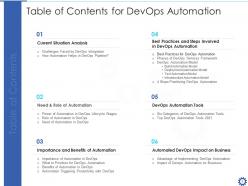
Slide 3: This slide showcases the table of contents for the project.
Slide 4: This slide exhibits the title for current situation analysis.
Slide 5: This slide explains the power of automation in devops lifecycle stages which focuses on different environment such as development, test, stage, production, etc.
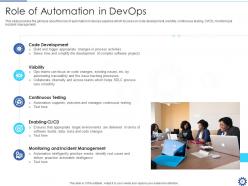
Slide 6: This slide describes the role of automation in devops pipeline which focuses on code development, visibility, CI/CD, monitoring & incident management.
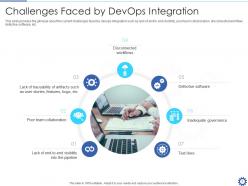
Slide 7: This slide presents the current challenges faced by devops integration such as lack of end to end visibility, disconnected workflow, defective software, etc.
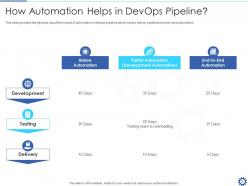
Slide 8: This slide provides the glimpse about the impact of automation in devops pipeline which covers before, partial and end to end automation.
Slide 9: This slide displays the title for need and role of automation.
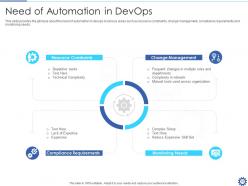
Slide 10: This slide exhibits the need of automation in devops in various areas such as resource constraints, change management, compliance requirements and monitoring needs.
Slide 11: This slide presents the title for importance and benefits of automation.
Slide 12: This slide provides the glimpse about the importance of automation in devops which helps in BDD, SDETs, CI, etc.
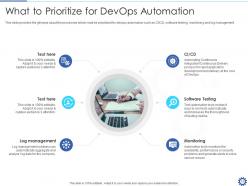
Slide 13: This slide provides the glimpse about the processes which must be prioritized for devops automation such as CI/CD, software testing, monitoring and log management.
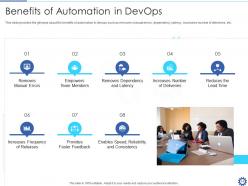
Slide 14: This slide provides the glimpse about the benefits of automation in devops such as removes manual errors, dependency, latency, increases number of deliveries, etc.
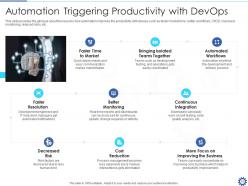
Slide 15: This slide presents the reasons how automation improves the productivity with devops like faster market time, CI/CD, improved monitoring, reduced risks, etc.
Slide 16: This slide displays the title for best practices and steps involved in DevOps automation.
Slide 17: This slide provides the glimpse about the best practices for devops automation which focuses on development, operations and quality assurance teams.
Slide 18: This slide provides the glimpse about the phases involved in devops services framework such as foundation, automation, streamline and transformation
Slide 19: This slide provides the glimpse about the building devops automation model which focuses on manifest, code repository, software building and orchestration engine.
Slide 20: This slide displays the deployment automation model which focuses on code repository, system configuration, procedures and releasing orchestration engine.
Slide 21: This slide presents the devops test automation model which focuses on requirement verification, business & technology facing issues and function validation.
Slide 22: This slide exhibits the infrastructure automation model which focuses on code repository, system configuration, system topology, and APIs service providers.
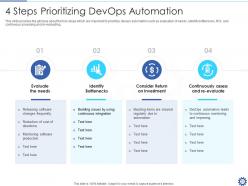
Slide 23: This slide explains the four steps which are important to prioritize devops automation such as evaluation of needs, identify bottlenecks, ROI, etc.
Slide 24: This slide presents the title for DevOps Automation Tools.
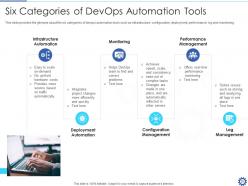
Slide 25: This slide provides the glimpse about the six categories of devops automation tools such as infrastructure, configuration, deployment, performance, log and monitoring.
Slide 26: This slide provides the glimpse about various devops automation tools which can be used within the company along with their features and price per year.
Slide 27: This slide displays the title for Automated DevOps Impact on Business.
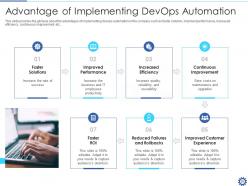
Slide 28: This slide explains the advantages of implementing devops automation in the company such as faster solution, increased efficiency, continuous improvement, etc.
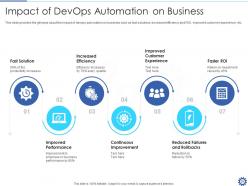
Slide 29: This slide displays the impact of devops automation on business such as fast solutions, increased efficiency and ROI, improved customer experience, etc.
Slide 30: This is the icons slide for the project.
Slide 31: This slide displays the title for additional slides.
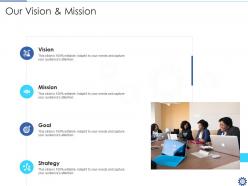
Slide 32: This slide showcases the vision, mission, strategies and goals of your company.
Slide 33: This slide exhibits the roadmap of the company.
Slide 34: This slide presents the targets of your company.
Slide 35: This slide displays the 30-60-90 days plan for your project.
Slide 36: This slide explains the ideas generated for your company.
Slide 37: This slide showcases the posts related to past experiences of clients.
Slide 38: This slide exhibits the venn diagram for your company targets.
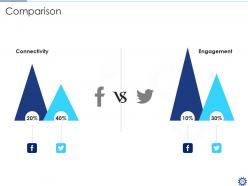
Slide 39: This slide presents the comparison of your products based on connectivity and engagement.
Slide 40: This slide explains the puzzle for your company.
Slide 41: This is the thank you slide and displays the contact details of the company i.e. office address, contact number, etc.
Devops automation it powerpoint presentation slides with all 41 slides:
Use our DevOps Automation IT Powerpoint Presentation Slides to effectively help you save your valuable time. They are readymade to fit into any presentation structure.














FAQs for Devops automation it
Dude, the time savings alone make it worth it. Deployments happen way faster, bugs get caught before they break stuff, and you're not doing boring manual work all day. No more "works on my machine" drama since everything's consistent across environments. Automated testing is clutch when you're shipping code constantly - saves your ass basically. Your team gets to actually build cool stuff instead of fixing deployment disasters. I'd say start with just one project's CI/CD pipeline, then expand once you see how much time you get back. Trust me on this one.
So automation basically tears down those walls between dev and ops teams. Everyone gets the same tools and can actually see what's happening across the pipeline. No more devs just tossing code over and leaving ops to figure it out - which honestly used to drive me crazy at my last job. You'll get continuous integration where both sides see real-time updates. Way fewer "whose fault is this?" meetings when stuff breaks. Deployments become way more predictable, so ops stops putting out fires constantly. Developers get quicker feedback too. Just start with automated testing or simple deployment scripts.
So the main tools everyone's using are Jenkins, Ansible, Docker, and Terraform. Docker's probably your best starting point if deployments are driving you crazy - it basically packages everything so your app runs the same everywhere. Jenkins automates all that build and release stuff you're doing manually right now. Ansible manages server configs without installing agents everywhere (seriously, such a pain saver). Then there's Terraform for spinning up cloud infrastructure with code instead of clicking through AWS consoles forever. Honestly, I'd go Docker first since it solves so many headaches, then add Jenkins once you get the hang of it.
First thing - measure how long everything takes right now so you know what's actually slow. Parallel builds help a ton, and caching dependencies is huge. Run your unit tests before the heavy integration ones. Most manual approvals are just security theater anyway, so automate what you can. Docker builds are usually the worst offender - optimize those first. Set up automated rollbacks too because deployments will fail eventually. Oh and infrastructure as code saves so much headache with environment setup. Don't run every single test for tiny changes either, that's just wasteful. Focus on the biggest time wasters first rather than trying to fix everything at once.
So cloud computing is what makes DevOps automation actually scale - you can spin up environments instantly instead of waiting forever for hardware. AWS Lambda and Azure Functions are clutch because they trigger workflows without you babysitting servers. Honestly took me a while to appreciate how much easier this makes everything. Your automation scripts provision whole environments in minutes now. The CI/CD pipelines just flow better with on-demand infrastructure. I'd say start with automated deployments to dev environments first, don't go crazy right away.
So IaC is basically treating your infrastructure like regular code - you write it in files instead of clicking around AWS consoles all day (seriously, that gets old fast). You can use stuff like Terraform or CloudFormation templates. The cool thing is everything goes through version control, so deployments are consistent every time. Plus it hooks right into your CI/CD pipeline for automatic provisioning and scaling. Honestly, it's a game changer because you're not dealing with manual steps or wondering "wait, did I configure that server right?" Just pick one environment to start with and go from there.
Get your logging sorted first - you need to see everything that happens during deployment. Trust me, I've debugged way too many "it deployed fine" situations that were actually disasters. Set up real-time monitoring with alerts for response times and error rates. Automate your rollback procedures before you need them (not after). Blue-green or canary deployments are lifesavers for catching issues early. Health checks are non-negotiable - both app and infrastructure level. Start simple with basic dashboards, then add fancier alerting as you figure out what actually breaks in your setup.
Honestly, just bake the security stuff right into your CI/CD pipeline instead of making it this separate thing. SAST/DAST scans, dependency checks, container scanning - run all that during your build process. Way cheaper to catch problems early. Policy-as-code tools like OPA are clutch for automating compliance rules without babysitting everything (saves me hours). Make security failures break builds just like test failures do. Developers need that instant feedback loop or they'll never pay attention. Start small with one check, then add more. Don't go crazy trying to implement everything at once - that's how projects die.
Honestly, the trickiest part is usually people freaking out about change - nobody wants their workflow messed with. Skills gaps are huge too. Don't try automating everything at once though, that's a nightmare waiting to happen. Start small, maybe pick something low-stakes that'll actually work. Training is super important (and expensive, but whatever). Your old systems will probably hate the new stuff, so brace for integration hell. I'd say nail one process first, get people on board, then slowly add more. The big dramatic overhaul thing never works out how you think it will.
Honestly, version control is what makes DevOps automation actually work instead of just being a hot mess. Git commits trigger your CI/CD pipelines automatically - tests run, code deploys, the whole thing. When stuff inevitably breaks, you can see exactly what changed and who did it, then roll back fast. Different branches let you automate workflows for dev vs production too. Oh, and start with Git webhooks connected to your build system - that's the easiest way to show people why this integration rocks. Once they see it working, they'll get hooked.
So there are four main things you should watch: how often you're deploying, lead time from idea to production, mean time to recovery, and change failure rate. These basically tell you if your automation is actually working or just making you feel busy. MTTR shows how fast you bounce back when things break (and they will break). Change failure rate is huge too - shipping broken code faster isn't exactly a win, you know? Don't try measuring everything at once though. Pick like 2-3 metrics first, then maybe add customer satisfaction stuff later once you've got the basics down.
Think of test automation as your safety net - it catches bugs before they hit users. Run unit tests when devs push code, integration tests during builds, then end-to-end stuff before going live. Yeah, it feels like extra work at first but trust me, it'll save your ass later. Build it straight into your CI/CD so there's no manual steps slowing things down. Code gets tested the same way every time, no shortcuts. I'd start with your most important user journeys first, then add more coverage as you go. Way better than finding out your checkout is broken at 2am.
Yeah, it's gonna mess with your team dynamics for sure. Developers and ops people suddenly have to actually talk to each other instead of just tossing stuff back and forth - super weird at first lol. Some people freak out thinking they'll get replaced, but honestly? Automation just gets rid of the boring repetitive crap. Your team ends up doing way more interesting strategic work instead of babysitting servers all day. The trick is being upfront about how everyone's role will change. Also invest in training early - like, really early. Trust me on that one.
Honestly, treat everything like code from the start - version control, docs, the works. Your scripts need solid error handling and monitoring built in. Keep it simple though. I've seen people build these insanely complex pipelines that become impossible to debug later. Stick with tools your whole team actually knows how to use. Test everything small first, then scale up. Oh, and seriously - go back and clean up your automation regularly. CI/CD technical debt is real and it'll bite you fast. Future you (and whoever inherits this mess) will definitely appreciate the effort.
AI automation and self-healing infrastructure are seriously worth watching - they're changing everything. Platform engineering is basically replacing traditional DevOps (which honestly makes sense). GitOps is huge right now too. The "infrastructure as code" movement? It's morphing into "everything as code." Sounds like marketing BS but it's legit happening. Security automation isn't optional anymore with all these compliance headaches we're dealing with. The real shift is autonomous systems fixing their own problems without us babysitting them. My advice? Start playing with AI tools in your CI/CD pipelines now. Even basic stuff will put you ahead of the curve.
-
Illustrative design with editable content. Exceptional value for money. Highly pleased with the product.
-
Presentation Design is very nice, good work with the content as well.
-
Great product with effective design. Helped a lot in our corporate presentations. Easy to edit and stunning visuals.