


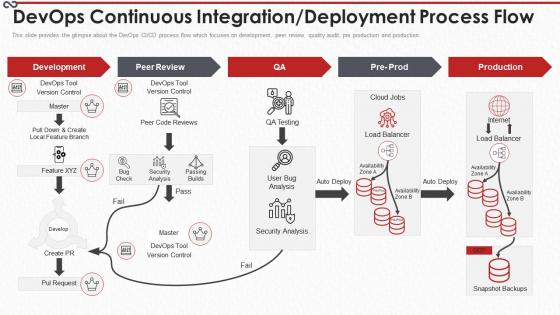
Devops process it devops continuous integration deployment process flow




Try Before you Buy Download Free Sample Product
 Impress Your
 Audience
 100%
100% Editable
 Save Hours
 of Time


Devops is a software development philosophy which stresses communication, collaboration and integration between software developers and system administrators. The goal of devops is to improve the quality and speed of software delivery, while minimizing risks. One key component of the devops process is continuous integration (CI). If you're looking for a more in-depth understanding of the devops continuous integration and deployment process flow, we've got just what you need. Our team at SlideTeam has put together some amazing devops powerpoint presentation templates that will give you all the information you need to get started with this transformative technology. So don't wait any longer, grab our devOps powerpoint presentation today.
People who downloaded this PowerPoint presentation also viewed the following :
Devops process it devops continuous integration deployment process flow with all 6 slides:
Use our DevOps Process IT DevOps Continuous Integration Deployment Process Flow to effectively help you save your valuable time. They are readymade to fit into any presentation structure.





FAQs for Devops process it devops continuous integration
The essential DevOps phases include planning, development, continuous integration, testing, deployment, monitoring, and feedback collection. These phases interconnect through automated pipelines and collaborative workflows, with development teams using CI/CD tools to streamline code integration, while monitoring insights feed back into planning cycles, ultimately delivering faster releases, reduced errors, and enhanced operational efficiency across organizations.
Continuous integration focuses on automatically merging code changes into a shared repository and running automated tests to catch issues early, while continuous deployment automatically releases validated code changes directly to production environments. CI emphasizes code quality and integration stability through frequent commits and testing, whereas CD streamlines the entire release pipeline, with many organizations finding that combining both practices significantly reduces deployment risks and accelerates time-to-market.
Automation serves as the backbone of DevOps, streamlining code integration, testing, deployment, and infrastructure management through continuous delivery pipelines. Tools like Jenkins, GitLab CI/CD, Docker, Kubernetes, and Terraform enable organizations to accelerate release cycles, minimize human errors, and enhance reliability, with many enterprises finding that strategic automation ultimately delivers faster time-to-market and significant operational efficiency gains.
Organizations measure DevOps success through key performance indicators including deployment frequency, lead time for changes, mean time to recovery, and change failure rate. These metrics enable teams to track operational efficiency, identify bottlenecks, and optimize workflows, with many enterprises finding that consistent monitoring ultimately delivers faster releases, reduced downtime, and enhanced competitive advantage.
Key cultural changes for DevOps include fostering collaboration between development and operations teams, embracing continuous learning and experimentation, accepting shared responsibility for outcomes, promoting transparent communication, and cultivating a mindset of iterative improvement. These cultural shifts streamline workflows by breaking down traditional silos, accelerating deployment cycles, and enhancing problem-solving capabilities, with many organizations finding that improved cross-team collaboration ultimately delivers faster innovation and more resilient systems.
DevOps accelerates time-to-market by streamlining development cycles, automating testing and deployment processes, and enabling continuous integration and delivery pipelines. Through enhanced collaboration between development and operations teams, organizations can reduce manual bottlenecks, minimize deployment errors, and deliver software updates more frequently, ultimately achieving competitive advantage in increasingly fast-paced markets.
Common DevOps adoption challenges include cultural resistance to collaboration, skills gaps in automation tools, legacy system integration complexities, security concerns with faster deployments, and establishing effective monitoring practices. While these obstacles can slow initial implementation, organizations in sectors like financial services and healthcare find that structured change management, comprehensive training, and phased rollouts ultimately deliver enhanced operational efficiency and competitive advantage.
DevOps practices enhance collaboration by implementing shared repositories, automated workflows, cross-functional team structures, and unified communication platforms that break down traditional silos. Through continuous integration and monitoring tools, development and operations teams achieve faster deployment cycles, reduced error rates, and improved system reliability, while fostering shared accountability and ultimately delivering enhanced customer experiences.
DevOps integrates automated security scanning, vulnerability assessments, access controls, compliance monitoring, and encryption protocols throughout development pipelines. These security measures streamline deployments by identifying threats early, enforcing policy compliance, and maintaining data protection, with many financial services and healthcare organizations finding that automated security testing ultimately delivers faster, safer releases while reducing operational risk.
DevOps facilitates better customer feedback by enabling faster deployment cycles, continuous integration, and real-time monitoring capabilities that accelerate product updates and feature releases. Through automated testing and streamlined release processes, organizations can implement customer suggestions more rapidly, monitor user behavior continuously, and iterate products based on actual usage data, ultimately delivering enhanced customer experiences and competitive responsiveness.
DevOps performance metrics include deployment frequency, lead time for changes, mean time to recovery, change failure rate, and code quality indicators. These measurements enable organizations to streamline software delivery, minimize downtime, and enhance operational efficiency, with many technology companies finding that consistent monitoring ultimately delivers faster releases and improved customer experiences.
Cloud computing significantly influences DevOps by enabling automated infrastructure provisioning, seamless scaling, and integrated CI/CD pipelines through platforms like AWS, Azure, and Google Cloud. These cloud services streamline deployment workflows, reduce operational overhead, and facilitate real-time collaboration between development and operations teams, ultimately delivering faster release cycles and enhanced system reliability for organizations.
AI and machine learning reshape DevOps by automating code reviews, predicting deployment failures, and optimizing resource allocation across development pipelines. These technologies enable organizations to achieve faster release cycles, reduce manual testing overhead, and enhance system reliability, with many financial services and e-commerce companies finding significantly improved deployment success rates and operational efficiency.
Teams effectively manage legacy systems within DevOps by implementing gradual containerization, API abstraction layers, and incremental automation strategies. Through strategic modernization approaches, organizations in banking, healthcare, and manufacturing streamline deployment processes, reduce system dependencies, and enhance operational efficiency, while maintaining critical business functions and ultimately delivering faster updates with improved reliability.
Successful DevOps transformation begins with establishing cross-functional teams, implementing continuous integration pipelines, automating testing processes, fostering collaborative culture, and securing executive sponsorship. These practices streamline deployment cycles by reducing manual handoffs, accelerating feedback loops, and minimizing production risks, with many organizations finding that starting small with pilot projects ultimately delivers faster releases and enhanced operational efficiency.
-
Easily Understandable slides.
-
Very well designed and informative templates.
-
Very unique, user-friendly presentation interface.
-
Awesome presentation, really professional and easy to edit.
-
Design layout is very impressive.