

Devops Continuous Integration Deployment Process Flow Ppt Powerpoint Presentation Portfolio




Try Before you Buy Download Free Sample Product
 Impress Your
 Audience
 100%
100% Editable
 Save Hours
 of Time


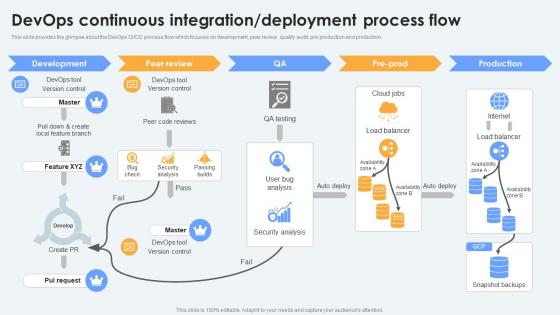
This slide provides the glimpse about the DevOps CI or CD process flow which focuses on development, peer review, quality audit, pre production and production.
People who downloaded this PowerPoint presentation also viewed the following :
Devops Continuous Integration Deployment Process Flow Ppt Powerpoint Presentation Portfolio with all 6 slides:
Use our Devops Continuous Integration Deployment Process Flow Ppt Powerpoint Presentation Portfolio to effectively help you save your valuable time. They are readymade to fit into any presentation structure.





FAQs for Devops Continuous Integration Deployment Process Flow Ppt
So CI is basically pushing your code changes super frequently - like multiple times daily - and having tests run automatically to catch bugs early. CD goes beyond that by automatically pushing those tested changes straight to production without anyone manually doing it. I think of CI as "does my code play nice with everyone else's?" CD is more like "alright, let's ship this thing." Some teams actually do continuous delivery instead, where you're always ready to deploy but someone still has to manually hit that button. The main difference is how much you're automating - CI handles the testing part, CD manages your whole release pipeline. Honestly, get your CI solid first before diving into full CD automation.
Honestly, automation just cuts out all those tedious manual steps that slow down your deployments. Testing, integration, rollbacks - you can automate pretty much everything. Jenkins is what most people use (though seriously, that interface hasn't been updated since dial-up). GitHub Actions and GitLab CI look way better if you care about that stuff. Docker and Kubernetes are solid for scaling containerized apps too. My advice? Don't try to automate everything at once - just pick whatever repetitive task annoys you most and start there.
So Docker packages your app with everything it needs into these containers that run the same everywhere. No more "works on my machine" headaches - I swear this used to be like 80% of our deployment issues. Build once, then it runs identically in dev, staging, prod, whatever. Each job gets its own isolated space too, so your build agents don't get all messy over time. Honestly, just pick your simplest service and containerize that first. You'll see the difference right away - deployments get so much less stressful.
Definitely lock down those dependency versions first - package-lock.json for npm, requirements.txt for Python, that sort of thing. Cache everything between builds because waiting around for the same downloads is just painful. I'd set up some automated security scanning too, catches the sketchy stuff before it becomes your problem. For internal packages, something like Nexus or Artifactory works well. Oh, and when you do update dependencies? Do it in a separate branch first - I learned that one the hard way. Test compatibility there before you merge anything back to main.
Don't try automating everything right off the bat - that's a recipe for disaster. Start with just automated testing, then build from there. Get your monitoring set up early too (trust me on this one, I've been burned). Your team needs to actually like using the pipeline or they'll just work around it, which defeats the whole point. Make sure failures happen fast and loud when something breaks. Oh, and always have a rollback plan ready to go. Honestly, keep your first workflow super simple and add complexity later. Way easier than trying to fix an overly complicated mess.
So version control basically runs your whole CI/CD setup - each commit kicks off builds and tests automatically. I'd stick with feature branches for dev work, then merge to main only after reviews. Branching strategies honestly turn into religious wars sometimes lol. But here's what works: protect main, require pull requests, run CI on every branch. Small commits with decent messages are clutch because when stuff breaks, you can spot the issue fast and rollback. Trust me, something will break eventually.
Okay so there are four main things you want to track. Deployment frequency is huge - basically how often you're actually shipping to prod. Lead time matters too, that's commit to deployment time. Change failure rate shows what percentage of your deployments break stuff (honestly this one stings when it's high). And mean time to recovery for when things inevitably go sideways. These are called DORA metrics and they're kind of the industry standard now. Don't waste time on nonsense like lines of code counts. Start with these four and you'll know exactly where your pipeline sucks.
Honestly, you've gotta weave security throughout your entire pipeline instead of slapping it on later. Scan your code during development first. Then hit dependencies and run SAST tools when building. I learned this the hard way after pushing sketchy code under pressure - never again! Container scanning before you deploy is clutch, plus DAST testing in staging. Oh, and don't sleep on validating your infrastructure-as-code too. The whole point is catching crap early rather than letting it reach production. Set up gates that'll actually stop bad code from moving forward.
Honestly, cloud CI/CD is just way easier to deal with. Setup's faster, it scales automatically, and you don't have to babysit servers or worry about updates. The pay-as-you-go thing is nice too - no upfront hardware costs. Sure, on-premise gives you more control and might save money if you're running at crazy scale, but most teams aren't there yet. Built-in integrations with all the tools you're probably already using is a huge time-saver. I'd go cloud first unless you've got some weird compliance thing blocking you. Way less headache overall.
Dude, microservices will flip your whole CI/CD setup upside down. Each service needs its own pipeline now since they all deploy independently. The upside? Teams can ship way faster without waiting on each other. But man, going from one build to managing like 20+ pipelines is pretty brutal at first. Dependencies between services become a real headache, plus integration testing gets weird when everything's in different repos. Oh and don't get me started on coordinating deployments across teams. Just start basic - one simple pipeline per service, then build up from there once everyone stops panicking about it.
Testing's your safety net - catches bugs before they wreck production. Run automated tests at every stage: unit tests for individual pieces, integration tests between services, end-to-end for the whole user flow. Trust me, you don't want to be that guy who breaks prod on Friday! Fast feedback loops are clutch so you know right away when stuff fails. I'd start with decent unit test coverage, then slowly build up more complex testing layers. Oh and honestly? Sometimes I skip writing tests for the really obvious stuff, but don't tell anyone I said that.
Honestly, you've gotta get dev and ops talking from the start - none of this throwing code over the wall nonsense. Put them on the same tools so everyone can see the CI/CD pipeline and monitoring stuff. I've seen it work best when you actually mix the teams up, like having ops people embedded with devs. Regular retrospectives catch issues early too. The whole point is shared ownership of everything, not just "my part, your part." Also throw them in the same Slack channels - sounds obvious but you'd be surprised how often teams stay isolated.
Honestly, IaC is a total game changer for your pipeline. Version control becomes your best friend since you can track infrastructure changes right alongside your code. No more of that "works on my machine" BS when things drift between environments. You'll catch problems way earlier instead of finding out your infrastructure is broken at 2am in production (been there). The coolest part? Spinning up entire test environments automatically. I'd start small though - pick one environment to convert first, then roll it out from there. Way less overwhelming that way.
Build feedback loops everywhere - track build times, deployment success rates, error rates, all that stuff. Make sure everyone can actually see this data though, not just some dashboard that gets ignored. Set up alerts for when things break (trust me, they will). Hold retrospectives regularly to dig into what went wrong and why. Look for patterns in failed builds and pipeline bottlenecks. User complaints are gold too. Then actually do something about it - tweak your processes, fix your tests, whatever needs adjusting. The whole point is catching problems early instead of scrambling later.
Honestly, you'll want to watch GitOps super closely - it's blowing up right now. Your Git repos basically control your deployments, which just feels way cleaner than the old CD mess. Platform engineering teams are crushing it by building internal platforms that hide all the infrastructure headaches from developers. Pretty brilliant if you ask me. AI's getting scary good at generating test cases and even reviewing code automatically. Oh, and security's moving left hard - policy-as-code is everywhere now. Start playing with GitOps workflows ASAP. Also think about what self-service tools your devs actually need.
-
The pricing page of this website is very sorted. I felt no pain while buying the PPTs.
-
SlideTeam never fails to surprise me with its amazing PPT designs. Thanks team for providing me with your constant support!