

Enterprise Performance Management Pyramid Hierarchy




Try Before you Buy Download Free Sample Product
 Impress Your
 Audience
 100%
100% Editable
 Save Hours
 of Time


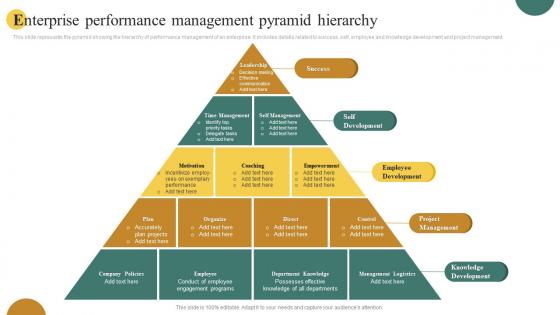
This slide represents the pyramid showing the hierarchy of performance management of an enterprise. It includes details related to success, self, employee and knowledge development and project management.
People who downloaded this PowerPoint presentation also viewed the following :
Enterprise Performance Management Pyramid Hierarchy with all 6 slides:
Use our Enterprise Performance Management Pyramid Hierarchy to effectively help you save your valuable time. They are readymade to fit into any presentation structure.





FAQs for Enterprise Performance
So the EPM Pyramid basically has three layers. Bottom layer is operational metrics - all the boring day-to-day tracking like task completion and resource usage. Middle layer handles tactical planning where you're juggling portfolios and deciding which projects matter most (honestly this is where everyone gets stuck). Strategic alignment sits at the top - that's connecting everything back to actual business goals. It works like building blocks, each level props up the next one. Start with getting your operational data sorted first, then climb up. Otherwise you'll just be running projects that don't actually move the needle for your business.
So basically the EPM Pyramid connects your big strategy to what you're actually doing day-to-day. Start at the top with your main objectives, break those down into specific projects and initiatives, then turn everything into tasks and KPIs you can track. Think of it like a roadmap everyone can follow. When someone asks "why are we doing this random thing?" you can trace it straight back to your core strategy - which honestly saves so many pointless meetings. Each layer builds on the next one. Just check regularly that your daily stuff still ties back to those bigger goals, otherwise you'll drift.
Look, data management is literally the bottom layer of the EPM Pyramid for a reason. Everything else crashes without it. Your planning, budgeting, reporting - all that stuff depends on having clean, reliable data first. I learned this the hard way at my last job actually. Try building forecasts on messy data and you'll spend all your time fixing errors instead of doing real strategy work. It's like... imagine constructing a skyscraper on swampy ground. Won't work. Get your data governance and integration sorted first, or you'll regret it later when your analytics are completely wrong.
So the EPM Pyramid basically structures your decision-making by stacking data from bottom to top - operational stuff at the base, strategic KPIs up top. Most companies screw up the foundation though, then can't figure out why everything looks weird later. Build your metrics so they connect through each level. That way execs see the big picture while managers get their operational details. Everyone's working from the same connected data instead of random Excel files floating around. I'd start by mapping what you've got now - you'll probably find some obvious gaps pretty quickly.
Honestly, the biggest pain points are getting everyone on board and dealing with data integration nightmares. Finance teams hate change - they've been doing month-end closes the same way forever, so good luck with that. Different departments can't agree on which metrics actually matter either. Oh, and the technical stuff gets ridiculous fast. You're trying to connect all these random data sources while keeping everything clean across pyramid levels. Start with just one business unit though. Prove it works there first, then slowly roll it out. Way less headache that way.
So tech basically automates all the annoying data collection stuff and gives you real-time dashboards. Your biggest win is connecting different systems so you're not pulling reports from like 5 different places. Cloud tools are honestly a game-changer for collaboration - beats those nightmare email threads about budget changes. Manual processes kill productivity, so automation frees up your team for actual analysis instead of just gathering numbers. I'd start with whatever reporting task makes you want to scream, then find tools to automate that mess first.
So basically the EPM Pyramid works like this - your big strategic metrics at the top trickle down to smaller operational stuff below. Customer satisfaction becomes response times for support teams, quality scores for production, that kind of thing. Pretty neat actually. Everyone gets metrics that feed into the level above them, so people can actually see how their daily grind connects to company goals. Oh and definitely map your current metrics against it - you'll probably find some weird gaps or things that don't quite line up right.
Honestly, treat it like building a house - everything has to connect properly. Your strategic goals go at the top, then work down through operational stuff and KPIs. Each layer should actually support what's above it, not just random metrics that look impressive on a dashboard (I've seen way too many of those disasters). Get your stakeholders involved early from each department - saves headaches later. Oh, and keep your data sources consistent across all levels. Don't go crazy with too many metrics per layer either. Test everything with real scenarios first before you roll it out everywhere.
Dude, stakeholder engagement can make or break your EPM Pyramid - I've watched projects crash and burn because people skipped this step. You need executives backing the big picture vision, then middle management has to translate that into actual tactical plans. Operational teams do the real work, obviously. But here's the thing - if even one layer doesn't buy in, everything gets misaligned super quickly. The whole pyramid depends on everyone understanding their piece and actually caring about results. Oh, and definitely map out who you need at each level first. Then figure out how to get each group engaged. Trust me on this one.
Yeah, totally doable! Just flatten out that pyramid structure and make everything more iterative. Quarterly OKRs work great at the top level, then you can do sprint planning down at the team level. The trick is keeping everyone aligned without being super rigid about it. Honestly, it does get messier than traditional approaches - but that's kind of the point with agile, right? You'll need way more check-ins between the different levels. Oh, and definitely build in regular retrospectives so you can actually adjust your strategy when things inevitably shift. Communication becomes huge when you're trying to stay flexible but not lose sight of the bigger picture.
Dude, check out Microsoft's Teams rollout - that's probably the cleanest example of EPM Pyramid done right. Netflix crushed it during their streaming pivot too. Salesforce built their entire growth strategy around this framework, which honestly doesn't surprise me at all knowing how they operate. Amazon's been using it for AWS launches forever. The pattern? They all started with small pilots first. Don't try to go big immediately - that's where most companies mess up. Look for case studies from these companies or maybe hit up someone you know who works there.
So each industry tweaks the EPM Pyramid differently depending on what they actually care about. Healthcare goes crazy with compliance stuff and patient metrics. Tech companies? They're all about innovation KPIs and those agile planning cycles everyone's obsessed with. Manufacturing digs deep into operational efficiency and safety - which honestly makes perfect sense given what they do. Financial services pump up risk management across every single layer. Don't just copy some generic template though. You'll want to match your industry's real success factors to each pyramid level instead.
So risk management touches every part of the EPM Pyramid, which is actually pretty smart when you think about it. You start at the top identifying big risks that could mess up your whole portfolio. Moving down to programs and projects, things get way more detailed with specific mitigation plans. What I like about the pyramid is how risks flow both ways - big ones trickle down, smaller issues can escalate up. It's like having built-in communication channels. Just make sure your risk processes stay consistent across levels. Otherwise stuff gets lost between strategic planning and actual project work, and nobody wants that headache.
Honestly, I'd do it quarterly if you can swing it. Most companies I know that are killing it review theirs every 3 months, though some move faster depending on their industry. The annual thing is kind of the bare minimum - your business changes way too much for once-a-year updates. Think about it like this: if your market shifts or you pivot strategy, you're stuck using old metrics that don't make sense anymore. Quarterly check-ins work great, then maybe do a bigger deep-dive annually. Oh and put it on your calendar now - seriously. It's one of those things that always gets bumped when you're swamped.
So you want metrics that match each pyramid level, right? Strategic stuff should be the big picture - revenue growth, market share, customer satisfaction. That's what the C-suite actually looks at. Tactical level is more about delivery: hitting deadlines, staying on budget, how you're using resources. Operations gets into the weedy stuff like team velocity and cycle times. Honestly, the trick is making sure everything connects - your operational metrics should ladder up to tactical, then strategic. I'd start with maybe 2-3 per level so you don't go crazy tracking everything. They should tell one story together.
-
Amazing product with appealing content and design.
-
“One of the best experiences with SlideTeam for my presentation.Everything on time, communication is efficient and price is reasonable. All good in one place.”