


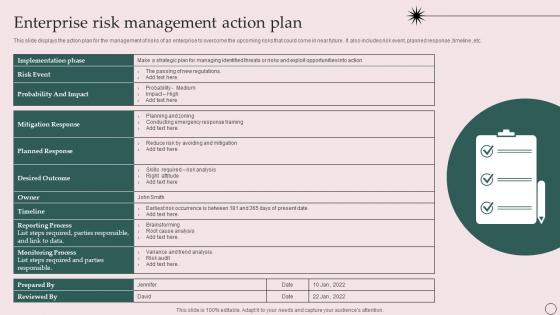
Enterprise Risk Management Action Plan




Try Before you Buy Download Free Sample Product
 Impress Your
 Audience
 100%
100% Editable
 Save Hours
 of Time


This slide displays the action plan for the management of risks of an enterprise to overcome the upcoming risks that could come in near future. It also includes risk event, planned response, timeline ,etc.
People who downloaded this PowerPoint presentation also viewed the following :
Enterprise Risk Management Action Plan with all 6 slides:
Use our Enterprise Risk Management Action Plan to effectively help you save your valuable time. They are readymade to fit into any presentation structure.





FAQs for Enterprise Risk
Effective ERM frameworks include risk identification processes, assessment methodologies, mitigation strategies, monitoring systems, and governance structures that align with organizational objectives. These components work together by establishing clear risk appetites, enabling proactive decision-making, and creating accountability mechanisms, with many organizations finding that integrated frameworks ultimately deliver enhanced operational resilience and strategic competitive advantage.
Organizations identify and prioritize significant risks through comprehensive risk assessments, stakeholder interviews, data analysis, scenario planning, and cross-functional workshops that evaluate probability and impact. These systematic approaches enable companies to create risk heat maps, establish risk tolerance thresholds, and allocate resources strategically, with many enterprises finding that regular risk prioritization enhances decision-making and operational resilience.
Corporate culture fundamentally determines Enterprise Risk Management success by shaping employee risk awareness, accountability standards, and decision-making behaviors throughout organizations. A strong risk-conscious culture encourages transparent communication, proactive risk identification, and consistent adherence to established protocols, with many financial institutions and healthcare organizations finding that cultural alignment ultimately delivers more effective risk mitigation and operational resilience.
Technology and data analytics enhance ERM effectiveness by automating risk identification, providing real-time monitoring capabilities, and enabling predictive risk modeling through advanced algorithms and machine learning. These tools streamline risk assessment processes, improve decision-making accuracy, and deliver comprehensive risk dashboards, with many financial institutions and healthcare organizations finding that automated systems significantly reduce response times while enhancing overall risk visibility.
Common ERM implementation pitfalls include inadequate leadership support, siloed risk assessments, insufficient stakeholder engagement, poor communication frameworks, and lack of integration with business strategy. These challenges often result in fragmented risk visibility and reactive approaches, with many organizations finding that comprehensive training, cross-functional collaboration, and technology-enabled monitoring ultimately deliver more effective risk mitigation and strategic alignment.
Regulatory requirements significantly shape ERM programs by mandating specific risk assessment frameworks, reporting standards, compliance protocols, and governance structures across industries. Financial institutions, healthcare organizations, and publicly traded companies must integrate regulatory expectations into their risk strategies, ensuring comprehensive documentation, regular auditing, and transparent stakeholder communication, ultimately delivering enhanced organizational resilience and competitive advantage.
ERM contributes to strategic planning by identifying potential risks early, aligning risk appetite with business objectives, and providing comprehensive risk assessments for major decisions. Through integrated risk frameworks, organizations can evaluate strategic opportunities more effectively, allocate resources with greater confidence, and make informed decisions that balance growth potential with risk exposure, ultimately delivering competitive advantage.
Organizations should approach risk communication through transparent reporting frameworks, regular stakeholder briefings, customized messaging for different audiences, and clear escalation protocols. Effective communication involves presenting risk assessments in accessible formats, establishing feedback mechanisms, and maintaining consistent dialogue with boards, investors, and operational teams, ultimately building stakeholder confidence while ensuring informed decision-making across all organizational levels.
Enterprise Risk Management effectiveness can be measured through key risk indicators (KRIs), risk appetite adherence rates, incident frequency and severity trends, regulatory compliance scores, and business continuity recovery times. These metrics enable organizations to track risk mitigation progress, optimize resource allocation, and demonstrate value to stakeholders, with many financial institutions and healthcare systems finding that comprehensive measurement frameworks ultimately deliver enhanced operational resilience and competitive advantage.
Organizations integrate ERM with governance frameworks by aligning risk assessment methodologies, establishing unified reporting structures, and creating cross-functional oversight committees that coordinate compliance, audit, and risk management activities. This strategic combination streamlines regulatory adherence while enhancing operational transparency, with many financial institutions and healthcare organizations finding that integrated frameworks reduce redundancies and deliver more comprehensive risk visibility.
Emerging risks include cyber threats, climate change impacts, supply chain disruptions, regulatory changes, and AI-related vulnerabilities, with many organizations finding these interconnected challenges require comprehensive oversight. ERM helps mitigate these risks by establishing early warning systems, scenario planning frameworks, and cross-functional response protocols, ultimately enabling companies to transform potential threats into competitive advantages through proactive risk intelligence.
SMEs can implement ERM through phased approaches, leveraging existing processes, utilizing cost-effective software solutions, and focusing on critical risks first rather than comprehensive frameworks. Starting with basic risk assessments, many smaller organizations find that integrating risk management into current operations, training existing staff, and using templates or cloud-based tools delivers significant protection without extensive resource investment.
Risk tolerance and appetite serve as foundational guidelines that determine acceptable risk levels, define strategic boundaries, and establish decision-making frameworks within ERM strategies. These parameters enable organizations to align risk-taking with business objectives, allocate resources strategically, and maintain consistent risk decisions across departments, with many financial institutions and healthcare organizations finding that clearly defined risk appetites streamline regulatory compliance while supporting growth initiatives.
Different industries tailor Enterprise Risk Management to sector-specific threats, with financial services emphasizing credit and market risks, healthcare focusing on patient safety and regulatory compliance, manufacturing prioritizing operational and supply chain disruptions, and technology companies addressing cybersecurity and data privacy concerns. These industry-specific approaches enable organizations to streamline risk identification, enhance regulatory adherence, and deliver targeted mitigation strategies, ultimately providing competitive advantage through more precise resource allocation and strategic decision-making.
Scenario planning enhances ERM by identifying potential risk events, testing response strategies, evaluating impact across business units, and stress-testing existing controls under various conditions. Through comprehensive scenario modeling, organizations can strengthen preparedness for market volatility, regulatory changes, and operational disruptions, ultimately improving resilience and enabling proactive risk mitigation rather than reactive crisis management.
-
Placing an order on SlideTeam is very simple and convenient, saves you a lot of your time.
-
Innovative and attractive designs.