

Environmental education showing awareness action and attitude




Try Before you Buy Download Free Sample Product
 Impress Your
 Audience
 100%
100% Editable
 Save Hours
 of Time


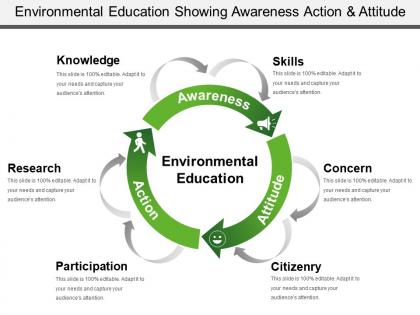
Allow individuals to explore environmental issues using this Environmental Education Showing Awareness Action And Attitude template. Build knowledge and skills necessary to address complex environmental issues utilizing this effective PPT template. Mention the components of environmental education which are awareness, attitude, and action utilizing this ecology PowerPoint slide. Highlight the steps which can help in protecting the environment by utilizing this impressive PPT slideshow. This template is appropriate for schools and colleges for promoting environmental awareness in children. Encourage your team to help in improving and maintaining the environmental quality by discussing the ways for the same with this sustainability PowerPoint layout. Discuss environmental problems such as ozone depletion, desertification, deforestation, loss of biodiversity, etc utilizing this readily available nature PPT template. Thus, take actions to improve the environment by downloading this ready to use PPT Presentation.
People who downloaded this PowerPoint presentation also viewed the following :
Content of this Powerpoint Presentation
Description:
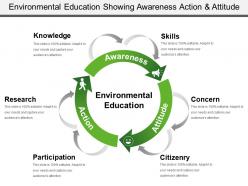
The image presents a circular flow diagram illustrating the key elements of Environmental Education including Awareness, Attitude, and Action, connected through concepts such as Knowledge, Skills, Concern, Citizenry, Participation, and Research. It emphasizes a cyclical learning process where each element feeds into another, highlighting the importance of a comprehensive approach to environmental education.
At the top of the cycle is 'Knowledge', indicating that environmental education begins with understanding the issues. This leads to 'Skills', which are necessary to address these issues effectively. 'Concern' shows an emotional engagement with the environment, and 'Citizenry' suggests a sense of responsibility and social engagement. 'Participation' is active involvement in environmental actions, which is underpinned by 'Research' that informs and improves practices.
Use Cases:
Let's explore the industries where such a slide would be applicable:
1. Education:
Use: To teach students about the importance of environmental stewardship
Presenter: Educator or environmental science instructor
Audience: Students or trainees
2. Non-Profit/NGO:
Use: To promote awareness and action for environmental causes
Presenter: NGO representative
Audience: Volunteers or potential donors
3. Government Agencies:
Use: For public outreach on environmental policies
Presenter: Government official
Audience: General public or community members
4. Corporate Social Responsibility (CSR) Departments:
Use: To present CSR strategies and environmental initiatives
Presenter: CSR Officer
Audience: Employees or stakeholders
5. Consulting Firms:
Use: To advise clients on sustainable practices and environmental compliance
Presenter: Sustainability consultant
Audience: Business clients or corporate executives
6. Event Management:
Use: To plan eco-friendly events with sustainable practices
Presenter: Event planner
Audience: Clients or event sponsors
7. Youth & Community Groups:
Use: To engage in and promote community-based environmental projects
Presenter: Youth leader or community organizer
Audience: Group members or local citizens
Environmental education showing awareness action and attitude with all 5 slides:
Cut across the divide with our Environmental Education Showing Awareness Action And Attitude. The gentry will appreciate your even handedness.

FAQs for Environmental education showing awareness
Honestly, get them outside first - gardens, nature walks, campus cleanups beat lectures every time. Kids need to actually DO stuff. Waste audits are amazing because they're always like "we throw away THAT much??" Try weaving it into other classes too. Math teachers can use environmental data for problems, art kids make recycling posters. Don't overthink it though - I'd just pick one thing to start with and see how it goes. The hands-on projects always work better than I expect them to.
Honestly, just start with an audit of where you're actually screwing up the environment - that's your biggest opportunity. Set real targets around those problem areas, like cutting carbon or waste. Don't do the greenwashing thing though, people see right through that BS. Partner with local environmental groups if you can. Get employees involved too - they usually have good ideas. The main thing is being super transparent about your progress AND when you mess up. Track actual numbers so stakeholders can see you're not just talking. I've seen too many companies do the feel-good statement route and it backfires.
Social media makes environmental stuff way more accessible - those infographics about climate change actually make sense, and don't even get me started on how those glacier timelapses mess with your head. You can follow scientists and activists directly instead of waiting for news coverage. It's honestly pretty cool how you stumble across environmental communities you'd never know existed otherwise. The visual content really works too - pollution videos go viral for a reason. Plus grassroots movements can organize fast and put real pressure on companies when things blow up online. Oh, and connecting issues to daily life always gets people more engaged than abstract data.
Honestly, you probably have more to work with than you think. Local parks, schools, businesses - that's your starting point right there. Community gardens are huge right now, or maybe organize some neighborhood cleanups. Partner with businesses for workshops if they're into it. Schools are honestly amazing for this because kids get so pumped about environmental stuff and then drag their parents along (which is kinda hilarious but it works). Libraries and community centers make great venues since they're already there. Find those people who are already super passionate about green stuff - every neighborhood has them. Start with whatever actually fits your community's vibe and go from there.
Ugh, so it's basically three main things messing with people's heads. First, cognitive dissonance - like when someone posts about saving the planet then takes a 20-minute Uber ride instead of walking. Your brain hates that contradiction, so it just makes excuses instead of changing behavior. Then there's social proof, which is huge honestly. If nobody in your circle is doing eco stuff, you won't either. And the biggest one? Environmental issues feel so far away and abstract that our brains can't prioritize them over immediate stuff like convenience or money. Make green choices social and immediate though, and people actually follow through.
Hey! So basically you'll want to track two things - actual behavior changes and what people say they're doing. Check stuff like recycling rates or energy use before vs during your campaign. Run some quick surveys too, but honestly people tend to exaggerate how green they are lol. Social media buzz and event turnout work as backup indicators. The trick is getting your baseline data first, then staying consistent with tracking. Oh and don't go crazy - pick maybe 2-3 metrics max or you'll drown in data. Keep it simple!
Hit up local groups first - neighborhood associations, community centers, that kind of thing. Digital screens at bus stops are clutch since people are just standing there scrolling anyway. Green block parties work surprisingly well, especially at farmers markets where everyone's already in that mindset. Kids are honestly your secret weapon - they'll go home and bug their parents about it. You can geotarget social media to show residents stuff that actually affects them, like "hey your neighborhood floods every two years." The hyperlocal angle is key though. People tune out generic climate stuff but pay attention when it's about their block.
Where you're from totally changes how you see environmental stuff. Like, some cultures are all about "we're in this together" so they tackle climate issues as a group thing. Others put economic growth first - which honestly makes sense if you're still developing as a country. Religious background matters too. Some people view nature as sacred, others see it as resources to use. Traditional practices play a huge role - certain cultures have conservation built into their DNA while others don't. Bottom line? You've gotta understand people's cultural perspective when you're trying to get them on board with green initiatives.
Honestly? It's mostly about complexity and trust. People don't know what to believe anymore with all the BS floating around online. Climate models and ecosystem stuff can get super dense, but you can't just oversimplify everything either. Political drama makes it worse - everything becomes left vs right instead of just science. Plus environmental problems take decades to unfold, but everyone wants answers now. I'd probably focus on local examples people actually care about. Find messengers each community already trusts rather than trying to be the expert yourself.
Honestly, art just hits people differently than dry statistics do. A powerful photo or documentary will stick with someone way longer than reading about carbon emissions - trust me on that. Creative stuff makes environmental issues feel real and personal instead of just abstract science. Plus you'll reach people who normally tune out traditional environmental messaging, especially younger folks. Street art, music, storytelling - whatever your thing is, you can probably use it to highlight local issues that matter. I mean, why not play to your creative strengths while actually making a difference?
So influencers can totally change how people see environmental stuff - like when someone with millions of followers goes plant-based, suddenly everyone's trying it. It's crazy but they honestly have more sway than actual scientists sometimes. The trick is finding ones who aren't just greenwashing for clout. People smell fake from a mile away. If you're doing campaigns, go for smaller creators who genuinely care over mega-influencers who'll post anything. They make climate action feel cool instead of preachy, which... yeah, that's probably what we need right now.
Honestly, apps and VR are your best shot for making people actually care about biodiversity. Wildlife tracking apps get people involved in citizen science, which is pretty cool. AR filters showing extinct animals hit different though - imagine a woolly mammoth just chilling in your backyard! Gaming platforms work great for younger crowds who'd normally scroll past conservation content. I'd combine emotional stories with real-time data showing habitat loss or species changes. Interactive documentaries are solid too. Figure out where your audience actually hangs out online first - no point posting on platforms they don't use.
Honestly, school programs with actual hands-on stuff work best - like gardens or recycling projects where kids can DO something instead of just sitting through lectures. Those climate strikes caught me off guard with how effective they've been too. Social media's been huge for connecting young activists globally, which is pretty cool to see. Oh, and here's the key thing - let them lead their own initiatives rather than adults constantly telling them what to care about. Kids respond way better when they have real agency. The whole "talk at them" approach just doesn't work anymore.
Dude, policy support is everything for environmental programs. When governments back these initiatives, they get actual funding and real authority behind their message. Without it? Programs basically die on the vine. I've seen this mess happen when federal environmental goals completely contradict what local governments want economically - the awareness campaigns just get crushed in between. It's honestly brutal for anyone trying to coordinate outreach. Before you plan anything environmental, definitely scope out the political landscape first. Short campaigns can work, but sustained impact needs policy allies or you're fighting uphill the whole time.
Make it personal first - stories about real people hit way harder than statistics. Honestly, social media's your best friend here. Short posts with clear action steps crush those long educational dumps every time. You'll want to team up with local businesses and schools too, gets you past the usual eco-warrior crowd. Here's the thing though - you absolutely have to celebrate the small wins publicly. People burn out super fast if they can't see their efforts actually working. Oh, and always give them something specific they can do right now. Abstract problems need concrete solutions, you know?
-
Excellent Designs.
-
Awesome presentation, really professional and easy to edit.