


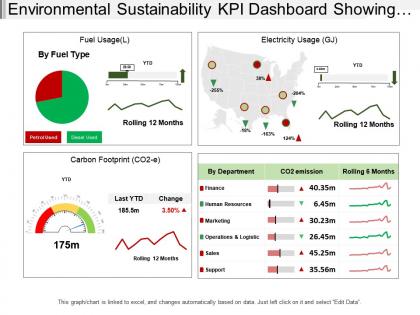
Environmental sustainability kpi dashboard showing carbon footprint and electricity usage




Try Before you Buy Download Free Sample Product
 Impress Your
 Audience
 100%
100% Editable
 Save Hours
 of Time


Download our environmental sustainability PPT presentation slide to present your projects on sustainability. This is a professional template showing a dashboard. It contains data related to carbon footprint, fuel usage and electricity usage. You can create dashboard presentations on environmental sustainability with related key performance indicators using our environmental sustainability KPI dashboard PowerPoint presentation. The simple to use environmental sustainability dashboard enables the user to display various KPIs. The key performance indicator may consist of environmental management, analytics, trends, sales targets etc. Our team of designing experts have crafted this PPT design for your use. You can modify this PowerPoint template as per your business requirement as it is completely editable. This nature sustainability PowerPoint template is most ideal for reports on current advances in the fuel technology, as well as providing information relating to the state of fuel prices and the related data. Bash on bravely with our Environmental Sustainability Kpi Dashboard Showing Carbon Footprint And Electricity Usage. They assist you to conquer your fears.
People who downloaded this PowerPoint presentation also viewed the following :
Environmental sustainability kpi dashboard showing carbon footprint and electricity usage with all 6 slides:
Get inputs that fir your imagination from our Environmental Sustainability Kpi Dashboard Showing Carbon Footprint And Electricity Usage. You will find a lot of inspiration.
FAQs for Environmental sustainability kpi dashboard showing carbon footprint
Honestly, start with the basics - energy use per unit, waste diversion rates, and carbon emissions (direct + indirect). Water efficiency matters too if you're in manufacturing or something. But here's the thing - don't go crazy tracking 20 different metrics. Pick 3-5 that actually move the needle for your business. First step? See what data you're already collecting - you probably have way more than you realize. Baseline those numbers, then aim for maybe 5-10% reductions each year. Nothing too aggressive at first. Focus on your top 3 and just start measuring. You can always add more later once you get the hang of it.
Honestly, just grab the SDG compass tool first - it makes this way less overwhelming than I expected. Match your current environmental stuff to the relevant goals, like carbon targets go with SDG 13. The UN has frameworks for this that nobody really talks about. Pick specific numbers too - "cut scope 1 & 2 emissions 50% by 2030" instead of vague promises. Track both your own progress AND how you're actually moving the needle on bigger targets. Don't just stick SDG logos everywhere and call it alignment. That's super obvious and kinda defeats the point, you know?
Dude, you absolutely need your stakeholders on board for environmental KPIs. Employees, customers, investors - get them involved early or you'll just be guessing at what matters. They know what's actually realistic and what data you can track without going crazy. I swear, half the sustainability programs I've seen tank because nobody bothered asking the right people what they cared about first. Map out who's affected by your environmental stuff, then bring them into setting goals AND checking progress. Honestly, they'll probably have way better ideas than you think.
Honestly, start small or you'll go crazy trying to track everything. Connect your energy meters and waste platforms to something like Tableau or Power BI - the setup's annoying but worth it. IoT sensors are clutch for real-time stuff like water usage. I'd focus on maybe 2-3 key data sources first, get those feeding in automatically, then build from there. Most people try to do too much upfront and it becomes a mess. Once you nail the basics with a decent dashboard, adding more systems gets way easier.
Honestly, the data collection part is brutal - your supply chain info is usually garbage or missing completely. Makes tracking scope 3 emissions feel impossible. Everyone measures stuff differently too, so good luck trying to benchmark against competitors. Regulations keep changing which is super annoying when you're trying to plan ahead. Oh, and quality monitoring systems cost a fortune (learned that the hard way). My take? Just start measuring whatever you can consistently, even if it's not perfect. You can always improve the process later once you've got something running.
Look, KPIs create this crazy competitive pressure that actually drives innovation. Your teams get forced to think outside the box when you set ambitious sustainability targets - you can't hit a 30% carbon reduction doing the same old stuff. Make those metrics visible across departments and tie them to bonuses. That's when people start brainstorming like mad. Supply chain gets creative. Product teams redesign everything. Honestly, I've watched companies stumble onto game-changing processes just trying to fix their water usage numbers (talk about happy accidents). Pick maybe 2-3 stretch goals that'll make your team sweat a little. Short wins don't push boundaries.
Really depends on what kind of business you're running. Manufacturing? Track energy per unit, water usage, and how much waste hits landfills. Retail's all about supply chain emissions and sustainable sourcing percentages. Tech companies obsess over data center efficiency - PUE ratios and e-waste stuff, though honestly some get way too into the weeds with metrics. Transportation's simpler: fuel efficiency and carbon per mile. Don't go crazy tracking everything though. Pick maybe 3-5 things that actually matter for your biggest environmental impacts. Start with whatever you can actually measure right now instead of getting fancy.
Yeah totally doable on a tight budget! Start with stuff you're already paying for - energy bills, water usage, waste costs. Your utility company probably does free audits which are actually pretty useful. Pick like 3-5 basic metrics to track monthly in a spreadsheet. Energy per unit, waste diversion rates, carbon footprint using those free online calculators. Don't get fancy software yet. Once you start seeing real savings (and you will), then you can justify spending money on better tracking tools. Honestly the hardest part is just getting started.
You absolutely need baseline data - can't track progress if you don't know your starting point, right? It's like trying to lose weight without knowing what you weigh first. Pretty pointless. Get your initial numbers for energy use, waste, emissions, whatever you're measuring. Otherwise your KPIs are just meaningless. Yeah, collecting baseline data might push back your launch a few weeks, but trust me, it's worth it. I've seen too many programs fail because they skipped this step. You'll actually be able to set realistic targets and see if you're making real improvements.
Honestly? Break those big environmental goals into stuff people can actually do something about. Like instead of "cut emissions 20%" - make it "get half our trucks electric by September" or "swap all office lights to LEDs for 15% less energy use." Someone specific has to own each target though. Can't just be floating out there with no name attached - I've watched so many pretty sustainability reports that nobody actually cares about because there's zero accountability. Do quarterly reviews and maybe tie it to budgets if you can swing it.
Honestly, check out Sustainalytics or Carbon Trust if you've got the budget - they'll handle most of the data integration automatically. But don't sleep on Excel or Google Sheets for smaller operations. I've seen some surprisingly slick homegrown tracking systems that work just as well. Power BI and Tableau are decent middle options too, give you nice visuals without the crazy price tag. Here's the thing though - pick whatever your team will actually stick with. The fanciest platform is useless if nobody uses it consistently. Start basic, then upgrade when you outgrow it.
Honestly, regulations are what drive most KPI decisions - they basically tell you what to track. Europe's super strict with their Corporate Sustainability Reporting Directive covering carbon, waste, biodiversity stuff. The US is all over the place though - different state rules plus SEC climate requirements. Asia's moving fast on this too, especially China with carbon intensity and Japan focusing on circular economy metrics. You'll need to match whatever rules apply where you operate. Sounds obvious but I've seen companies mess this up by not checking local requirements first when building their dashboards.
Oof, yeah missing those environmental targets can really mess you up. Customers start side-eyeing your green claims, investors freak out about ESG stuff, and honestly the media just loves a good greenwashing story. Your competitors who actually hit their numbers suddenly look like saints. Social media's brutal too - Gen Z will drag you through the mud if you can't back up your sustainability talk. It hits everything from sales to hiring good people. My advice? Own up to it fast and show people exactly how you're gonna fix it. Being sneaky about it just makes things worse.
Set up quarterly reviews - trust me, you'll need them. The regulations shift constantly and it's honestly a nightmare trying to stay on top of everything. Get your legal, ops, and sustainability people in a room together to figure out if your current metrics actually make sense anymore. Industry newsletters help, plus those compliance platforms (though some are pretty expensive). Your KPIs can't just sit there collecting dust. Oh, and definitely check what your competitors are tracking since they're probably dealing with the same regulatory chaos you are. Start with auditing what you've got now against current requirements.
Look, people can smell BS from a mile away now, so just be real about your data - the good AND the ugly stuff. Your stakeholders want to see actual numbers, not just the wins you're proud of. I'd publish regular reports that actually make sense to read (dashboards work great for this). Show the trends over time and be upfront about where you're still screwing up. Trust me, admitting you have problems makes people believe your success stories way more. Figure out who you're talking to first though - different groups care about totally different metrics. The whole point is building trust, and you can't fake that.
-
Helpful product design for delivering presentation.
-
Excellent design and quick turnaround.