


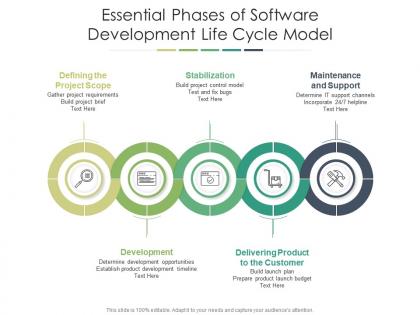
Essential phases of software development life cycle model




Try Before you Buy Download Free Sample Product
 Impress Your
 Audience
 100%
100% Editable
 Save Hours
 of Time


Our Essential Phases Of Software Development Life Cycle Model are topically designed to provide an attractive backdrop to any subject. Use them to look like a presentation pro.
People who downloaded this PowerPoint presentation also viewed the following :
Essential phases of software development life cycle model with all 2 slides:
Use our Essential Phases Of Software Development Life Cycle Model to effectively help you save your valuable time. They are readymade to fit into any presentation structure.
FAQs for Essential phases of software development
The key phases of SDLC include planning, analysis, design, implementation, testing, deployment, and maintenance. These phases streamline software development by establishing clear requirements, creating robust architectures, and ensuring quality through systematic testing, with many organizations finding that this structured approach ultimately delivers faster time-to-market and reduced development costs.
SDLC model choice significantly impacts project outcomes through delivery speed, adaptability, and stakeholder satisfaction. Waterfall delivers structured predictability for regulated industries like healthcare and finance, while Agile enables faster iterations and customer feedback integration, with many software companies finding that model alignment with project complexity, team dynamics, and market demands ultimately determines success rates and competitive advantage.
Stakeholder involvement ensures SDLC projects align with business requirements, user needs, and organizational objectives through continuous feedback, requirement validation, and strategic decision-making. Active stakeholder engagement throughout planning, development, and testing phases enables teams to minimize costly revisions, accelerate project delivery, and ultimately deliver solutions that drive measurable business value and user satisfaction.
Risk management integrates into SDLC through early threat assessment, continuous monitoring at each phase, automated security testing, and regular stakeholder reviews throughout development cycles. This strategic approach enables organizations to identify vulnerabilities during requirements gathering, minimize costly post-deployment fixes, and deliver more secure applications, with many software teams finding that proactive risk integration ultimately reduces project timelines while enhancing product reliability.
Automation improves SDLC efficiency by streamlining code testing, deployment processes, quality assurance checks, and integration workflows, while minimizing manual errors and accelerating release cycles. Through automated CI/CD pipelines, organizations enhance development speed, reduce operational costs, and deliver more reliable software products, with many tech companies finding that strategic automation ultimately delivers faster time-to-market and improved competitive advantage.
Common SDLC challenges include unclear requirements gathering, scope creep during planning, technical debt in development, insufficient testing coverage, and complex deployment processes. These obstacles streamline project delivery by requiring structured communication, regular stakeholder alignment, and automated testing protocols, with many software teams finding that proactive risk management and iterative feedback ultimately enhance product quality and reduce development costs.
Requirements gathering varies significantly across SDLC methodologies, with waterfall emphasizing comprehensive upfront documentation, agile focusing on iterative user stories and continuous collaboration, and DevOps integrating operational requirements throughout development cycles. While traditional approaches prioritize detailed specifications before coding begins, modern methodologies enable adaptive requirements refinement, ultimately delivering more responsive software solutions that better align with evolving business needs.
Regulatory requirements significantly impact SDLC by mandating enhanced documentation, rigorous testing protocols, compliance checkpoints, and audit trails throughout development phases. Industries like healthcare, finance, and pharmaceuticals find that while these requirements extend development timelines, they ultimately deliver higher security standards, reduced legal risks, and improved product reliability, providing competitive advantages in regulated markets.
Testing can be effectively managed throughout the SDLC by implementing continuous testing strategies, establishing clear quality gates at each phase, integrating automated testing frameworks, and maintaining comprehensive test documentation. This strategic approach enables development teams to identify defects earlier, reduce remediation costs, and accelerate delivery timelines, with many software organizations finding that embedded testing practices ultimately deliver higher-quality products and improved customer satisfaction.
SDLC documentation best practices include maintaining clear requirements specifications, detailed design documents, comprehensive code comments, thorough test cases, and updated user manuals throughout each phase. These practices streamline communication, reduce development errors, and ensure knowledge transfer, with many software teams finding that consistent documentation standards ultimately accelerate project delivery and enhance long-term maintainability across complex development cycles.
CI/CD integrates throughout the SDLC by automating code integration, testing, and deployment processes, enabling faster releases, reduced manual errors, and continuous feedback loops. Through automated pipelines, development teams streamline collaboration between planning, coding, testing, and deployment phases, while ensuring quality control and rapid iteration, ultimately delivering more reliable software with shorter development cycles.
Key SDLC success metrics include defect density, cycle time, code coverage, customer satisfaction scores, and deployment frequency. These measurements enable organizations to streamline development processes, enhance software quality, and accelerate time-to-market, with many technology companies finding that comprehensive metric tracking ultimately delivers improved operational efficiency and competitive advantage.
Teams maintain quality assurance throughout the SDLC by implementing continuous testing, automated code reviews, peer assessments, regular security audits, and integrated feedback loops at each development phase. These practices enable organizations to identify defects early, reduce costly rework, and accelerate delivery timelines, with many software companies finding that embedded QA processes ultimately deliver more reliable products and enhanced customer satisfaction.
Emerging SDLC trends include AI-powered code generation, low-code/no-code platforms, containerization with microservices, DevSecOps integration, and cloud-native development approaches. These innovations streamline development cycles, enhance security protocols, and accelerate deployment processes, with many organizations finding that strategic adoption delivers faster time-to-market, reduced operational costs, and improved scalability across diverse business environments.
DevOps culture transforms traditional SDLC by breaking down silos between development and operations teams, enabling continuous integration, automated testing, and faster deployment cycles. This collaborative approach streamlines software delivery through enhanced communication, shared responsibilities, and integrated toolchains, with many organizations finding that DevOps significantly reduces time-to-market while improving software quality and operational efficiency.
-
Easily Editable.
-
Visually stunning presentation, love the content.
-
Great quality product.
-
Much better than the original! Thanks for the quick turnaround.